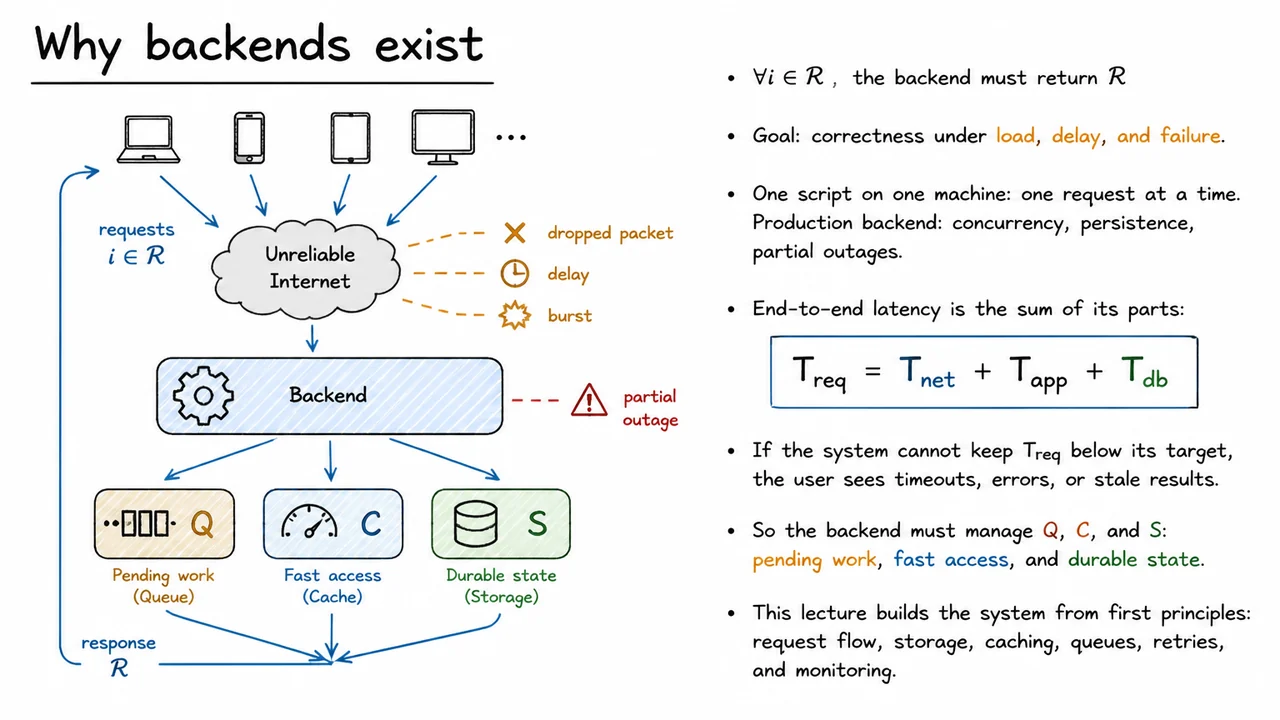
A backend exists because the world outside the server is messy. Clients disconnect, networks reorder or drop packets, traffic arrives in bursts, and the same user action may be retried multiple times. The backend’s job is to take those unreliable incoming requests and still produce a correct, durable response . In the simplest mathematical form, if denotes a request drawn from the request set, the system must ensure that
not just when everything is ideal, but when latency spikes, dependencies slow down, and parts of the system are degraded.
This is why “backend” is not synonymous with “server code.” A single script on one machine can process one request at a time, in a mostly linear and forgiving environment. Production backends are different: they must coordinate concurrency, persist state, and survive partial outages. That means the design problem is no longer “how do I run this function?” but “how do I keep many functions correct when the world is adversarial?”
The first useful lens is latency decomposition. End-to-end request time is not a monolith; it is the sum of network, application, and database costs:
This equation is simple, but it changes how you reason about bottlenecks. If the total latency budget is fixed, then any increase in one term must be paid for elsewhere. A slow database can make an otherwise efficient application miss deadlines; a congested network can make a fast database irrelevant. In practice, users do not care which term caused the delay—they experience the aggregate as a timeout, an error, or a stale response.
That is why backends are fundamentally about managing three things at once: , , and . Here is pending work, the queue of requests waiting to be handled; is fast access, usually served by cache or memory; and is durable state, the source of truth that survives process crashes and machine restarts. Every backend tradeoff can be interpreted as balancing these three pressures:
The subtle failure mode is that these goals conflict. If you optimize only for speed, you risk serving stale or incorrect data. If you optimize only for durability, you may miss your latency target. If you optimize only for throughput, you may build up unbounded queues and turn transient overload into a lasting outage. The real system must preserve correctness under load, delay, and failure, not just in a quiet demo environment.
This is also why reliability concerns appear so early in backend design. Retries can save a request lost to the network, but they can also amplify load if every client retries at once. Caches can hide database latency, but they can also serve stale values unless invalidation is handled carefully. Queues can absorb spikes, but they can also introduce lag that makes the system feel broken even when it is technically alive. Each mechanism solves one class of problems while creating another, which is why a backend architecture has to be built from first principles rather than from habit.
A good mental model is that the backend sits at the boundary between untrusted arrival and trusted persistence. It receives arbitrary request timing from clients, converts that into a controlled processing path, and returns a response only after it has enforced the system’s invariants. That path might be short for a cache hit and long for a database write, but the core responsibility stays the same: maintain correctness while meeting latency and availability targets.
The visual below compresses that idea into a single picture. The left side makes the request journey concrete: multiple clients send traffic through an unreliable network into backend components that must absorb bursts, survive delays, and still return . The equation is not decoration; it is the backbone of the argument, reminding us that user-visible latency is the sum of network, application, and database time. The small labels , , and then summarize the design space the rest of the lecture will unpack.
So when you look at the diagram, read it as more than a flowchart. It is a compact statement of the backend problem: convert many unreliable inputs into one correct output, repeatedly, while the system is under stress. Everything that follows—storage, caching, queues, retries, observability, and failure handling—exists because that problem never goes away.
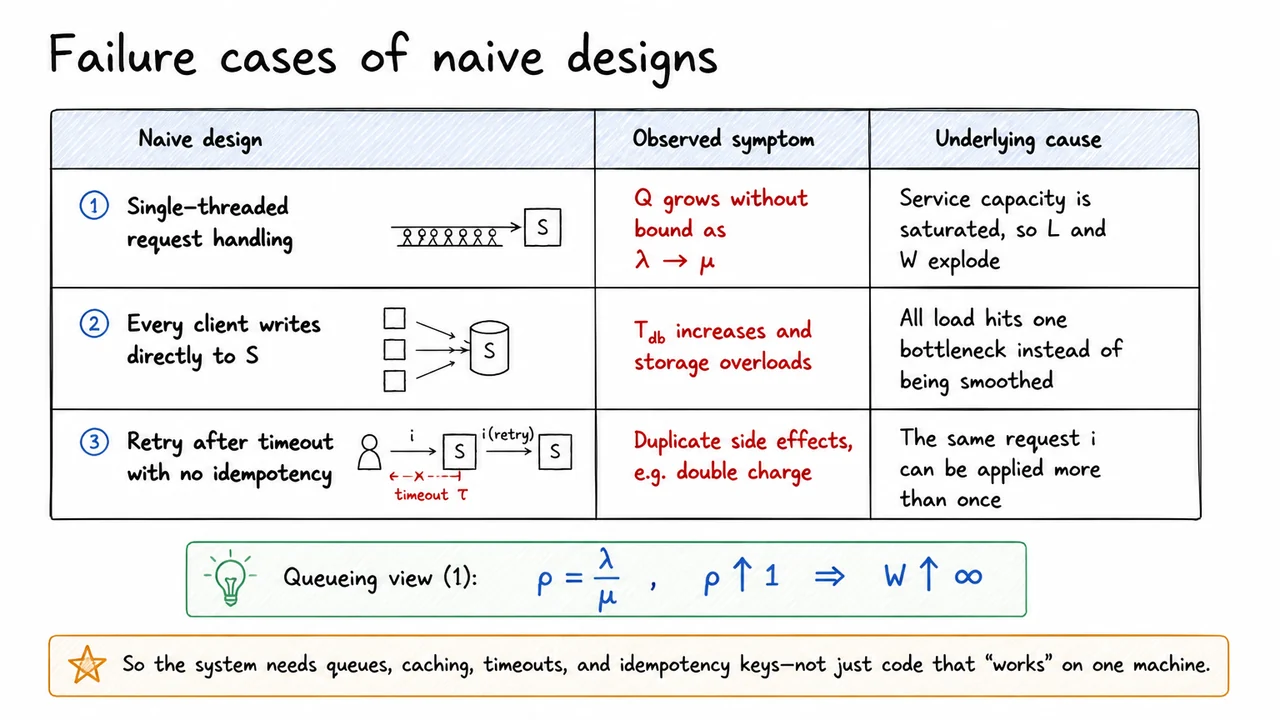
Building on the end-to-end goal, the first thing to understand is that a backend does not fail all at once; it usually fails in one of a few predictable ways when naive assumptions meet real traffic. A design can look perfectly fine in a local demo and still collapse under load because it has no mechanism for smoothing bursts, no protection against repeated work, or no way to isolate a slow dependency. Those are not edge cases—they are the default failure modes of any system that accepts more requests than it can immediately finish.
The simplest way to see the problem is through queueing. If requests arrive at rate and the system can complete work at rate , then the utilization is
When is comfortably below 1, the system has slack: short bursts can be absorbed, and waiting time stays modest. But as , slack disappears. The queue length starts to grow, which increases latency, which causes more requests to remain in flight, which makes the queue even larger. In the standard first-order view, this is the dangerous regime:
The key lesson is subtle but important: a saturated service is not merely “busy” — it is unstable. Once the arrival process nudges past capacity, waiting time can explode nonlinearly, so adding more clients does not produce a gentle slowdown; it can produce collapse.
A second naive design is to let every client write directly to the storage system. That sounds clean because it avoids intermediate layers, but in practice it turns the database or primary store into a single shared bottleneck. All variability in request arrivals is pushed straight onto one dependency, so the backend loses the ability to buffer, batch, or prioritize. The symptom is usually rising , then lock contention, then tail latency, and finally failures that look “random” from the client side but are actually the predictable result of a hot storage path.
This is why backend architecture is not just about making the happy path fast; it is about shaping load. A queue, a cache, or a write buffer is valuable precisely because it changes the arrival process seen by the bottleneck. Without that smoothing, the storage layer becomes the point where small spikes turn into system-wide slowdown. In other words, the backend needs to absorb irregularity before it reaches the expensive component.
The third failure mode is more insidious: timeouts plus retries without idempotency. Retries are necessary because networks fail and responses are delayed, but they are dangerous if the server cannot tell whether it is seeing a first attempt or a duplicate. If request times out at and the client retries, the backend may apply the same mutation twice unless duplicate detection is explicit. That can mean two charges, two email sends, or two inventory decrements for one user action.
This is the difference between transport reliability and application correctness. A retry policy can improve the chance that the client eventually gets a response, but it does not automatically guarantee that the side effect happened exactly once. For mutation-heavy APIs, the server therefore needs some notion of identity—often an idempotency key or a deduplication record—so that repeated attempts map to the same logical operation rather than creating repeated outcomes.
Taken together, these failures motivate the core backend toolbox:
The visual below compresses those ideas into a comparison table because the pattern matters more than any one example. Each row pairs a naive design with its observed symptom and underlying cause, making the failure mechanism legible at a glance: saturation grows waiting time, direct writes overload storage, and blind retries duplicate side effects.
The small queueing callout underneath the table is there for a reason as well. It anchors the intuition mathematically: once approaches 1, waiting time does not merely increase a little—it can blow up. That single relationship explains why a backend that “worked fine” in testing can become fragile in production, and it sets up the next step: building a performance model that can predict where the bottlenecks will appear before they become incidents.
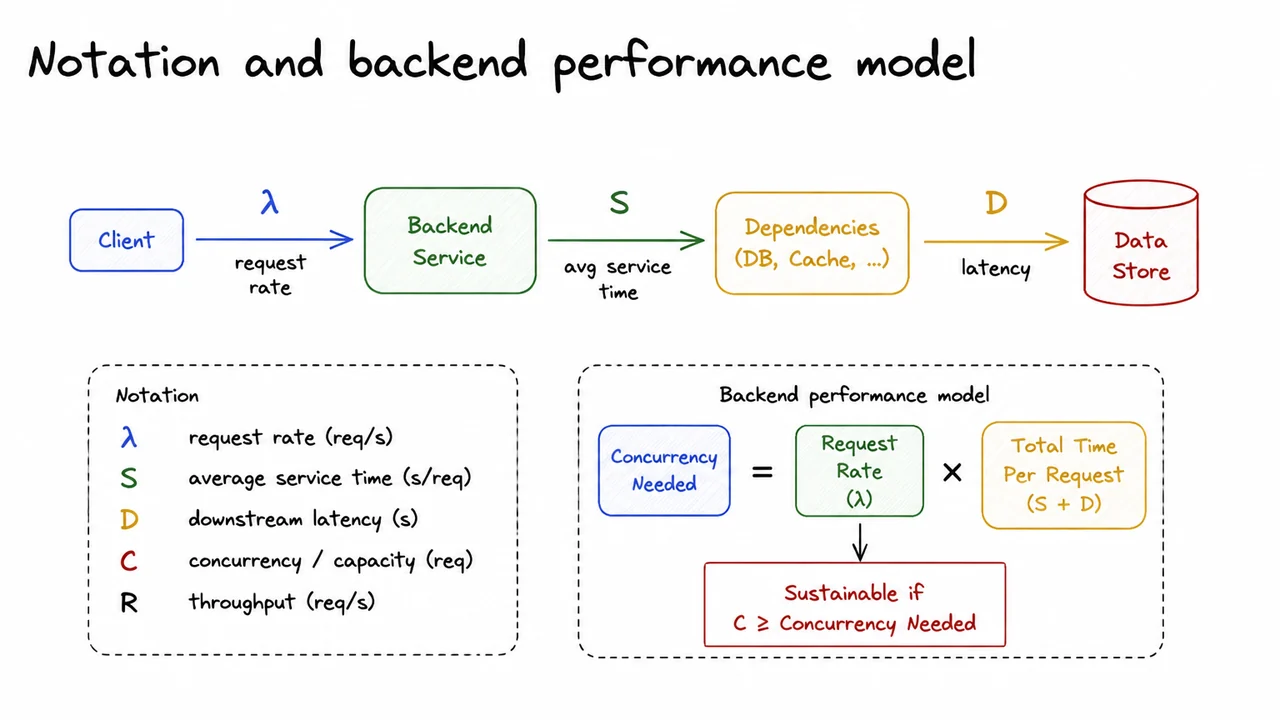
Before we can reason about architectures, caches, queues, or retries, we need a shared performance language. Backend systems fail less because of exotic algorithms than because teams argue about the wrong quantities: average latency instead of tail latency, throughput instead of saturation, or correctness assumptions that were never made explicit. A good notation turns vague operational instincts into something we can measure, compare, and optimize.
At the most basic level, a backend exists to convert incoming requests into durable effects under resource constraints. The useful question is not just “how fast is it?” but “what is the path of a request, what can slow it down, and what happens when a component is overloaded or unavailable?” That naturally suggests a model with a few moving parts: arrival rate, service time, queueing delay, storage latency, retry behavior, and failure probability. Once these are named, the design space becomes much easier to reason about.
A standard abstraction is to treat a backend as a service pipeline. Requests arrive at some rate , each stage processes work at some effective rate , and the total response time is the sum of compute, waiting, and I/O. For a single request, we can think of latency as
This decomposition matters because each term has different behavior. Compute time may shrink with better code, but queueing time explodes when utilization gets too high. Storage time may be stable on average yet highly variable in the tail. Retries can improve success rate while making overload worse if they are not bounded. Good backend design starts by separating these effects instead of blending them into one average number.
The key subtlety is that average latency is often misleading. Two systems can both report 50 ms mean latency while one is smooth and the other occasionally stalls for seconds. In production, users feel the stalls, not the mean. That is why we care about percentiles such as and , and why we distinguish throughput from latency. A service can have high throughput and still be unusable if the queue grows without bound under bursty load.
A useful mental model is the simple saturation picture:
This is the essence of backend instability. Even when the code is correct, a system can fail because its effective service capacity is lower than its incoming demand, or because one slow dependency propagates delay upstream. The notation lets us talk precisely about where the bottleneck lives: CPU, network, disk, lock contention, remote API calls, or a bounded worker pool.
It is also worth distinguishing latency from durability and consistency, because they are not the same axis. A request can return quickly but still be unsafe if the write is not persisted. Another can be durable but slow because it waits for replication. Likewise, a response can be fast under eventual consistency yet incorrect for a client that assumes immediate visibility. In practice, the performance model must track not only time but also the reliability of each stage and the semantics of completion.
That is why backend notation is not just bookkeeping. It gives us a way to predict the tradeoffs that will appear later in the system design:
Once these are formalized, we can analyze a design as a composition of rate limits, waiting times, and failure probabilities rather than as a vague “fast” or “scalable” system.
The visual below condenses that model into a compact pipeline: requests entering from the client, passing through service stages, encountering queues and storage, and exiting as responses with measurable latency and reliability effects. It is meant to be a map of the quantities we will keep reusing, so that when we move from client request to durable response, the tradeoffs feel like consequences of a model rather than a list of ad hoc engineering tricks.
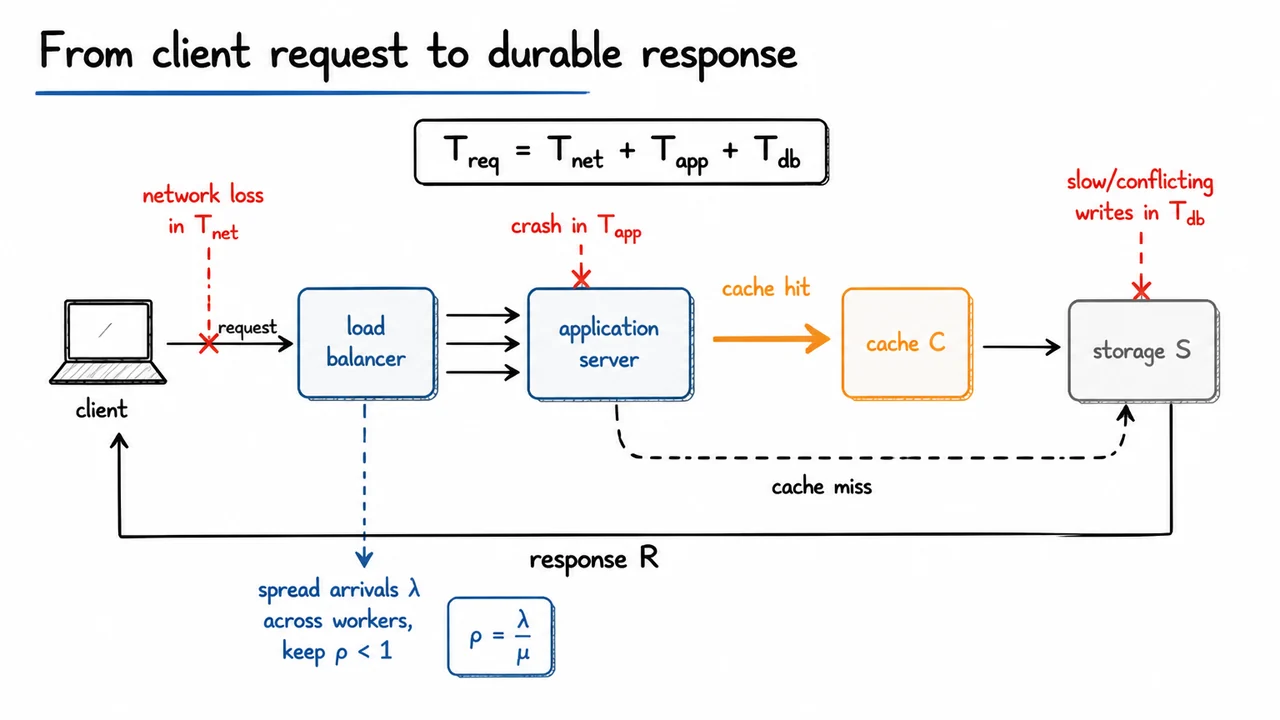
A backend becomes concrete the moment we stop speaking in abstractions and follow a single request end to end. The important question is no longer “what does the system do?” but where does time go, where can it fail, and what makes the response durable enough to trust. That is why the canonical request path is such a useful mental model: it turns a sprawling distributed system into a sequence of bottlenecks and protection points.
If we build from the earlier performance decomposition, then each term corresponds to a different layer of responsibility. Network time covers transport and delivery uncertainty; application time covers routing, business logic, serialization, and local computation; database time covers durable state access, conflict resolution, and commit latency. The sum is intentionally simple, but the simplicity hides a subtle point: these are not independent in practice. A slow database can inflate application latency through blocking, retries, or thread exhaustion, and a congested network can cause timeouts that trigger duplicate work upstream.
The standard request path therefore looks like a guarded pipeline: client load balancer application server cache storage response . The load balancer is not just a routing convenience; it is the first defense against uneven arrivals. If requests arrive at rate and a worker can serve at rate , then the utilization must stay comfortably below . Once approaches , queueing delay grows sharply, and a backend that looked fine under average load can collapse under bursty traffic. In other words, load balancing is about keeping the service region stable, not merely spreading packets around.
The cache is the first place where the system can win back latency. A request may terminate early at on a cache hit, or continue to on a cache miss. This distinction matters because a hit changes the entire shape of the path: no durable read, no storage contention, and often no expensive serialization round-trip. But caching is not a free lunch. It introduces freshness assumptions and invalidation failure modes: if the cached value is stale, the system may be fast and wrong, which is usually worse than slow and right.
Storage is where correctness becomes durable. Once the request reaches , the backend is no longer only answering a question; it is updating or retrieving the source of truth. That is why the database term is the most semantically loaded one. It includes slow writes, lock contention, replication lag, write conflicts, and commit uncertainty. A backend that returns a response before state is safely persisted may look successful to the client while silently violating the system’s consistency guarantees.
Failure can enter the path at several points, and the important design move is to treat those failures as ordinary rather than exceptional. Three especially common ones are worth isolating:
This is why the backend’s job is not simply to produce . It must produce correctly, durably, and within the service-level objective. Those three constraints are in tension: faster responses can compromise durability, stronger consistency can increase latency, and aggressive retries can improve success rate while amplifying load. The practical art of backend engineering is to choose the failure behavior explicitly instead of discovering it in production.
The visual below is useful because it compresses that whole argument into one path. The left-to-right flow makes the normal case easy to remember: the request arrives, load is distributed, the application checks cache first, and only then does it pay the full storage cost when needed. The highlighted cache hit and cache miss paths are especially important because they show that the same logical request can have very different latency profiles depending on state already present in the system.
The red callouts summarize the places where the clean pipeline breaks: transport, compute, and durability. That is exactly the set of faults a backend must be built to resist. Read it as a compact map of the rest of the lecture: we will refine this baseline with caching, queues, retries, and monitoring, but every refinement still has to respect the same core path from request to durable response.
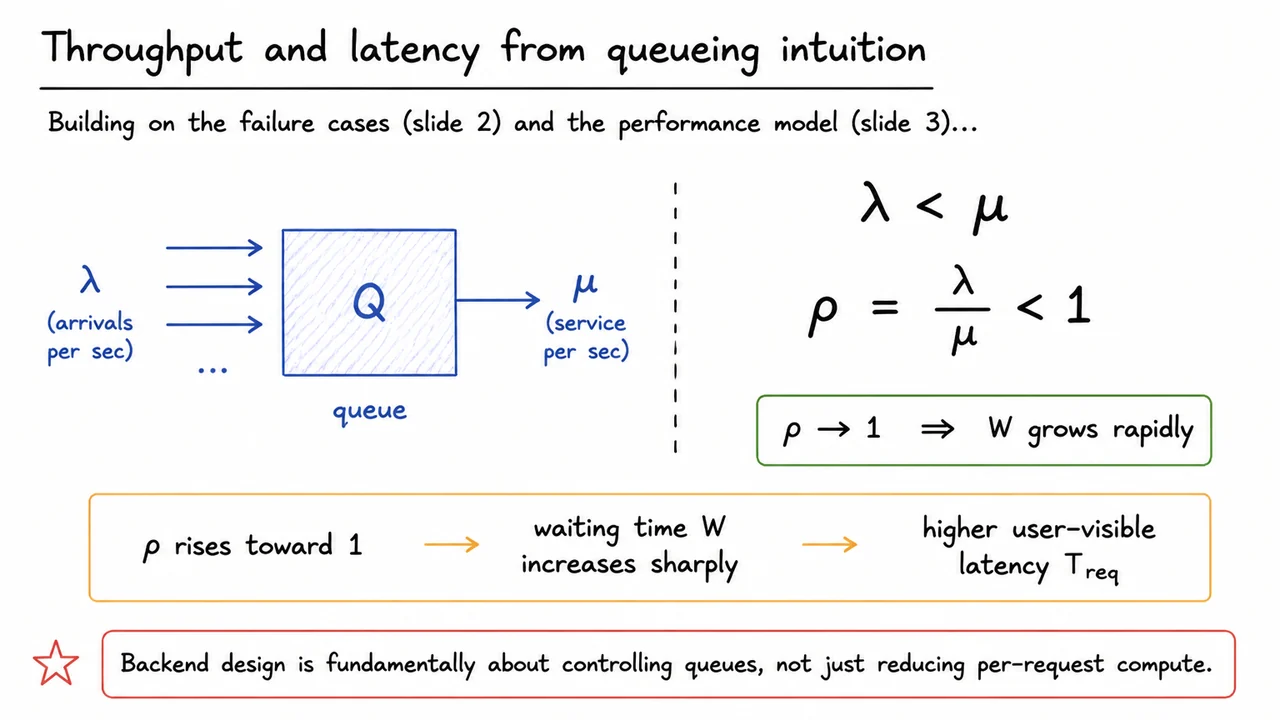
We can now sharpen the performance story into a stability criterion. A backend is not “fast” merely because its code path is short; it is stable only if the system can drain work at least as fast as it arrives. That is the queueing lens: requests enter at rate , workers complete work at rate , and the central question is whether the backlog stays bounded or grows without limit.
The first-order condition is deceptively simple:
If this inequality fails, then every second brings in more work than the system can retire, so the queue necessarily accumulates. In steady operation, that means the backend is not merely slow under load—it is mathematically incapable of catching up. Even if individual requests are well implemented, a sustained arrival rate above service capacity guarantees eventual overload.
It is useful to normalize the picture by defining utilization
so that stability becomes . This ratio tells us how close the system is to saturation. When is small, servers spend a meaningful fraction of time idle, and arrivals are often served immediately. But as approaches 1, there is little slack to absorb randomness in arrivals or service times. That lack of slack matters because real systems are never perfectly regular: bursts, retries, cache misses, GC pauses, noisy neighbors, and lock contention all create temporary imbalances.
That is the subtle failure mode people often miss. The average rates may look “fine,” yet the queue can still become long because variance gets amplified near saturation. Once a request must wait behind earlier work, it inherits not just the average service time of the current request, but the accumulated delay of all requests ahead of it. In many queueing models, this produces a sharply nonlinear increase in waiting time as utilization rises:
This is why backend latency can feel brittle. A small increase in traffic does not always cause a small increase in response time. Near capacity, the system enters a regime where tiny disturbances cause disproportionately large delays, and those delays are often much worse than the original compute cost suggests.
From the user’s point of view, the important quantity is not the service time of a single handler, but the end-to-end request latency . That latency includes queuing delay before execution, time spent in the application, and any downstream waiting in storage, locks, or network hops. So even if the application code is unchanged, a growing queue can make the product feel slower. The backend has not become “less correct”; it has become less stable.
A few practical implications follow immediately:
This perspective also clarifies why many backend techniques exist at all. Caching, batching, load shedding, async processing, and rate limiting are all ways of shaping , , or the queue itself. They are not arbitrary patterns; they are control mechanisms for keeping comfortably below 1 under realistic load.
The visual below condenses that reasoning into a compact equilibrium picture. The queue box, the incoming arrival rate , and the service rate make the stability condition tangible: if work arrives faster than it is drained, the middle queue grows. The highlighted reminds us that the real danger is not just high traffic, but traffic that pushes utilization toward saturation.
It also ties the abstract waiting time back to something users actually feel: . That connection is the key lesson here. Backend engineering is not only about making each request cheap; it is about ensuring the system can absorb demand without turning small delays into visible latency explosions.
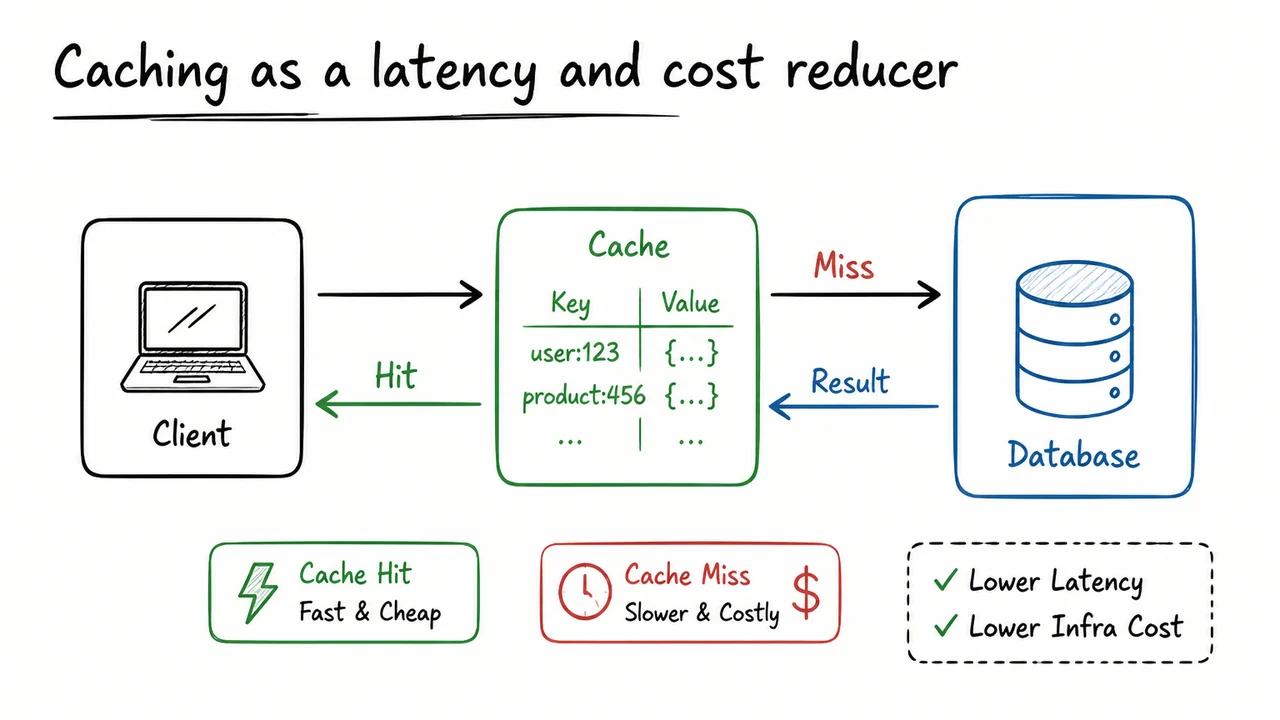
When a backend is under load, the first instinct is often to add more servers. That helps with capacity, but it does not automatically help with latency or cost. Caching exists because a large fraction of backend work is not truly novel: the same user profile, feature flag snapshot, product catalog entry, or rendered page fragment is requested again and again. If we can serve those repeated reads from a cheaper, closer store, we reduce the amount of time spent waiting on the slow path and avoid paying the full price of recomputation or database access on every request.
The core idea is simple: keep a copy of something expensive to compute or fetch in a place that is faster to access than the source of truth. In the abstract, a cache is just a memory of past answers. The important qualifier is that the answer must still be useful when repeated. That means caching works best when the underlying data is read-heavy, changes relatively infrequently, or can tolerate a small amount of staleness. If every request is unique, or if the data changes so frequently that cached results are almost always wrong, the cache becomes decorative overhead rather than an optimization.
A useful way to think about this is through the economics of a request. Suppose a backend operation costs when it hits the database or an external service, and when it is served from cache. If the cache hit rate is , then the expected cost per request is roughly
Because , even a moderate hit rate can produce a large win. The same logic applies to latency: a cache hit can avoid network hops, disk reads, lock contention, serialization overhead, and downstream fan-out. The business value is not only speed for the user, but also reduced load on the expensive systems that tend to become bottlenecks first.
That said, caching is not free. Every cache introduces new failure modes and new operational questions. A cache can become a second source of truth in practice, even if we do not intend it to. If it serves stale data too long, users observe inconsistency. If it is too aggressive about eviction, the hit rate collapses and the system pays extra complexity without benefit. If it is sized or partitioned poorly, hot keys can create uneven load. If it is shared across tenants or request types without careful key design, it can leak data or return the wrong answer.
The decision process is therefore not “should we cache?” but rather “what is safe and valuable to cache, where, and for how long?” Common patterns follow directly from that question:
These patterns differ less in mechanism than in who owns the responsibility for coherence. In practice, cache-aside is often the most flexible because the application can decide what is cacheable, how to serialize it, and how to handle misses. But flexibility cuts both ways: if the application forgets to invalidate or refresh entries, stale data lingers. That is why many systems cache derived values or immutable artifacts first—things like compiled templates, configuration snapshots, or computed rankings—before they attempt to cache mutable user-facing state.
Another subtle point is that caching can improve more than throughput. It can also stabilize the system during traffic spikes. Suppose a popular endpoint gets a sudden burst of requests. Without a cache, each request may trigger the same expensive backend work, multiplying load exactly when the system is most vulnerable. With a cache, the first request pays the cost and the rest collapse into cheap hits. This “amplification reduction” is one reason caches are often placed close to the edge, near API gateways or application servers, where they can absorb repeated demand before it reaches the database.
The most effective caches are built around access patterns, not around data models. A backend engineer should ask: what is repeated, what is expensive, and what can safely be reused? That may mean caching an entire response, a database row, a fragment of rendered HTML, or a computed permission check. It may also mean caching negative results, such as “user not found,” when repeated misses are themselves costly. But every one of these choices depends on the same tradeoff triangle: freshness, speed, and simplicity. You can usually optimize two of the three, not all three at once.
The visual below is useful because it compresses these ideas into a single mental model. The repeated request path, the fast cache hit path, and the slower source-of-truth fallback make the latency and cost savings concrete. Just as importantly, the diagram should make the tradeoff visible: the cache is not replacing the database, only intercepting the common case so that the expensive path is reserved for misses and refreshes.
It also helps to see caching as a control point rather than a magic box. The arrows in the diagram are a reminder that cache behavior is shaped by policy: what gets stored, when it expires, and what happens on a miss. That framing will matter in the next section, because once we start talking about consistency and invalidation, the central question becomes not whether caching speeds things up, but how much staleness we are willing to tolerate while keeping the system correct enough to trust.
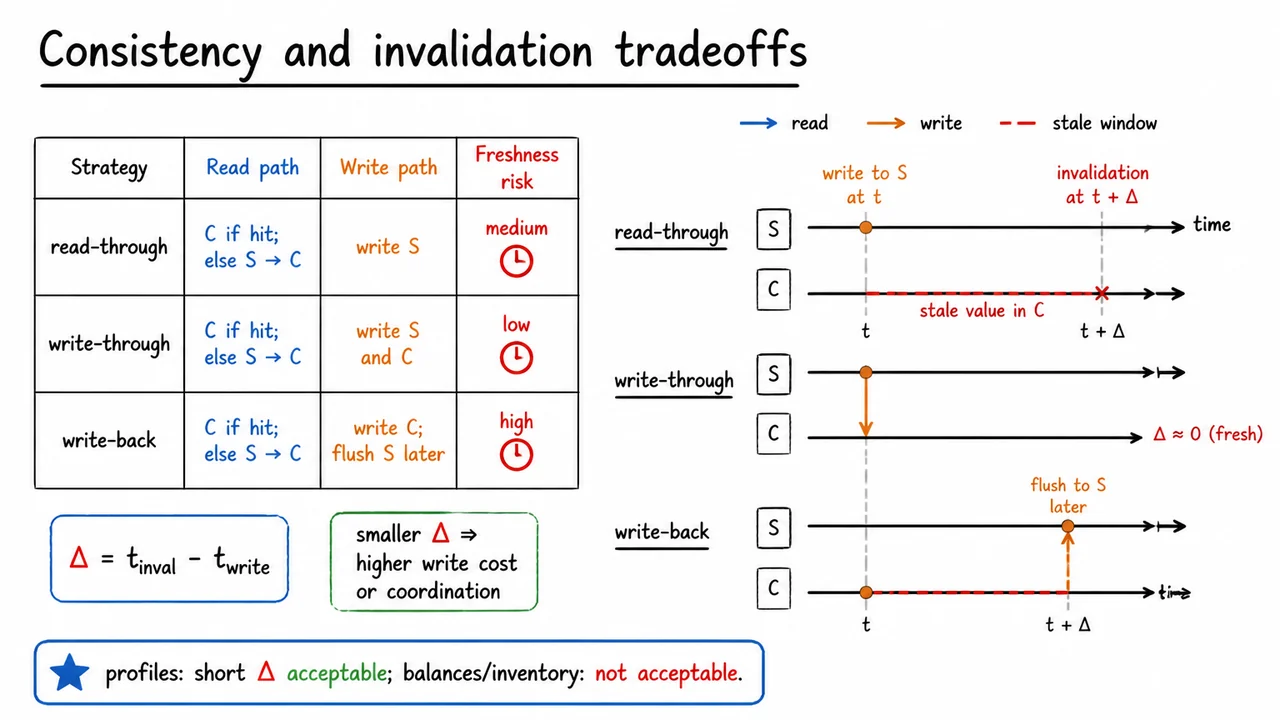
After introducing caches as a way to cut latency and cost, the next question is less glamorous but more important in production: how do we keep the cache from lying? The whole point of a cache is to serve reads faster than the backing store , but the moment the underlying data changes, the cache can drift out of date. That drift is the real tax of caching. The benefit is immediate speed; the price is a temporary consistency gap.
A useful way to think about that gap is as a stale-data window. If a write lands in at time and the cache is invalidated or refreshed at time , then the cache may serve old data for
That is not just a clock difference; it is the interval during which clients can observe a value that is no longer true. In many systems, a small is harmless. In others, even a brief stale read can produce a bad user experience or a correctness bug.
The key tradeoff is that smaller is not free. To shrink the inconsistency window, you usually need more coordination, more synchronous work on the write path, or more complicated invalidation logic. In shorthand:
That is the core backend design tension here. You are never just choosing a cache strategy; you are choosing where to pay for freshness. Pay on reads and reads become slower, pay on writes and writes become heavier, or pay in complexity and the system becomes harder to reason about during failures.
This is why the standard cache patterns differ so much in practice:
The subtle point is that read-through does not solve invalidation by itself. It improves the happy path for reads, but once a write has happened somewhere else, the cache still needs to learn that its copy is stale. Without an explicit invalidation or refresh mechanism, the system may keep returning old data until the entry expires naturally or is overwritten by coincidence. That is why cache correctness is not about “having a cache”; it is about defining the lifecycle of cached state.
Different data tolerate different values. A user profile can often be stale for a few seconds without breaking anything important. A balance, inventory count, or seat reservation usually cannot. Those domains are sensitive because stale reads can violate business rules, not just user expectations. If a customer sees an old inventory count and places an order that should have been rejected, the cache has become a consistency bug, not merely a performance optimization.
So the design question becomes: what is the system willing to trade for freshness? If you push toward very small , you typically need one or more of the following:
If you relax freshness, you gain throughput and simplicity, but you must accept that some reads may be stale. The right answer depends on the semantics of the data, not on the cache mechanism alone.
The visual below is useful because it compresses that whole argument into two views at once. The left side organizes the three major strategies by read path, write path, and freshness risk, which makes the cost placement easy to compare. The right side makes concrete: it shows the write to , the stale value persisting in , and the eventual invalidation point that closes the window. That timeline is the real intuition behind the formula.
Taken together, the table and timeline make one message hard to miss: caching is not just about fast reads. It is about managing the inconsistency window deliberately, because every reduction in has a price somewhere else in the backend.
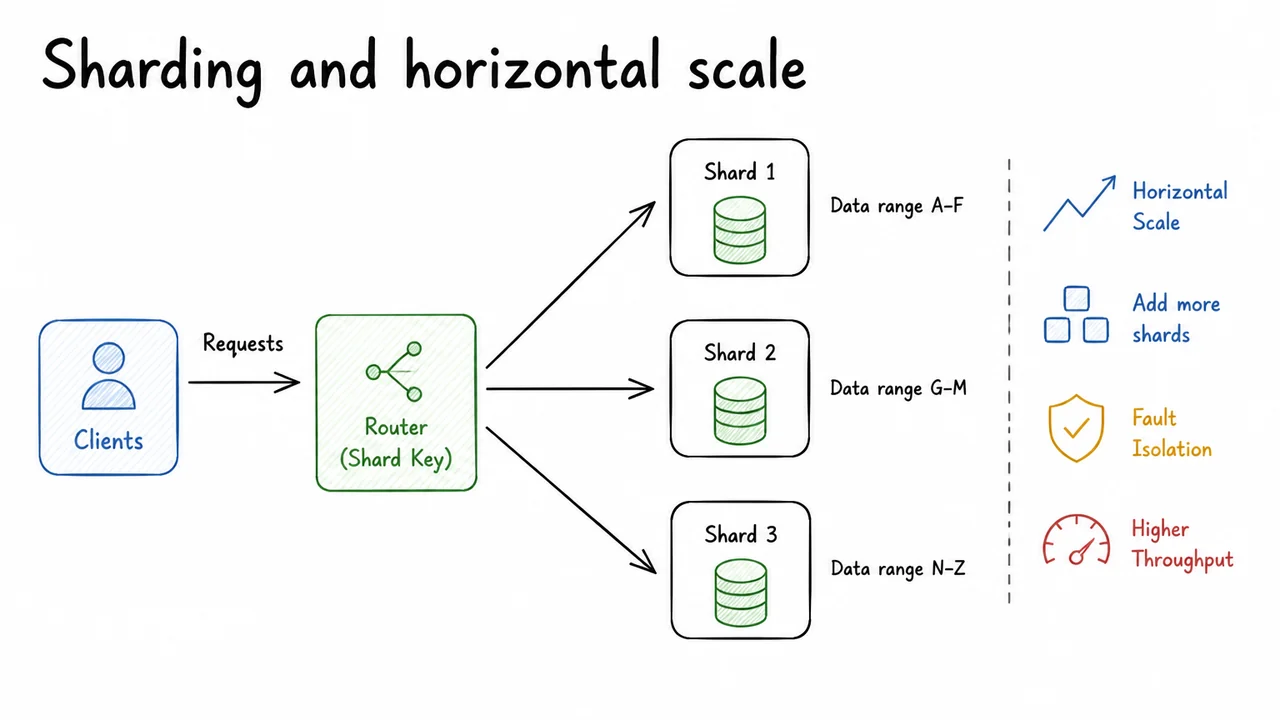
Once a backend outgrows a single machine, the central question changes from how do we make one server fast enough? to how do we split responsibility without breaking correctness? That is the essence of sharding: partitioning data and traffic so that no single node owns the entire workload. In the ideal case, adding shards turns one overloaded bottleneck into several smaller ones, each handling a slice of the key space and a slice of the requests.
The first principle is simple: if the system can be decomposed into mostly independent subsets, then we can distribute them. A user table might be partitioned by user_id, a message store by conversation, or a metrics stream by tenant. The shard key is not just a routing detail; it defines the boundary of locality. Good shard keys keep related reads and writes together, which minimizes cross-node coordination. Bad shard keys create hotspots, where one shard absorbs a disproportionate fraction of load and becomes the new bottleneck even though the cluster looks healthy on paper.
This is why horizontal scale is never just “add more servers.” It is “add more servers and preserve a useful partitioning structure.” If requests are uniformly distributed, throughput can scale roughly with the number of shards. If they are skewed, the scaling curve bends sharply downward. In practice, the bottleneck often appears in three places:
A healthy sharding strategy has to anticipate these failure modes before they show up in production.
The most common routing strategies are worth understanding in terms of their tradeoffs. Range-based sharding groups adjacent keys together, which makes range scans and ordered queries natural, but it is vulnerable to uneven growth if one region of the key space becomes much hotter than the rest. Hash-based sharding spreads keys more evenly and is usually better for uniform load, but it destroys locality for ordered access patterns. There is no free lunch: the shard key must reflect the dominant access pattern of the system, not just the shape of the schema.
A useful mental model is that sharding moves us from a single shared queue to many smaller ones. That helps latency because the queue behind any one shard is shorter, and it helps reliability because a failure may only affect a subset of traffic. But it also introduces new operational work: routing, rebalancing, backup/restore, and cross-shard queries all become harder. So the real objective is not merely distribution; it is controlled distribution.
The hardest engineering problem is what happens when the partitioning assumption changes. Traffic grows, tenants churn, one shard heats up, or the business launches a feature that needs broader queries than the original data model anticipated. Then the system must rebalance without losing correctness. That may mean moving partitions, splitting a hot shard, or using virtual shards so that the logical partitioning layer can be remapped onto physical machines. These techniques exist because the cluster is not static; the partition function must evolve as demand evolves.
Two invariants matter throughout:
Notice that this is also where consistency concerns reappear. If a request can touch multiple shards, then the system has to decide whether it will pay the cost of coordination or accept weaker guarantees. Horizontal scale is therefore not only about throughput; it is also about where the system draws the line between local operations and distributed ones.
The visual below compresses that logic into a single picture: a request comes in, a router maps the key to one of several shards, and the load is spread across independent partitions instead of collapsing onto one machine. The arrows and separation are doing important conceptual work here. They emphasize that the shard key determines ownership, and that ownership is what makes scale possible.
Just as importantly, the diagram hints at the tradeoff that comes with the win. Once the data is split, the system must respect boundaries: some operations stay local and cheap, while others become cross-shard and expensive. That tension is the bridge to the next topic, because architectural style is largely about how we manage those boundaries—whether we keep them inside a monolith, expose them as services, or let them flow through events.
After we have decided how to partition load and where state lives, the next question is organizational: what shape should the backend itself take? The answer is not purely stylistic. Architecture determines how failure propagates, how teams coordinate, how quickly features ship, and how much of the system can be reasoned about at once.
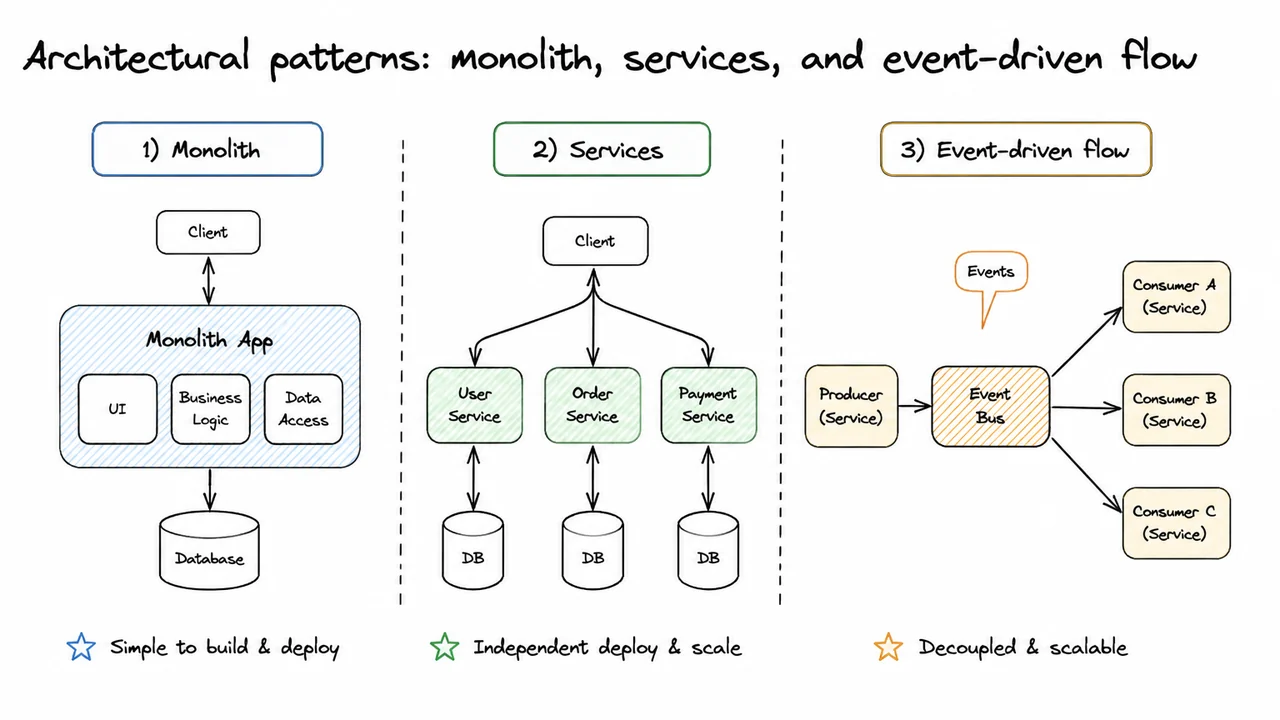
At a first-principles level, every backend must do three things: accept requests, preserve invariants, and produce durable effects. Different architectural patterns are simply different ways of arranging those responsibilities across code boundaries and process boundaries. A monolith keeps the whole request path in one deployable unit. Services split the domain into separately deployed components. Event-driven flow breaks the request-response assumption and turns state changes into messages that other components consume later.
The monolith is often the best starting point because it minimizes coordination overhead. A single codebase makes it easier to enforce invariants atomically: the same process can validate input, update multiple tables, write an audit record, and return a response without crossing a network boundary. That matters because every extra network hop introduces latency, partial failure, and a new consistency problem. If the business logic is still changing quickly, the monolith keeps the cost of refactoring low and the cost of debugging manageable.
But the monolith’s simplicity is not free. As the system grows, one deployment unit becomes a shared bottleneck. Teams start stepping on each other’s toes, unrelated changes get coupled into the same release, and a localized fault can become system-wide if the process crashes or a hot path consumes all resources. In practice, the monolith fails when organizational boundaries and technical boundaries diverge: if different parts of the product need different release cadence, scaling profiles, or reliability guarantees, the single unit becomes too coarse.
Services address that by dividing the system along stable domain boundaries. The intuition is appealing: if billing, search, and user profiles have different traffic patterns and failure modes, separate them so each can scale and evolve independently. A service boundary can turn a tangled code dependency into a clean network contract. This helps when you need:
The tradeoff is that a service boundary is also a consistency boundary. Once two steps of a workflow live in different processes, you can no longer assume a single transaction will protect the whole operation. You must choose between coordination protocols, compensating actions, or eventual consistency. Latency also compounds: a request that once touched memory and disk in one process may now traverse load balancers, RPC stacks, retries, and remote storage. Services reduce coupling in one dimension while increasing it in another: they make the system easier to split, but harder to reason about as a single unit.
That is why service decomposition only works when the boundaries are real. A common failure mode is carving the monolith into many services before the domain is understood. The result is a “distributed monolith”: lots of network calls, but no meaningful autonomy. Every change still requires coordinated releases, and every request becomes a chain of synchronous dependencies. At that point, the system inherits the worst parts of both worlds: the operational complexity of distribution and the tight coupling of a monolith.
Event-driven flow is a different response to the same pressure. Instead of making every subsystem wait for an immediate answer, the producer records that something happened and moves on. Consumers react asynchronously, often to build indexes, send notifications, update analytics, or trigger downstream workflows. Conceptually, this changes the system from command now, finish now to record intent now, converge later. That can dramatically improve availability and throughput because the critical path shrinks: the user request no longer waits for every side effect to complete.
The subtlety is that event-driven systems trade synchronous certainty for temporal decoupling. Once a message is published, delivery may be delayed, duplicated, or reordered. Consumers must therefore be idempotent, and the overall design must tolerate eventual consistency. This is powerful when the business can accept lag—search results can catch up, emails can be sent later, analytics can be approximate—but dangerous when the user expects an immediate invariant, such as “inventory must be reserved before payment completes.” In other words, events are not a magical solution; they are a way to move work out of the request path when strict immediacy is unnecessary.
A useful way to compare the three patterns is by asking what each one optimizes:
The architectural choice is therefore not “which is best?” but “which failure modes are acceptable for this part of the product?” If a workflow is latency-sensitive and deeply transactional, a monolith or a tightly scoped service with synchronous calls may be best. If a capability evolves independently and can tolerate cross-process communication, services are appropriate. If the work is naturally deferred, fan-out heavy, or tolerant of eventual consistency, events are often the cleanest abstraction.
The visual below condenses that reasoning into a compact comparison. Rather than treating these patterns as competing slogans, it places them on the same spectrum of coupling, latency, and consistency so the tradeoffs become obvious at a glance. The diagram is most useful if you read it as a map of where complexity moves: from code boundaries to network boundaries, and from synchronous certainty to asynchronous coordination.
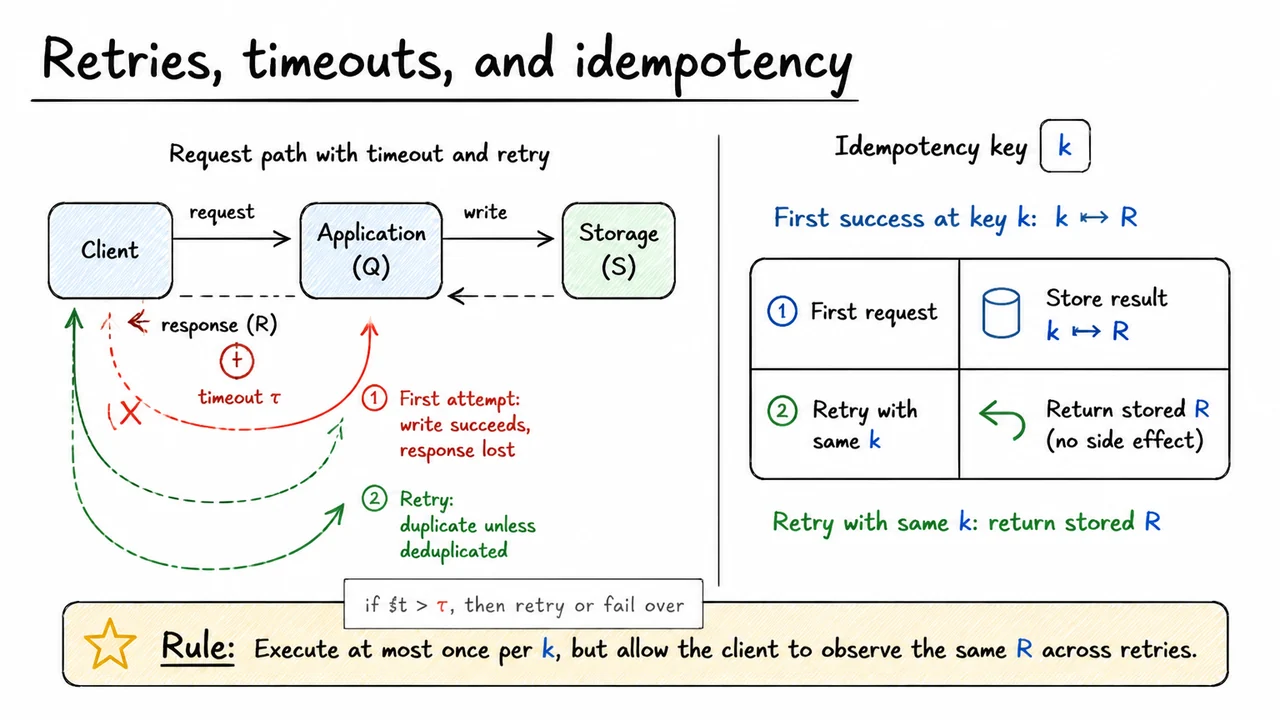
Once we accept that a backend can fail in the middle of a request path, the next question is not whether to retry, but when retrying is safe. The answer begins with a timeout threshold : if a request has not completed by time , the client or an upstream service stops waiting and either retries or fails over.
That rule sounds simple, but it hides an important asymmetry. A timeout is a local decision made by the caller; it does not tell us what the server actually did. The server may still be processing the request, may have already committed a write, or may have finished successfully while the response was lost in transit. So the policy is only reasonable if we understand what a retry can cost.
The first cost is load amplification. Suppose a request is slow because the system is under pressure, or because the downstream storage is momentarily sluggish. If the caller times out and retries, now the same logical request may be in flight multiple times. In effect, the arrival pressure on the queue increases, which can push the system further into congestion. This is one reason blind retries can turn a transient slowdown into a self-inflicted overload.
The second cost is more subtle and much more dangerous: duplicate side effects. Imagine the first attempt reaches storage and performs a write, but the response never makes it back to the client. From the client’s point of view, that attempt looks like a failure. From the server’s point of view, it may have succeeded already. If the client retries without any deduplication mechanism, the second attempt can repeat the same write, charge the same card twice, create two orders, or send two emails.
So retries are not really a transport concern; they are a semantic concern. We do not want to execute an operation “twice because the network was uncertain.” We want to execute it at most once per logical intent, while still allowing the caller to recover from lost responses. That is exactly what idempotency gives us.
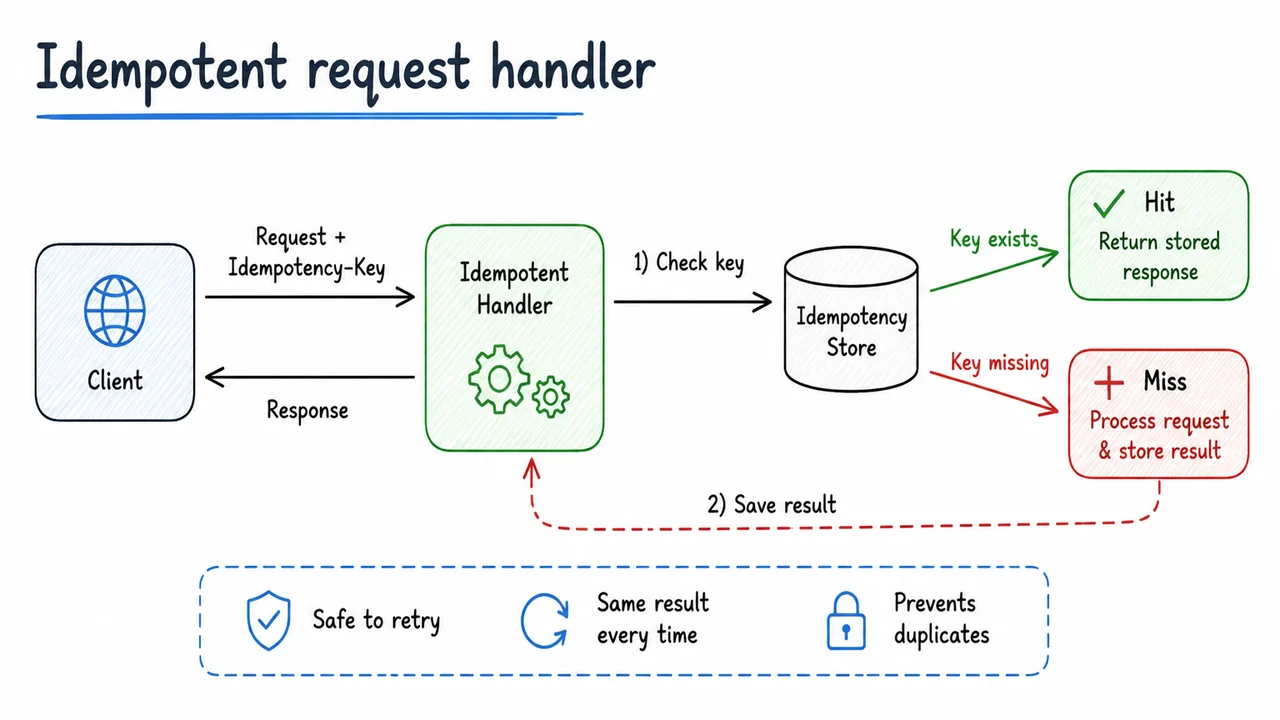
The standard pattern is to attach an idempotency key to the request. The first successful execution stores the result under that key: Then, if the same request is retried with the same key, the server does not repeat the side effect. Instead, it returns the stored result: The important invariant is: execute at most once per , but let the client observe the same across retries.
This pattern is powerful because it turns a brittle network failure into a recoverable application-level replay. It also makes retries composable with timeouts. A caller can safely say: “if I did not hear back by , I may try again,” provided the server recognizes the attempt as a duplicate and answers from stored state rather than repeating the side effect.
There are a few practical caveats worth keeping in mind:
The visual below compresses all of that into a single mental model. On the left, it makes the failure mode concrete: the client times out, retries, and without deduplication the same write can happen twice. On the right, it replaces that unsafe loop with a keyed memory: the first request stores under , and the retry simply replays the stored result. Together, the two columns explain why retries and timeouts are not enough on their own—they become safe only when the server can recognize the duplicate attempt and return the same stored outcome instead of redoing the work.
A reliable backend cannot treat every request as a fresh event with no memory. That approach works only in the idealized world where clients never disconnect, proxies never retry, and packets never get duplicated. In practice, timeouts, retransmissions, and user impatience all create the same uncomfortable possibility: the same logical action may arrive more than once.
That is why the next step is not merely “handle requests,” but handle requests idempotently. An idempotent request handler is designed so that repeating the same request has the same externally visible effect as performing it once. This does not mean the server literally does nothing on repeats; it means the system protects the business invariant. If the operation is “create an order,” the invariant might be “there is at most one order for this client intent.” If the operation is “charge a card,” the invariant is even stricter: duplicate processing must not produce duplicate charges.
The first subtlety is that idempotency is a property of the handler, not just the HTTP verb. People often associate it with PUT or DELETE, but a POST can be idempotent if it carries a stable request identity and the server uses that identity to deduplicate work. Conversely, a nominally idempotent verb can still be dangerous if the server’s internal side effects are not guarded. The real question is: what state change is the client intending, and how do we make that state transition safe under repetition?
A useful way to reason about this is to split the system into two layers:
Retries make these layers diverge. A client may not know whether the server processed the request before the connection dropped, so it retries. The server may have already written to storage, emitted an event, or sent an email. If the retry is treated as a brand-new action, you get duplicate rows, duplicate charges, duplicate notifications, or a request that appears to “succeed twice” in different parts of the system.
The standard defense is to attach a request key — often called an idempotency key — to the logical operation. The handler then follows a simple invariant:
In effect, the backend turns “maybe repeated delivery” into a single durable decision. A concise mental model is: one key, one outcome. That outcome might be a success response, a validation error, or a failure state that should be replayed consistently. Replaying the same error matters more than it sounds, because otherwise a client might alternate between “unknown” and “done” depending on timing, which makes automated recovery brittle.
To make this practical, the handler typically stores a record before or alongside the side effect. The exact implementation varies, but the invariants are the same:
This is where many designs fail. If the server checks “have I seen this key?” and then performs the action in separate steps without coordination, two concurrent retries can both slip through. That is the classic race condition: duplicate work happens between the check and the write. The fix is usually a database-level uniqueness constraint, a transactional insert, or a compare-and-set style reservation that makes “first writer wins” a durable fact.
It is also important to separate idempotency from deduplication after the fact. Deduplication that happens only in logs or analytics may help reporting, but it does not protect the business system. Idempotency must guard the actual state transition. If money has already moved, if inventory has already been decremented, or if a notification has already been queued, the duplicate request should resolve against that existing result rather than trying to reconstruct intent from scratch.
A practical handler therefore behaves like a tiny state machine with a memory of prior outcomes:
That distinction between “retrying the same intent” and “issuing a new intent” is the difference between safety and accidental repetition. If a payment attempt times out, the client should retry with the same idempotency key. If the user explicitly submits a second, separate payment, that should use a different key because it represents a new business action.
The visual below compresses that logic into a compact flow: the request arrives with a stable key, the handler checks whether the key has already been recorded, and then either returns the cached outcome or performs the side effect exactly once. The key idea is not the arrows themselves, but the preservation of intent under repetition. Once you see that structure, the next topic becomes natural: if a request can safely become “one durable decision,” then slower or noncritical work can often be moved behind the response entirely, which is exactly where background jobs and queues enter the picture.
Once the request handler is already idempotent, the next step is deciding which parts of the work must happen before the response and which parts can safely happen after. That separation is one of the most important design moves in backend engineering. If we try to do everything synchronously, then the user-visible latency is dominated by the slowest downstream step, and the request path inherits every expensive operation in the system.
A useful way to reason about this is to start from the simple decomposition
If the application layer includes image resizing, email sending, report generation, or other heavy work, the whole request becomes slow even when the database is fast. The fix is not to eliminate the work; it is to move slow work off the request path. The request should do the minimum necessary to accept the user action, persist the intent, and enqueue a job. Then it can return a response quickly, while workers finish the expensive part later.
That shift changes the latency profile in a very deliberate way. The client now sees a fast acknowledgment, but the actual completion of the task is delayed by time spent waiting in the queue and by worker service time. In other words, we trade shorter interactive latency for longer end-to-end completion time. This is often the correct tradeoff because users care most about the system feeling responsive at the moment they initiate the action. A five-second upload confirmation is bad UX; a 200 ms acknowledgment plus a later “your thumbnail is ready” update is usually much better.
The queue is what makes this pattern robust under bursty load. If requests arrive at rate and workers process jobs at rate , then the basic utilization is
When , the worker system can keep up on average; when approaches 1, queueing delay grows quickly; and when , the backlog tends to explode. This is the first subtle failure mode: a queue is not free capacity, it is deferred pressure. It can absorb bursts, but only up to the point where the consumer side remains ahead of the producer side.
That leads to an important operational distinction:
These are not just architectural labels; they encode different failure behaviors. In the synchronous design, a slow dependency immediately harms the request. In the asynchronous design, the request is protected from slow work, but now the system must handle retries, backlogs, and eventual completion. In practice, the background system becomes its own small distributed system, with all the reliability concerns that implies.
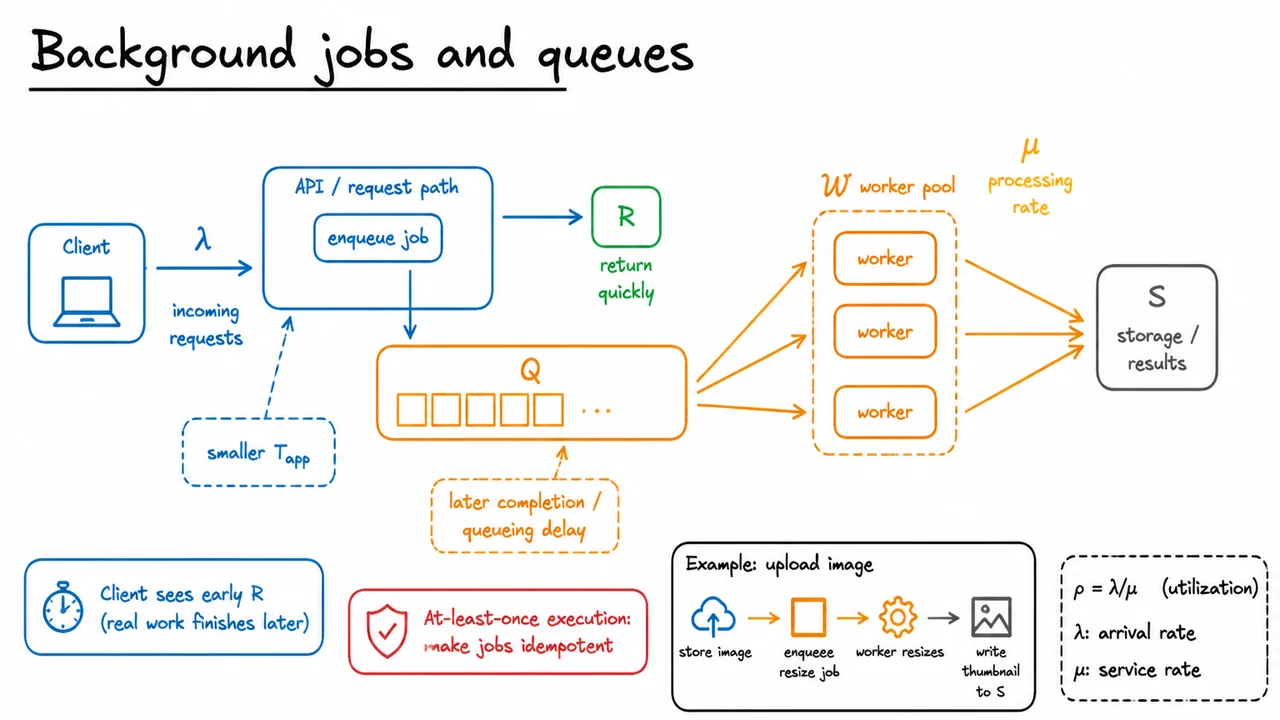
The most important consequence is that jobs must tolerate at-least-once execution. A worker may crash after doing the work but before acknowledging it; the queue may redeliver; an operator may retry a stuck task. So the job handler must be safe if it runs twice. This is where the earlier idempotency discussion becomes essential again. A resize job, for example, should either deterministically overwrite the same thumbnail or detect that the desired output already exists. Deduplication keys, unique output paths, and write-once semantics are all ways of making repeated execution harmless.
A concrete example helps make the tradeoff feel real. Suppose an upload request stores the original image, enqueues a resize job, and returns immediately. The request path is short: validate input, save metadata, enqueue job, respond. Later, a worker from picks up the job, reads the stored image, writes the thumbnail to , and marks the job complete. The user gets a fast response, while the system still finishes the expensive work eventually. The cost is that the thumbnail is not immediately available, so the product must be designed with that delay in mind.
The visual below compresses that reasoning into one pipeline. The left-to-right flow makes the key idea explicit: the request path ends after enqueueing, so the API can return quickly even though the real work continues in the background. The queue sits between the fast front door and the slower workers, which is exactly where burst absorption and queueing delay live.
It also highlights the operational boundary: the synchronous path is optimized for low , while the asynchronous path owns completion and retries. That split is the reason background jobs are so valuable in production systems, and also why they must be built with idempotency, deduplication, and queue health in mind.
Now that we have the basic building blocks—requests, queues, retries, and storage—we can put them together in a realistic backend workflow. A checkout request is a good stress test because it mixes user-facing latency, durable state changes, and downstream side effects. The interesting part is that these concerns do not belong to a single execution style. Some steps must finish before the user gets a response; others should continue in the background; still others are best treated as events that fan out into independent consumers.
A useful way to think about the pipeline is to split work into three classes:
In checkout, the critical path usually includes validating the cart, reserving inventory, charging payment, and creating the order record. If any of those fail, the system must preserve a coherent result: either the order is not created, or it is created in a clearly recoverable state. Everything else—confirmation emails, receipts, thumbnail generation, fraud scoring, analytics—should usually be decoupled so that slow or flaky downstream systems do not block the user.
The main design challenge is that these categories have different reliability requirements. The checkout endpoint should aim for exactly-once semantics from the user’s perspective, even if the implementation underneath is only at-least-once or effectively-once. That means the API has to be idempotent. If the client retries because of a timeout, the backend should not charge the card twice or create duplicate orders. In practice, we accomplish this by using an idempotency key, durable order state, and transactionally recording the fact that a given request has already been processed.
A subtle but crucial point is that “durable” does not mean “everything happens in one database transaction.” A single transaction can protect local invariants, but it cannot safely span payment providers, email services, and object storage in the general case. Instead, robust systems use state transitions plus background delivery: persist the order, commit the payment result, and publish an event that downstream workers can consume later. If a worker crashes after sending an email but before acknowledging the queue, the message may be retried, so the email service itself should also be tolerant of duplicates or deduplicate by message ID.
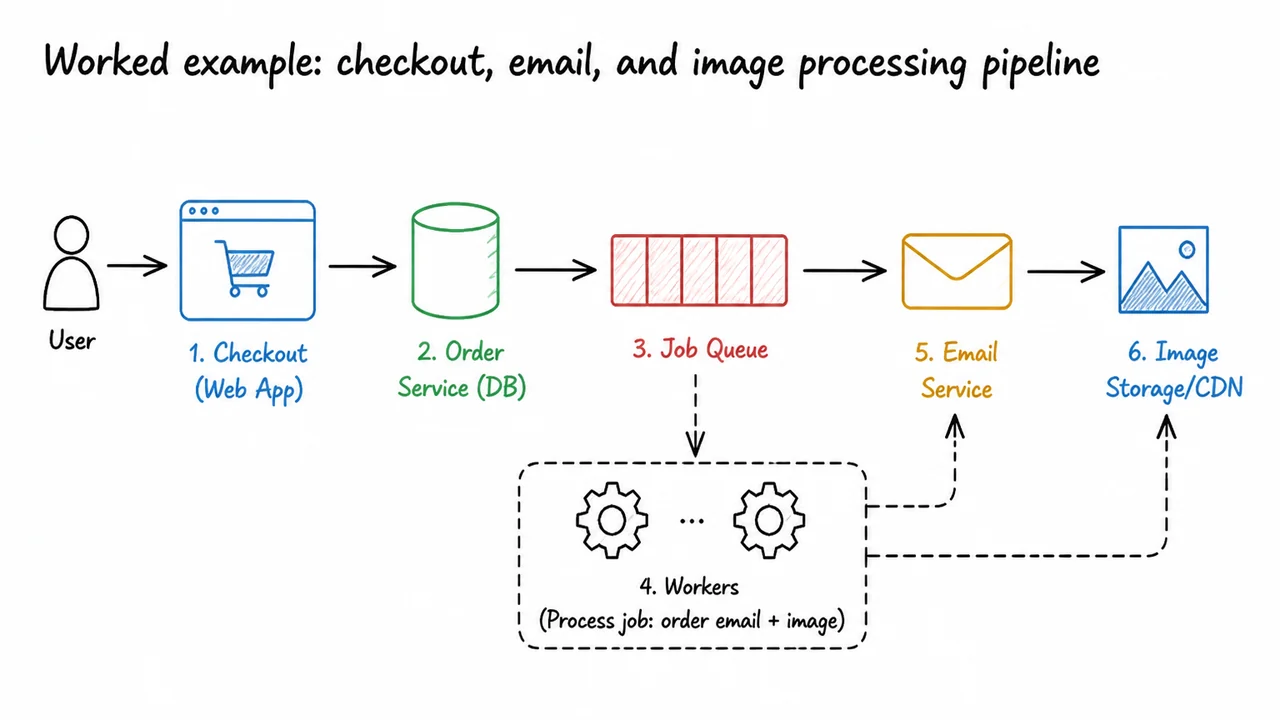
That same pattern shows up in image processing. After a user uploads an image, the application should store the original blob, write a metadata record, and enqueue a processing job for resizing, compression, or content scanning. The immediate request can return once the upload is safely persisted, because the resized thumbnails are not part of the correctness of the upload itself. If the image worker is slow, the user sees a short delay in preview generation rather than a failed upload. If the worker is retried, it should overwrite or skip outputs deterministically so repeated jobs do not create inconsistent variants.
This gives us a principled architecture for the whole flow:
Notice how the tradeoff is not “fast vs. slow” so much as “what must be correct now vs. what can be correct soon.” Synchronous steps reduce uncertainty for the user, but they increase tail latency and concentrate failure risk. Asynchronous steps improve resilience and responsiveness, but they demand stronger operational discipline: dead-letter queues, retry limits, idempotent consumers, and observability into lag. Event-driven systems are especially powerful when the same source event drives multiple downstream consumers, because each consumer can evolve independently without coupling the producer to their internal logic.
The visual below condenses this reasoning into one compact pipeline. Rather than treating checkout, email, and image work as separate anecdotes, it places them on the same request path so you can see where the backend should block, where it should enqueue, and where it should fan out. The arrows are doing the architectural work here: they mark the boundary between user-visible correctness and background side effects.
If you read the diagram from left to right, it should reinforce the core lesson of the example: a production backend is rarely one execution model. It is usually a carefully chosen mix of synchronous confirmation, durable event emission, and asynchronous workers, stitched together with idempotency and retries so that failure becomes a recoverable state rather than a surprise.
When a backend moves from a controlled environment into production, the unit of analysis changes. We stop asking whether the code is correct in isolation and start asking whether the system is healthy under real traffic, partial failures, retries, and noisy neighbors. That is why observability is not an accessory to backend engineering; it is one of the mechanisms by which we maintain the service as an operating machine rather than a pile of functions.
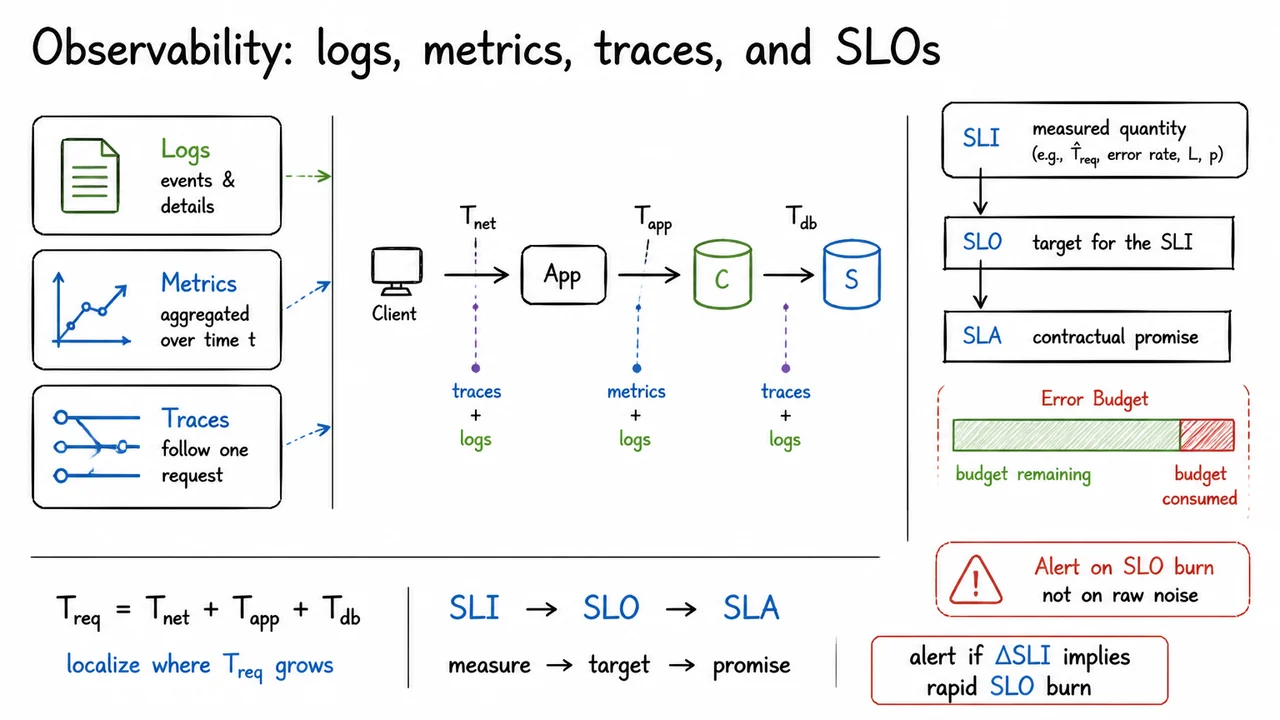
A useful starting point is to separate what the system does from what we can measure about what it does. A single request has an end-to-end latency we can decompose as
That decomposition matters because the same symptom — “the API is slow” — can have very different causes. Network time, application time, and database time fail differently, saturate differently, and respond to different interventions. If we only watch total latency, we know that the service is degrading, but not where to fix it.
This is the first conceptual distinction in observability: logs, metrics, and traces answer different questions.
The subtle but important assumption here is that no single signal is sufficient. Logs are rich but expensive to search at scale; metrics are cheap and alert-friendly but lose detail; traces are precise for causality but too granular to monitor every invariant directly. Production systems need all three because each one projects the same underlying behavior into a different coordinate system.
That leads naturally to the vocabulary of SLI, SLO, and SLA. The SLI is the measured quantity itself — for example , an error rate, queue depth, or cache hit rate. The SLO is the target we want that measured quantity to satisfy. The SLA is the externally meaningful promise, usually contractual, that may include consequences if the service misses the target. In compact form:
The arrow matters: we do not pick alert thresholds arbitrarily. We first decide what user experience we care about, then turn that into a measurable indicator, then set a target that reflects acceptable service quality. If that chain is reversed, the dashboard becomes a museum of irrelevant numbers.
A practical backend usually defines a small number of SLIs that track the actual user experience. Common examples are:
These are not abstract metrics for their own sake; they are proxies for failure modes that matter. High queue depth predicts delayed work, falling cache hit rate predicts extra database load, and rising tail latency often predicts a hot partition, a slow downstream dependency, or resource contention in the application tier.
The next question is how to turn measurement into action. Good alerts should not fire on raw noise; they should fire when the service is consuming its error budget too quickly. That is the idea behind burn-rate alerting: if the observed implies rapid SLO burn, the system is on track to miss its target even if the instantaneous value still looks acceptable. In other words, we care not just about the current level, but about the slope and persistence of degradation.
This avoids a common failure mode in operations: alerting on short spikes that recover on their own while missing slow regressions that steadily erode availability or latency. A backend can spend a long time “technically up” while quietly violating the user experience. Burn-based alerts are designed to catch that trajectory early, before the service has exhausted its budget for bad behavior.
The final mental model is simple but powerful: observability is the bridge from a request path to an operational decision. If a user complains, logs tell us what happened for a particular request. If the service degrades over the day, metrics tell us how often it is happening. If the latency spike is localized, traces tell us where in the path it happened. Together, those three layers let us move from symptom to cause instead of guessing blindly.
The visual below compresses that whole reasoning into one compact layout. The left side groups the three signal types, the middle ties them to a request path and its latency decomposition, and the right side shows the hierarchy from SLI to SLO to SLA with an error budget and alert threshold. Read together, the diagram is a reminder that observability is not “more dashboards”; it is a disciplined way to connect measurements to reliability decisions.
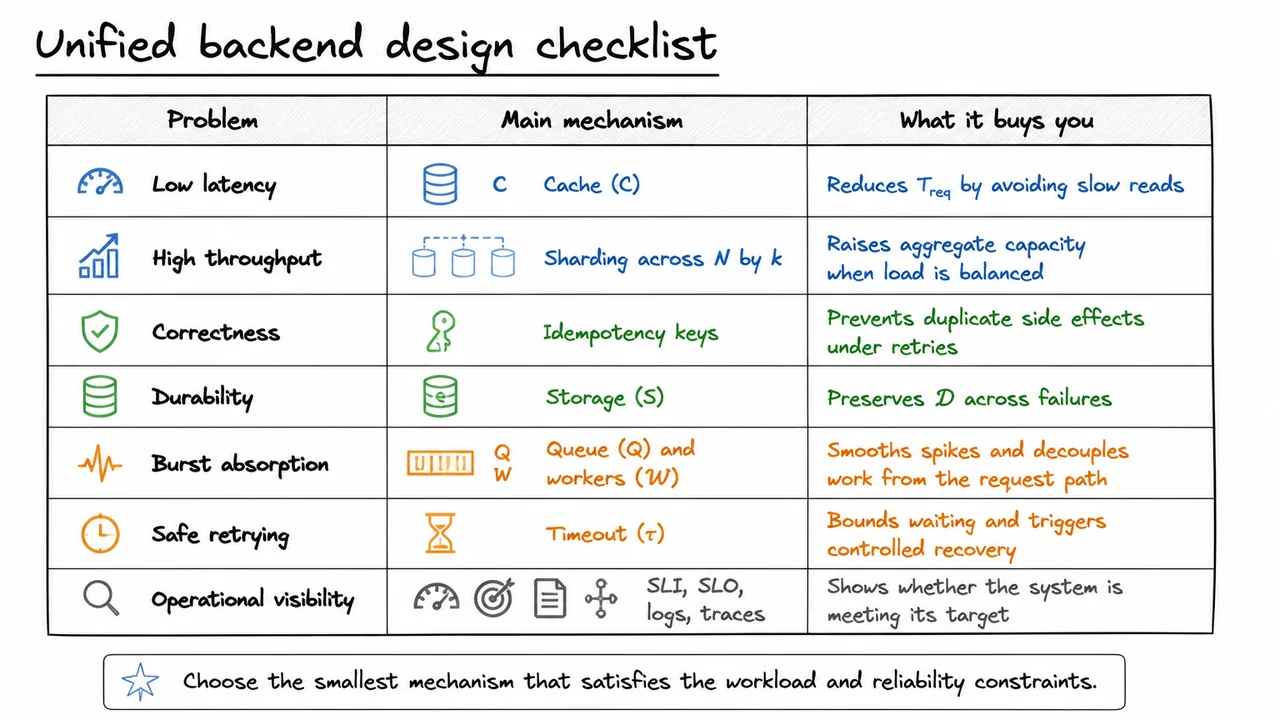
Up to this point, the backend has been decomposed into a request path, a set of failure modes, and a handful of reliability tools. The remaining step is to turn those pieces into a design rule: do not reach for infrastructure by habit; choose the smallest mechanism that satisfies the workload’s actual constraints.
That principle becomes clearer if we separate the kinds of pressure a system can face. A backend is rarely “failing” in an abstract sense. More often it is failing one dimension at a time: the request takes too long, the service saturates under load, retries create duplicate side effects, a crash loses state, a burst overwhelms the app server, or operators cannot tell what is happening. Each of those corresponds to a different engineering objective, and each objective has a different minimal fix.
A useful starting point is the request-time decomposition This is not just accounting; it is a diagnostic lens. If latency is high, you should ask where the time is going before adding more machinery. A cache helps only when the expensive part is repeated read work. Sharding helps only when a single storage or application instance is the throughput bottleneck. A queue helps only when immediate completion is not required and the work can be decoupled from the request path.
Throughput has a similar first-principles view. If requests arrive at rate and a server can serve at rate , then the load factor is Once gets too close to 1, queuing delay grows rapidly, and the system feels “slow” even before it fully collapses. This is why scaling is not automatically a correctness issue, but a capacity issue: if the workload is balanced, sharding across partitions can raise aggregate service rate. If the workload is skewed, however, the shard with the hottest key becomes the new bottleneck. So sharding is a capacity tool, not a magic wand.
Correctness and durability live in a different category entirely. If a client retries because of timeout or network uncertainty, the backend may execute the same logical action twice unless the request is made idempotent. An idempotency key turns “at least once” transport into “exactly once effect” for a given logical operation, as long as the server remembers the key long enough and stores the deduplication state reliably. Likewise, durability is not about speeding things up; it is about preserving data across failures. For that, you need a real storage boundary , not just in-memory state.
Bursts are yet another concern. The system may be perfectly fine at average load and still fail when a traffic spike arrives. In that case, the right mechanism is often a queue with workers , which absorbs the burst and smooths work into a controllable execution stream. This is especially useful when the user does not need an immediate answer. But it changes the product contract: the request path becomes a submission path, and the user must tolerate eventual completion. That tradeoff is intentional, not incidental.
Safe retrying deserves its own mention because it sits between latency and reliability. A timeout is not just a timer; it is a failure bound. Without one, clients can wait indefinitely, and backends can accumulate stuck work. With one, the system can fail fast, free resources, and trigger controlled recovery such as retry, fallback, or circuit breaking. The subtlety is that retries are only safe when the operation is idempotent or otherwise guarded, because aggressive retrying without deduplication can worsen overload and duplicate side effects.
Finally, observability is the mechanism that prevents the rest of the design from becoming guesswork. SLIs and SLOs define whether the system is meeting its target, while logs and traces explain where the target is being missed. This matters because the right fix depends on the violated constraint: if latency is broken, you inspect the request path; if throughput is broken, you inspect saturation and queueing; if correctness is broken, you inspect retry behavior and deduplication; if durability is broken, you inspect the storage boundary and recovery path.
The strongest summary is that backend architecture is not a catalog of features, but a sequence of minimal choices. The checklist is therefore not “add cache, add queue, add sharding, add retries,” because that usually creates unnecessary complexity and new failure modes. Instead, ask a more disciplined question:
The visual below condenses that logic into a compact table: each row pairs one operational problem with the smallest mechanism that meaningfully addresses it. Read it as a design checklist, not a shopping list. If a row is not needed, leave it out; if a row is failing, the first task is to identify which constraint has actually been violated.