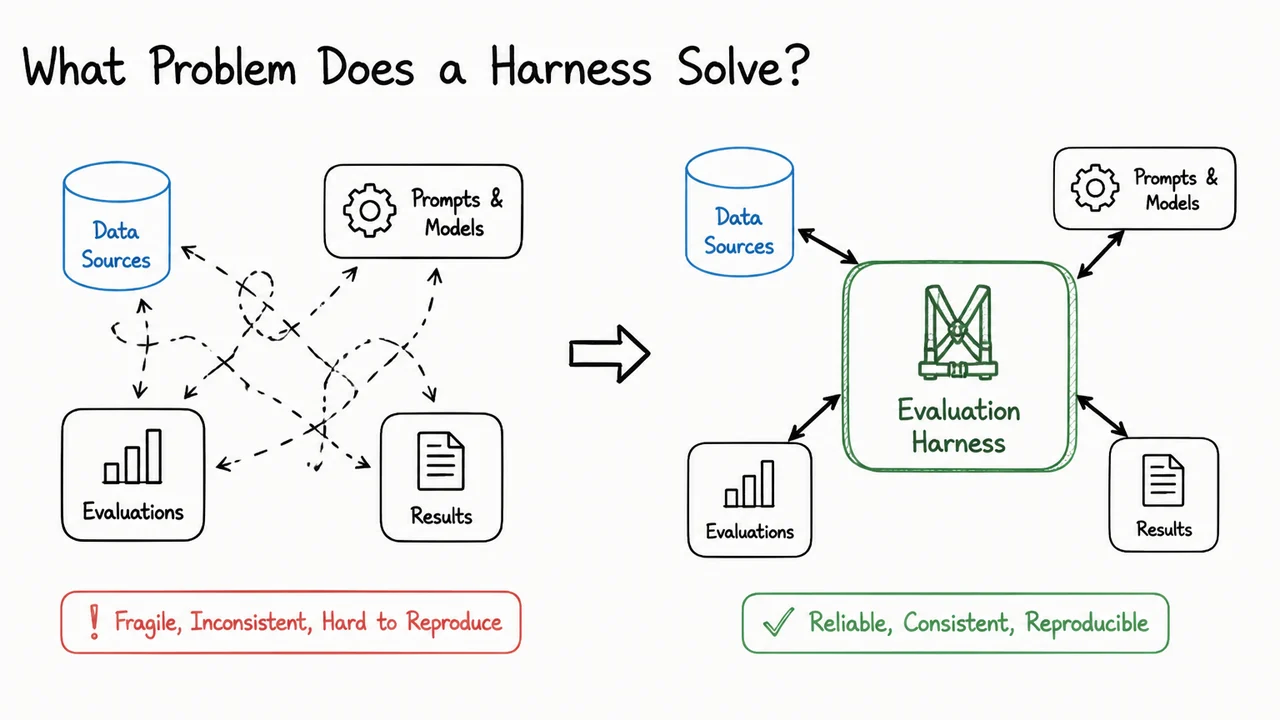
When an ML system starts producing numbers that people trust, the question is no longer just “does the model work?” It becomes “can we reliably tell when it works, why it works, and whether a change improved it or merely changed the measurement process?” That is the problem a harness solves. A harness is the controlled scaffold around the model: it fixes the inputs, the environment, the random seeds, the data splits, the metric computation, and the logging path so that evaluation becomes a system property rather than an accident of whatever script happened to run that day.
This matters because most apparent model progress is fragile. If a result depends on an unstated preprocessing step, a silently changed dataset version, a different CUDA kernel, or even a different order of examples, then the metric is not measuring only the model. It is measuring the entire execution context. In that sense, a harness is the boundary between model behavior and measurement noise. Without that boundary, training and evaluation can drift together, and a “better” score may simply mean the pipeline changed in a favorable way.
The core idea is simple: a harness makes the evaluation problem closed. Given the same model artifact and the same dataset artifact, the harness should produce the same outputs, the same metrics, and the same logs. Formally, if we write the model as and the evaluation pipeline as , then we want to be stable under repeated runs, where is the data artifact and captures configuration and environment. The practical version of this requirement is reproducibility: if the run cannot be replayed, the metric cannot be trusted as evidence of improvement.
There are several distinct sources of noise that a good harness isolates. Some are obvious, like random seeds in initialization, shuffling, augmentation, or batched sampling. Others are more subtle: nondeterministic GPU operations, different library versions, changes in tokenization, schema drift in input data, or metric code that averages over a different subset than intended. A robust harness treats each of these as a failure mode to be controlled, not as an implementation detail to be hoped away.
A useful way to think about the harness is as a small contract with five parts:
Each piece exists because a different kind of confusion can otherwise sneak into the workflow. Configuration prevents ambiguity about “which run” we are discussing. Seeding prevents stochastic drift from masquerading as progress. Assertions catch invalid inputs early, before they become believable metrics. Logging makes the run auditable. Versioning lets us re-create the run months later, which is essential once a metric becomes part of a launch decision or regression analysis.
The subtle point is that harness engineering is not mainly about convenience; it is about epistemic control. In an ML system, the model is only one component in a larger causal chain. If the chain is unstable, then the score is not a reliable observation. That is why harness failures are often expensive: they produce false confidence, delayed bugs, and difficult postmortems. A small leak in the harness can make an offline experiment look like a genuine gain when it was really caused by data leakage, changed normalization, or a metric mismatch.
Put differently, the harness converts an ML workflow from an improvised experiment into a repeatable measurement apparatus. In the same way that a lab instrument must be calibrated before its readings mean anything, an evaluation harness must be calibrated around the model and dataset before its numbers deserve interpretation. The better the harness, the less time engineers spend asking whether the result is “real” and the more time they can spend asking the more interesting question: what changed in the model, and why did it help?
The visual below is a compact summary of that idea. The central model is not surrounded by decoration; it is surrounded by the things that usually distort measurement. That framing makes the key point visible at a glance: a harness is the controlled interface between a model and the messy world around it. The arrows, boundaries, and labeled safeguards are there to emphasize that reliable evaluation is not a property of the model alone, but of the entire path from inputs to metrics.
Seen this way, the diagram is not just a schematic. It is evidence for the argument that harness engineering is a first-class ML systems problem. The model sits in the middle, but the real engineering challenge is to ensure that everything around it is stable enough that the resulting number means what we think it means.
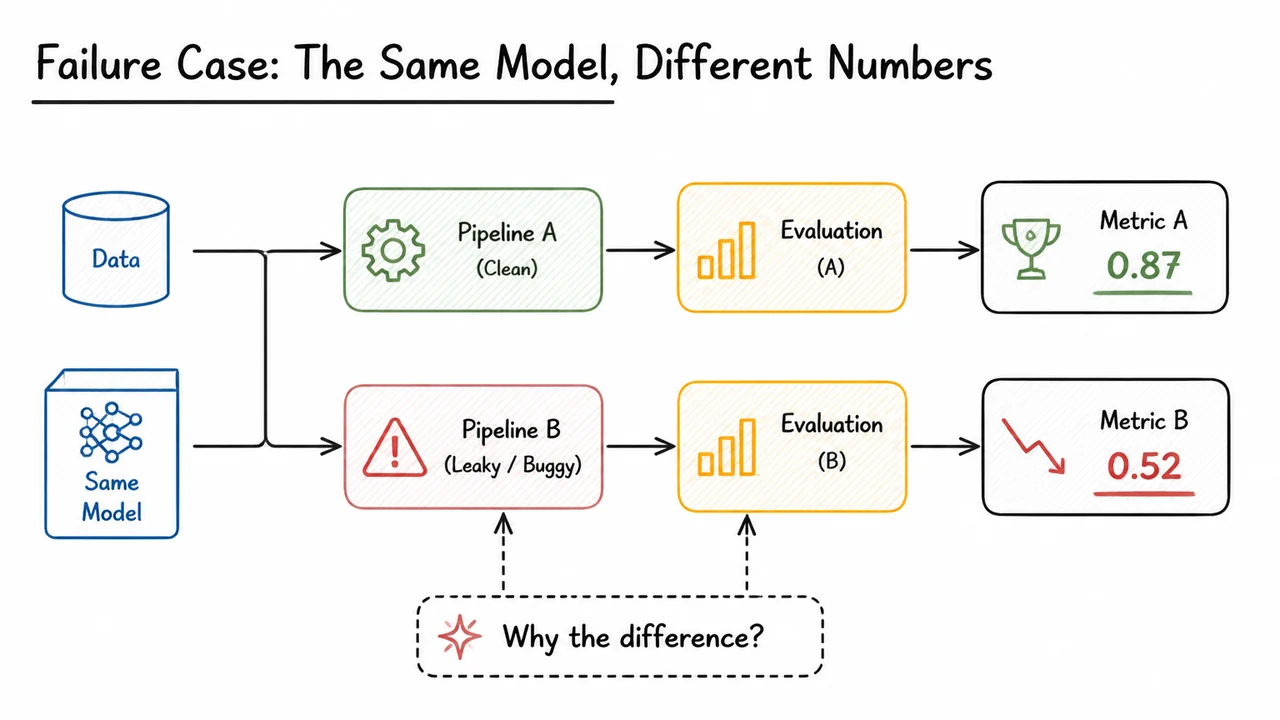
A common way to discover that a harness is missing is to run the “same” model twice and get different answers. Not different in the last decimal place, but different enough to change conclusions: one run says the model improved, another says it regressed, and a third lands somewhere in between. At that point, the model is no longer the only variable. The evaluation process itself has become part of the experiment.
That is the core failure mode behind many misleading ML results: when we say “the same model,” we often mean the same code checkpoint, but not the same execution context. A supposedly identical evaluation can still vary because of data order, random augmentation, nondeterministic kernels, async preprocessing, version drift in metrics, or even a different subset of examples being silently filtered. If the harness does not pin these sources of variation down, the reported score is a mixture of model quality and infrastructure noise.
From a systems perspective, this matters because evaluation is supposed to estimate a quantity like expected performance, but a weak harness is not measuring only . It is also measuring the state of the data pipeline, the runtime, the random seed, and the metric implementation. In practice, what we observe is closer to where is the seed, is the environment, and is the versioning state of code and data. The moment those extra variables are uncontrolled, the estimate stops being a stable property of the model.
The subtle failure is that these differences are often plausible. A one-point swing in accuracy can look like normal variance. A small change in F1 can be blamed on stochasticity. But repeated inconsistency is not harmless noise if it changes ranking, triggers a false regression alert, or hides a genuine improvement. The danger is not just that metrics fluctuate; it is that teams start rationalizing the fluctuation instead of eliminating it.
A reliable harness therefore has to make the run reproducible enough to answer a very specific question: did the model change, or did the measurement change? That requires isolating the model from everything else. At minimum, the harness must pin:
If any one of these drifts, the number can drift with it. And if the drift is silent, the evaluation pipeline becomes an unreliable narrator.
Another reason this failure mode is so common is that ML systems are not single-step functions. Data may be read, normalized, batched, cached, filtered, and augmented before the model ever sees it. Predictions may be aggregated, thresholded, or postprocessed before a metric is computed. Each stage introduces a chance for hidden nondeterminism or version skew. In other words, “the same model” is only meaningful if the harness makes the rest of the pipeline behave like controlled instrumentation rather than a moving target.
This is why robust harness design emphasizes separation of concerns. The model should be treated as the object under test, while the harness owns repeatability and observability. Good harnesses do not merely run experiments; they also record enough context to explain them later. When results diverge, the harness should help answer questions like: Was the same dataset used? Was the same seed applied? Did the metric implementation change? Were we evaluating on the same hardware path?
The visual below condenses that idea into a compact failure story: one model enters multiple ostensibly identical evaluation runs, but the outputs diverge because the surrounding conditions are not actually identical. That mismatch is the symptom of a weak harness, not a mysterious property of the model itself. The diagram is useful because it makes the hidden variables explicit—what looked like one experiment is really several different experiments wearing the same label.
Read it as a diagnostic pattern. Whenever you see “same checkpoint, different score,” ask which of the surrounding boxes was not fixed. That habit is the bridge to the next problem: even when the numbers look stable, silent data and metric bugs can still make them wrong.
The most dangerous evaluation bugs are the ones that look like success. After you’ve fixed obvious sources of nondeterminism, the next class of failure is more insidious: the model is stable, but the data pipeline or metric computation is quietly wrong. In practice, that means the reported number can be perfectly repeatable and still be meaningless.
This is why “evaluation” is not just a function from predictions to scores. It is a chain of assumptions about which examples were included, how they were transformed, how labels were interpreted, and which rows were counted together. A harness that does not make those assumptions explicit is vulnerable to silent drift: the code runs, the metric prints, and everyone ships the wrong conclusion.
A useful way to think about it is that every metric is a contract over a dataset slice. If the slice changes, the score changes; if the label mapping changes, the score changes; if duplicate examples sneak in, the score changes; and if the aggregation ignores missing values or weights incorrectly, the score changes again. None of these necessarily throw an exception. Worse, many of them can produce a number that looks reasonable enough to pass a casual review.
Common failure modes tend to cluster into a few categories:
The subtlety is that these bugs often preserve the shape of the pipeline. The notebook still runs, the job still completes, and the dashboard still updates. That is exactly why a harness must include assertions that check invariants about the data before and after every critical transformation. For example, you want to know that row counts match expectations, that label sets are known, that no example appears in more than one split, and that metric denominators match the intended population.
This is also where versioning becomes more than bookkeeping. If the dataset snapshot, label dictionary, feature preprocessing logic, and metric implementation are not versioned together, then a score from last week is not comparable to a score from today. Reproducibility here is not only about rerunning the same code; it is about rerunning the same meaning.
A production-ready harness therefore treats evaluation as a guarded pipeline with explicit checkpoints. At minimum, it should answer questions like:
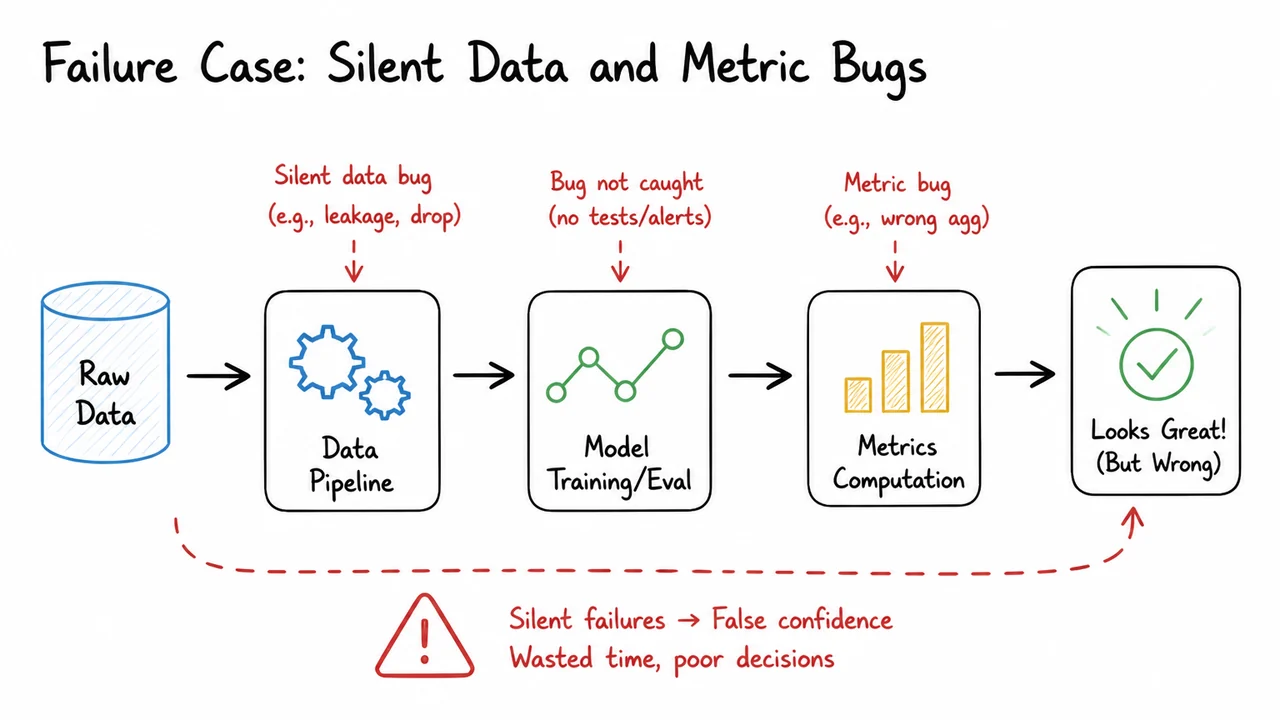
The visual below condenses that logic into a simple failure story: a clean-looking metric can emerge from a corrupted path, and the harness’s job is to catch the corruption before it becomes a published result. The arrows and warning points are less about decoration than about causality—where a tiny upstream data mistake propagates all the way to a misleading score.
Just as importantly, the diagram emphasizes the contrast between what the number says and what the pipeline actually did. That distinction is the core lesson of harness engineering: reliable evaluation is not achieved by hoping the metric is correct, but by constructing a system that makes silent errors hard to express and easy to detect.
After we have seen how silent data and metric bugs can slip through, the next question is not whether to test harder, but what exactly a production harness must guarantee. The key shift is to stop treating evaluation code as a convenience wrapper around training and instead treat it as a systems boundary: a place where we deliberately constrain inputs, execution, and outputs so that results mean what we think they mean.
A robust harness exists to answer a deceptively simple claim: if the model, data snapshot, and configuration are the same, then the outcome should be the same up to known stochastic variation. That sentence hides most of the engineering difficulty. In practice, a harness has to separate the signal we care about—model quality—from the noise we do not: random initialization, nondeterministic kernels, data ordering effects, drifting dependencies, flaky infrastructure, and metric implementations that quietly disagree with one another. Without that separation, “improvement” can be an illusion caused by a different seed, a different file version, or a subtly changed preprocessing step.
A useful way to think about this is that the harness must provide three kinds of guarantees:
Those guarantees matter because ML systems fail at the boundaries. A model can be mathematically sound and still be operationally untrustworthy if the harness lets train/validation leakage occur, if preprocessing differs between offline and online paths, or if a metric silently changes definition after a library upgrade. In other words, the harness is not “around” the model; it is part of the model’s real specification in production.
The first guarantee is configuration completeness. Every run should be fully reconstructible from an explicit config: dataset identifiers, preprocessing toggles, model hyperparameters, metric choices, thresholds, device settings, and environment flags. Implicit defaults are dangerous because they create hidden branches in behavior. A production harness should make the configuration an artifact, not an afterthought, so that a result always answers the question: what exactly was executed?
The second guarantee is controlled randomness. Seeding is not about eliminating all variability; it is about making variability legible. A good harness seeds every stochastic component it controls—Python RNGs, NumPy, framework RNGs, shuffling, sampling, dropout behavior where applicable—and records those seeds with the run metadata. But seeding alone is not enough. Some operations remain nondeterministic because of parallelism, hardware kernels, or distributed synchronization. A production harness should therefore distinguish between:
That distinction prevents a common failure mode: overclaiming reproducibility when the system only offers statistical consistency.
The third guarantee is observable execution. Logging is not just for debugging; it is the evidence trail for scientific and operational accountability. A minimal production harness should log dataset versions, sample counts, class balance, feature statistics, model hashes, metric outputs, wall-clock timing, and any assertion failures. Equally important, the harness should log negative space: dropped examples, skipped batches, missing fields, and fallback code paths. Many of the most damaging bugs are invisible unless the harness makes them impossible to ignore.
Assertions are the next layer of defense. They encode assumptions that are otherwise left as folklore: label ranges, schema compatibility, monotonic timestamps, nonempty splits, no overlap between training and validation IDs, and metric-domain constraints such as probabilities staying within . Good assertions fail early and locally. Bad harnesses let corrupted inputs flow deep into training and only reveal the problem at the end as a suspiciously good validation score or an inexplicably poor deployment outcome.
Versioning ties the whole system together. A reliable harness should version data, code, configuration, and ideally environment as first-class artifacts. That includes commit hashes, dependency locks, container or image identifiers, and dataset snapshot IDs. The deeper reason is that “the same experiment” is not a meaningful statement unless its constituents are pinned. If any of these versions can drift silently, then performance comparisons become confounded by changes in the experimental apparatus rather than changes in the model.
At a practical level, the safest harness architecture is minimal but layered:
This design does not merely reduce bugs; it changes the meaning of a benchmark. Instead of asking whether a number looks good, we can ask whether the number is causally attributable to the thing we meant to measure. That is the real role of harness engineering in ML systems: to turn evaluation from a fragile script into a trustworthy contract.
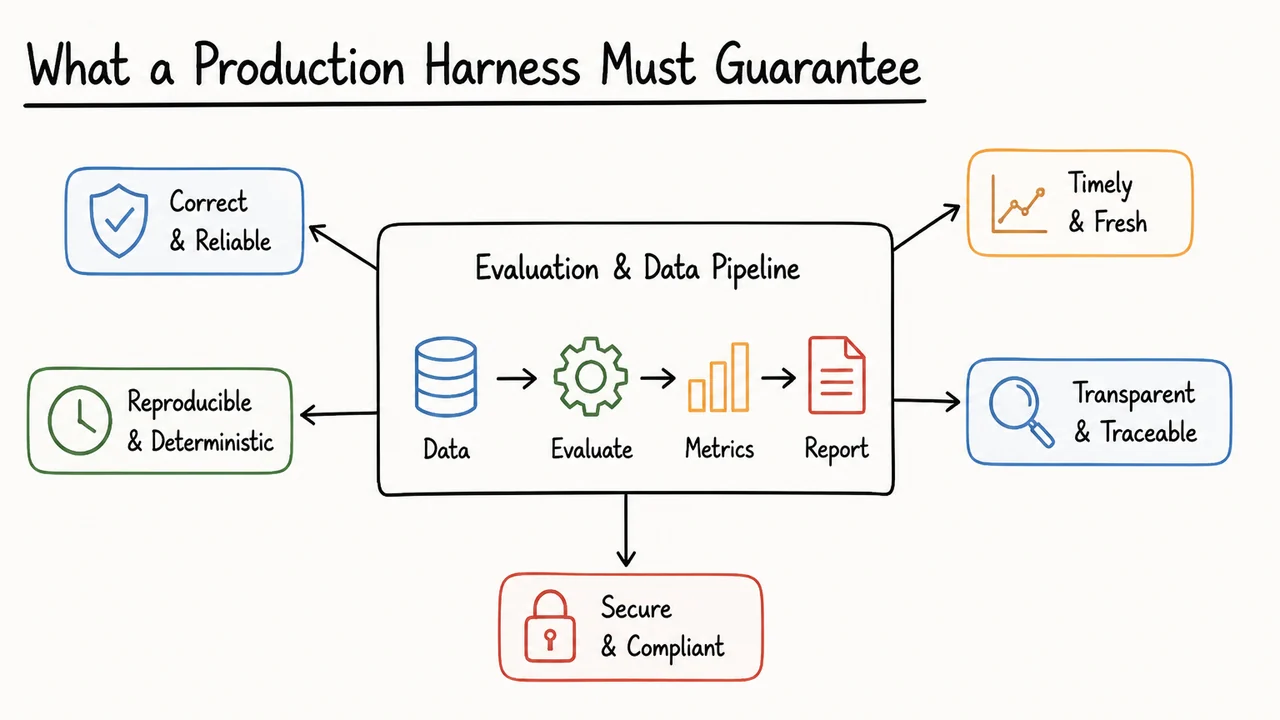
The visual below compresses those guarantees into a compact pipeline view. Rather than presenting the harness as one monolithic box, it separates the responsibilities that must be made explicit: inputs are pinned, randomness is controlled, checks fire at boundaries, and outputs are logged with versioned context. That structure is the key insight—reliability emerges not from one clever trick, but from several small constraints working together.
Seen this way, the diagram is less a decoration than a summary of the argument. Each labeled component corresponds to a failure mode we want to rule out, and each arrow reflects a promise the harness must uphold from configuration to artifact.
To make harness engineering precise, it helps to stop thinking about it as a loose collection of scripts and start treating it as a formal interface between a model and the rest of the ML system. The key idea is that a harness is not “the training code” or “the evaluation notebook.” It is the controlled environment that defines what the model is allowed to see, what it must produce, and how success or failure is measured.
A useful way to frame this is as a mapping from inputs to outputs under explicit constraints. If we denote the harness by , then it mediates a model operating on data , configuration , environment , and random state . The model itself is rarely the whole story; what we actually care about is the composed system: This is not just notation for its own sake. It captures an operational truth: two runs of the “same model” can diverge because the harness changed the data slice, the evaluation threshold, the preprocessing path, the hardware backend, or the RNG seed. In production ML, those differences are not edge cases; they are the source of many false wins, false regressions, and irreproducible bugs.
The formal view becomes even more important when the system is stateful. A harness does not merely execute a function once; it orchestrates a pipeline with setup, execution, measurement, and teardown. In the training case, it determines how batches are sampled, how gradients are accumulated, when checkpoints are written, and what exactly counts as an epoch. In the validation or offline evaluation case, it freezes training-time degrees of freedom and isolates the model from accidental feedback loops. That isolation is the whole point: a sound harness makes it hard for hidden state to leak into the result.
This is why a harness must define its own invariants. A good invariant is a property that should remain true no matter how the underlying model evolves. Typical examples include:
Without these guarantees, “evaluation” degenerates into a fragile ritual. A model may appear better simply because the data loader shuffled differently, the tokenizer changed, or a new default threshold silently shifted the metric. The formal harness model exists to prevent exactly this kind of metric noise from being mistaken for model progress.
There is also an important distinction between model error and harness error. If the model is truly worse, the harness should reveal it. But if the harness is malformed, the apparent model quality is no longer interpretable. That is why strong harnesses emphasize:
Each of these components is part of the formal contract. Configuration fixes the intended experiment. Seeds pin down stochasticity where possible. Logging records the actual realized execution. Assertions enforce assumptions before they become corrupt results. Versioning ties the whole run to a stable lineage of code and data.
A subtle but crucial point is that formalization does not mean eliminating all nondeterminism. Some systems remain partially stochastic because of parallelism, GPU kernels, or data-dependent control flow. The goal is not metaphysical purity; it is bounded uncertainty. A well-designed harness makes the remaining uncertainty explicit, measurable, and small enough that differences between runs are interpretable rather than mysterious. That is what turns repeated experiments into evidence instead of anecdotes.
Seen this way, a harness is a reliability layer wrapped around the core ML computation. It defines the boundary between what is controlled and what is allowed to vary. That boundary is what lets teams compare experiments, reproduce regressions, and trust offline metrics enough to use them for decision-making. In other words, the harness is the mechanism that converts a model run into a scientific observation.
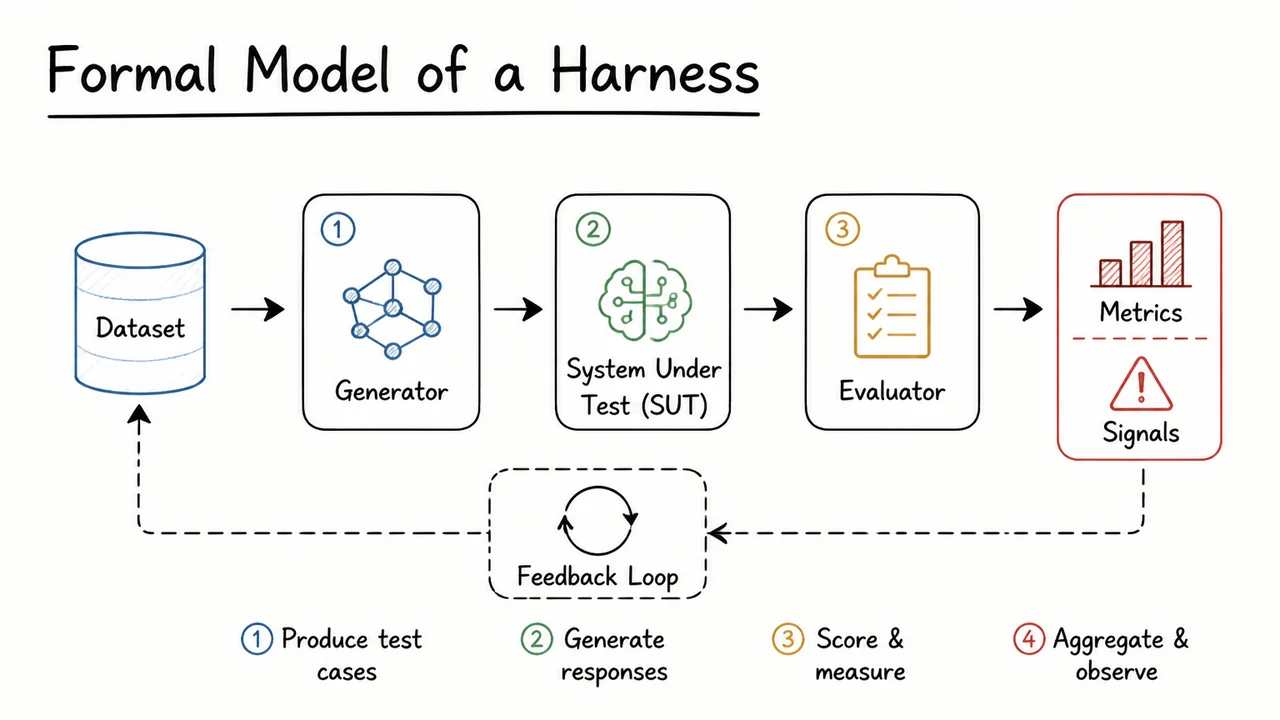
The visual below compresses that abstraction into a compact system diagram. The model sits in the middle, but the surrounding pieces are what make its outputs meaningful: configuration constrains the run, seeds stabilize stochastic paths, logging captures the realized behavior, assertions guard invariants, and versioning preserves provenance. Together, they form the formal envelope of the harness.
If you read the diagram as a contract rather than a flowchart, its structure becomes easier to remember. The central message is that a harness is not just something that “executes training” or “computes metrics”; it is the mechanism that keeps the experiment well-defined. That framing sets up the next step naturally: once the harness is formalized, we can ask how to implement the most important sources of reproducibility—configuration, seeds, and determinism—without relying on luck.
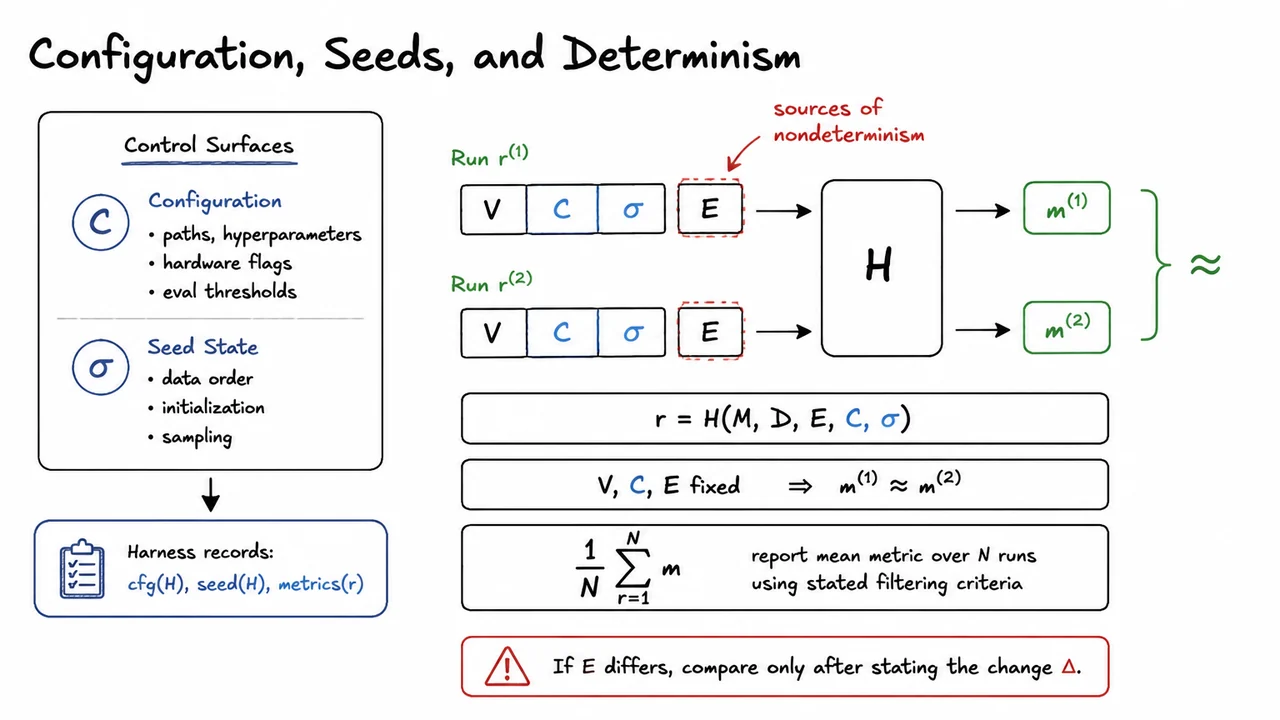
Building on the formal harness model, the key point is that reproducibility is not a vague property of “the code”; it is a property of a run under explicitly controlled inputs. If we write the harness output as
then the only way to compare two runs meaningfully is to know which parts were held fixed and which parts were allowed to vary. In practice, the most important control surfaces are the configuration and the seed state , because they determine how the same model and data are actually exercised.
The configuration is much richer than “hyperparameters.” It includes file paths, batch sizes, preprocessing flags, evaluation thresholds, device settings, precision modes, and any runtime switches that alter the semantics of the run. If a result cannot be reconstructed from the recorded configuration, then the metric is not really a result—it is an anecdote. A good harness therefore treats configuration as a first-class artifact and records , not just a summary in a notebook or log message.
The seed state controls the stochastic parts of the pipeline: random initialization, data shuffling, dropout, subsampling, augmentation, and any randomized evaluation procedure. This is easy to underestimate because a single seed often feels like “enough,” but in modern systems stochasticity can come from multiple libraries and multiple processes. If the harness only seeds one framework while leaving sampler state, dataloader workers, or distributed ranks uncontrolled, then the run is only partially deterministic.
That distinction matters because reproducibility is usually a statement about equivalence up to tolerance, not exact bitwise identity. If the validation set , the configuration , and the environment are fixed, then repeated runs should preserve the metric to within acceptable numerical error:
The approximation sign is doing real work here. Floating-point reduction order, nondeterministic GPU kernels, asynchronous I/O, and distributed scheduling can all perturb the result slightly even when the “logical” setup is unchanged. A robust harness does not pretend these effects do not exist; it records them so that a change in metric can be interpreted correctly.
There is also a subtle but important statistical layer. For repeated runs under the same validation protocol, the number you usually want to report is not a single lucky outcome but the average behavior:
Just as important as the average is the rule for including runs in that average. A meaningful harness must state the filtering criteria: which runs were restarted, which were aborted, which were excluded due to environment drift, and which were considered invalid because the seed state or configuration diverged. Without that bookkeeping, the mean can become misleadingly optimistic.
This is why determinism in ML systems is often partial, conditional, and environmental rather than absolute. Even with identical , , and , two runs may differ because contains nondeterministic kernels, different library versions, hardware-specific math, or distributed execution effects. In those cases, the right response is not to force a false notion of “same run,” but to log the source of variation explicitly and make the comparison contract precise.
A useful way to think about the harness is as the mechanism that binds together the evidence for comparison:
When those pieces are captured together, a metric becomes interpretable as the outcome of a controlled experiment rather than a one-off computation.
The visual below compresses that logic into a single reproducibility story: two runs enter the same harness with the same fixed controls, and the resulting metrics are close enough to be compared. The point is not merely that the diagram contains arrows and braces, but that it makes the contract visible: if the environment is equivalent and the configuration and seed are fixed, then repeated measurements should agree up to tolerance. The small warning about environmental change is equally important, because once differs, the comparison must be re-framed as a controlled difference, not treated as noise.
Building on reproducibility controls, the next question is not merely whether a run is deterministic, but whether it is auditable after the fact. In practice, the moment an evaluation result is published or a checkpoint is handed to another team, we have crossed from “a computation happened” into “a claim was made.” At that point, a harness is no longer complete unless it can reconstruct the claim’s provenance.
That is why logging belongs to correctness, not to observability as a nice-to-have. A harness that cannot explain where a metric came from is functionally incomplete, even if the training code itself is perfect. If a score changes by 0.3 points, we need to know whether the difference came from the model, the dataset slice, the software stack, the random seed, or a silent environment drift. Without structured logs, those possibilities collapse into guesswork.
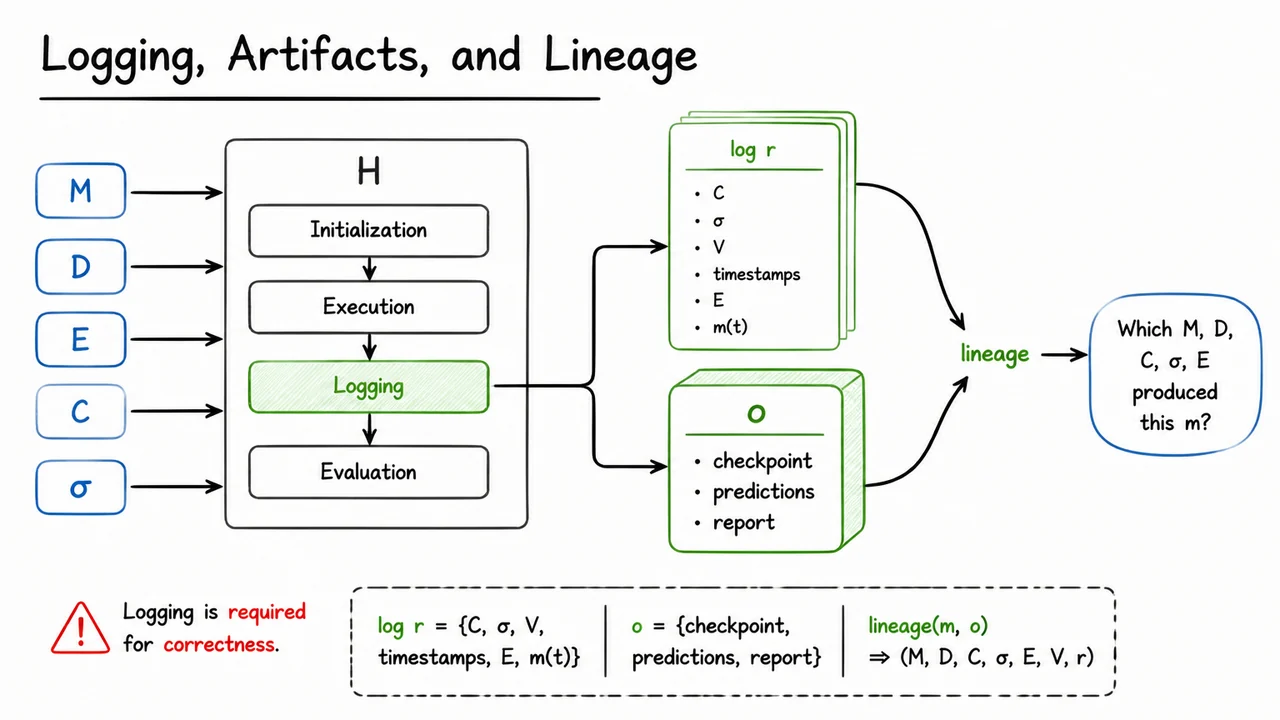
Formally, a run should emit a structured log where captures the configuration, the seed state, the version context, the execution environment, and the key metrics as they evolve over time. The exact contents can vary by system, but the principle does not: the log must contain enough information to replay the decision context of the run, not just its final score.
This distinction matters because many failures are temporal rather than instantaneous. A single scalar metric at the end of training hides important structure: divergence at step 400, a data loader stall at step 1200, or a metric bug that appears only after a checkpoint restore. By preserving timestamps and metric traces, the harness gives us a timeline for diagnosis rather than a single opaque number. That timeline is often what separates a reproducible experiment from a mystery.
Logs alone, however, are still insufficient. A run also produces artifacts—the tangible outputs that downstream users inspect, reuse, or compare. We can think of the artifact set as These artifacts are not just files; they are evidence. A checkpoint encodes model state, predictions encode behavior on a specific dataset snapshot, and the report encodes the derived summaries that people actually read. If they are not tied back to the originating run identity and version , they become detached objects whose meaning is easy to misattribute.
That tie-back is what we call lineage. In the strongest form, lineage answers a provenance question of the form: In words: given a metric or artifact, can we recover which model , dataset , configuration , seed , environment , version , and run produced it? This is the difference between “we have a file” and “we know what the file means.” Once lineage is established, the harness can support debugging, rollback, comparison, and compliance without relying on tribal memory.
There are a few subtle failure modes worth calling out. First, unstructured logs often look adequate until a bug appears and the critical field is missing or ambiguously named. Second, orphan artifacts tend to proliferate when file names encode meaning informally, so later consumers cannot tell which checkpoint corresponds to which evaluation report. Third, partial provenance is especially dangerous: a result may be linked to a seed and a config, but not to the exact environment or data snapshot, which makes “reproducible” claims fragile under re-execution.
A robust harness therefore treats logging as a synchronized system with three responsibilities:
This is why the statement “logging is required” is not a process reminder; it is a specification constraint. If the harness cannot reconstruct provenance, then it cannot certify the correctness of the result in any operational sense. The result may still be numerically accurate, but it is not trustworthy as an engineered output.
The visual below compresses that logic into a single flow. The left side represents the harness as an execution boundary that receives model, data, configuration, seed, and environment inputs; the center highlights logging as an explicit internal function rather than an afterthought; and the right side shows that both the structured log and the artifact bundle must emerge from the run together. The looping provenance arrow is the key idea: it reminds us that auditability comes from being able to trace any reported metric or saved file back to the exact ingredients that produced it.
Read the diagram as a compact proof sketch. If contains the run context and contains the concrete outputs, then their combination determines lineage; and if lineage is known, then the harness can answer the only question that matters in production evaluation: what exactly produced this result?
After we have logging, artifacts, and lineage in place, the next question is less glamorous but much more important: what is the smallest harness that can still be trusted in production? In practice, a harness is the thin layer that turns a collection of scripts into a repeatable system. It decides how configuration enters the run, how randomness is controlled, how data is selected, how metrics are computed, and how every result is recorded so that the next run can be meaningfully compared to it.
A good minimal harness is not “minimal” in the sense of being bare or fragile. It is minimal in the sense that every component has a clear responsibility and no hidden coupling. That separation matters because the most common source of evaluation failure is not a broken model; it is a broken boundary. A model can be stable while the surrounding pipeline drifts because of dataset filtering, nondeterministic sampling, environment changes, metric implementation differences, or an accidental dependency on state from a previous run. The harness exists to make those dependencies explicit.
The design principle is simple: the model should be evaluated inside a controlled box. Inputs enter through a configuration object, the runtime is seeded, the dataset is pinned, the metric logic is versioned, and the outputs are logged with enough metadata to reconstruct the run later. When any of those pieces are implicit, the evaluation becomes hard to trust. When they are explicit, the harness becomes a reproducible contract between training, validation, and offline evaluation.
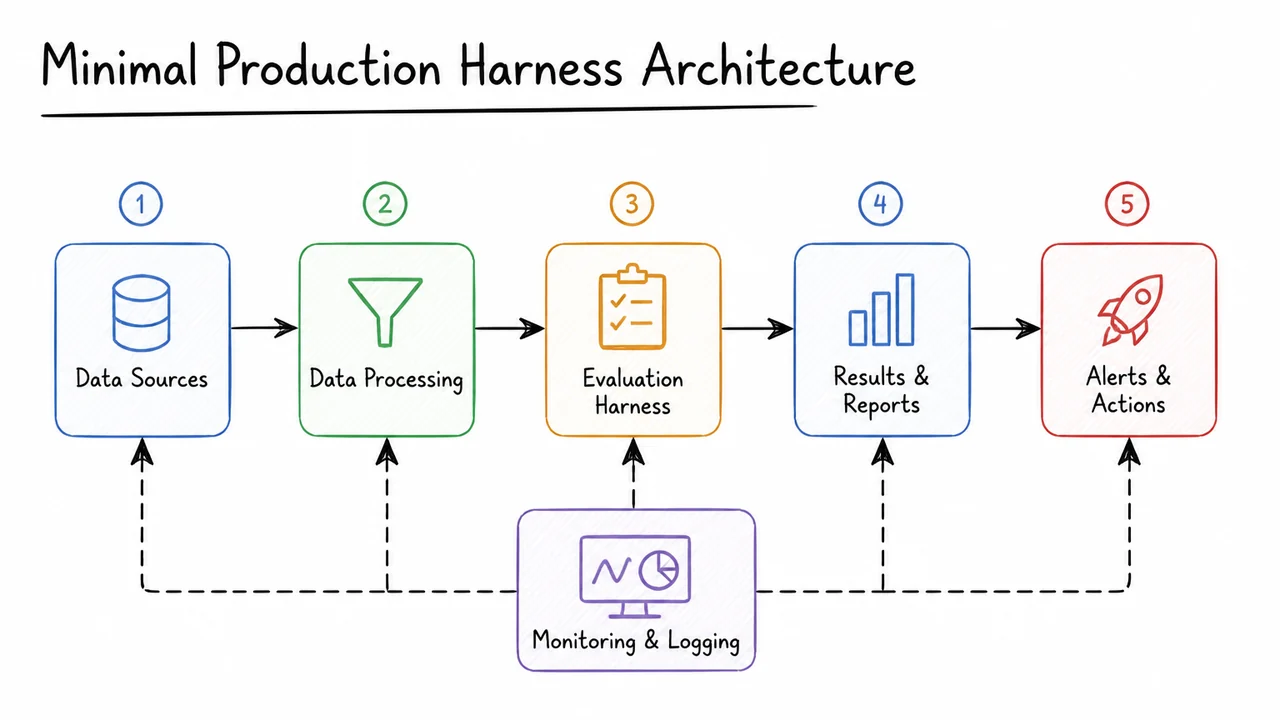
A practical way to think about the architecture is to separate it into five layers:
That list may look operational, but it encodes a deeper statistical idea: comparability. If two runs are meant to be compared, then the differences should come from the model or data under study, not from hidden variation in the harness itself. For example, if validation data is sampled differently on every run, then a small metric improvement can be indistinguishable from random fluctuation. If preprocessing code changes silently, then a drop in accuracy might really be a tokenization mismatch. A production harness reduces these confounders.
The configuration layer deserves special care because it is where reproducibility starts. A robust harness should make it possible to answer, “What exactly was run?” without opening source code. That means the config should include identifiers for model checkpoint, data snapshot, metric version, batch size, device settings, and any thresholding logic. In mature systems, this config is often treated as an immutable run manifest rather than a loose bag of parameters. Mutability is convenient for experimentation, but it becomes a liability once results need to be audited.
Seeding is the next line of defense, though it is easy to overestimate what it can do. A seed helps control randomness in sampling, shuffling, dropout, and some numerical libraries, but it does not guarantee full determinism across hardware, distributed settings, or third-party kernels. That subtlety matters: a harness should not claim stronger reproducibility than the environment can support. Instead, it should record the seed, declare the determinism level, and surface the remaining uncertainty. In other words, the harness is responsible not only for reducing noise, but also for making residual noise legible.
Assertions are the final piece that turns a pipeline into a reliable system. A production harness should reject invalid inputs, mismatched shapes, empty datasets, missing labels, unexpected class vocabularies, and metric outputs outside plausible ranges. These checks are not defensive programming in the narrow sense; they are a safeguard against silent metric corruption. If the harness allows bad states to pass through, then the resulting numbers may look precise while being meaningless. A failed assertion is usually cheaper than a mistaken deployment decision.
The reason this architecture matters is that it gives every later stage something solid to stand on. Training can reuse the same machinery as offline evaluation; validation can be compared against historical runs; and regression checks can be automated against a known baseline. The harness becomes the stable interface between model development and production decision-making. Once it exists, “Did the model improve?” becomes a question answerable by controlled evidence rather than by intuition.
The visual below compresses this logic into a small system diagram: a run enters through configuration, is stabilized by seeding and environment capture, passes through data and execution, and exits through logging plus assertions. That arrangement is the point. It shows that a minimal production harness is not a single script, but a set of narrow, testable responsibilities that together prevent evaluation from drifting into ambiguity.
Seen this way, the architecture is almost a checklist for trust. If a component is missing, the system may still run, but it will be harder to compare, harder to reproduce, and easier to fool. The diagram provides a compact summary of those dependencies so that, in the next section, we can ask a more precise question: what should the harness assert, and how do invariants stop bad runs before they contaminate downstream decisions?
Coming out of the pipeline view, the next question is not how the harness moves data and models through stages, but how it knows when something has gone wrong. That is the role of assertions and invariants: explicit boolean checks that the harness evaluates at well-defined points in the run. An invariant is not a vague expectation or a post hoc diagnostic; it is a predicate whose falsity has operational meaning. In a production harness, that meaning is usually simple and severe: where is the realized run produced by the harness over model , data , environment , configuration , and randomness .
The key idea is that correctness is checked, not assumed. A model may train successfully while silently violating the contract of the data, the configuration, or the metric computation. If the harness treats those violations as warnings, then evaluation can continue under corrupted assumptions and produce numbers that look legitimate but are not comparable. If the harness treats them as assertions, then a broken run fails fast, and the resulting is never mistaken for a trustworthy experiment. This is why assertions are a first-class part of harness engineering: they define the boundary between a valid run and an invalid one.
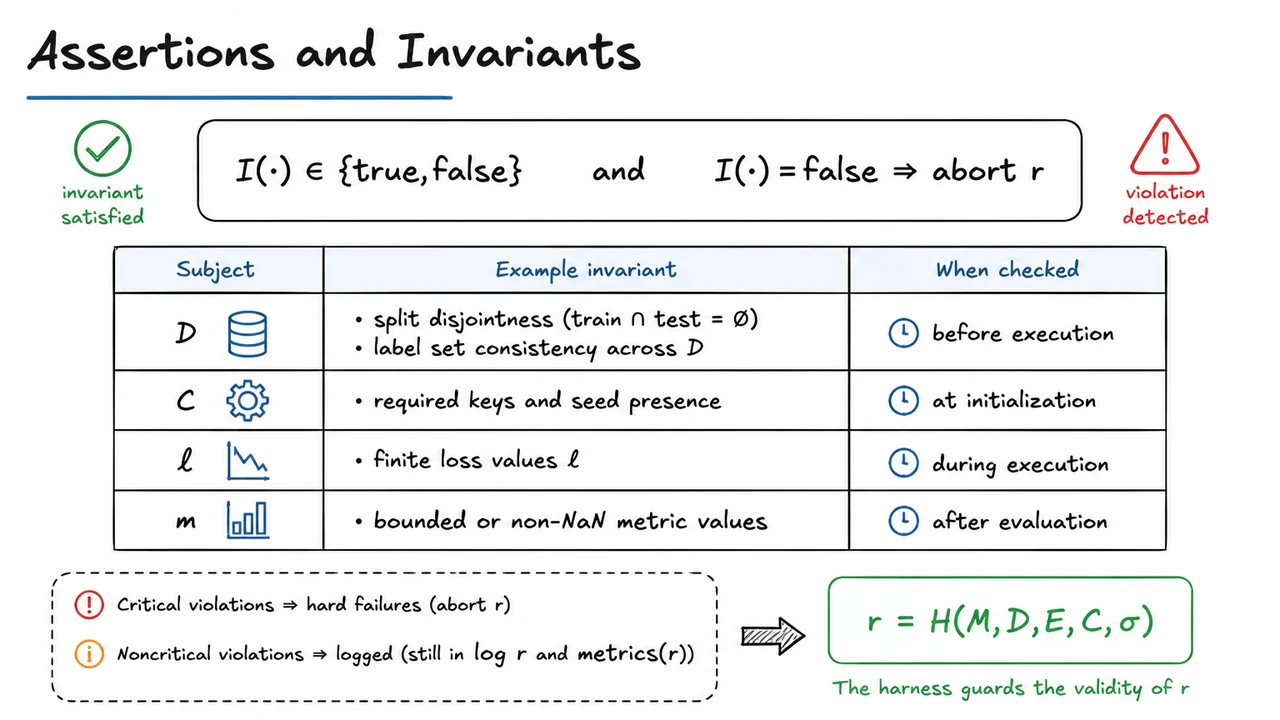
Different stages require different kinds of invariants, because different failure modes appear at different points in the lifecycle. We often write them as , , , and to emphasize what they guard:
These are not interchangeable checks. A split-overlap bug is a dataset failure, while a missing seed is a reproducibility failure, and a NaN metric could reflect either a numerical issue or an upstream data defect. The harness becomes more reliable when each check is attached to the right semantic object and executed at the right time.
That timing matters. Some invariants should fire before execution because they are cheap and structural: “Do train and test share any IDs?” “Is the label vocabulary consistent?” Others belong during execution because they depend on intermediate state: “Is the loss finite on every step?” “Did the step counter increase exactly once per batch?” A final class appears after evaluation, when the harness can validate outputs and aggregates: “Are all reported metrics numeric?” “Is the AUC within its theoretical range?” The practical rule is simple: if a violation makes later outputs meaningless, it should abort immediately; if it only informs debugging, it can be logged, but it must still be recorded in and .
This distinction between hard and soft failures is essential. A hard failure is for conditions that invalidate the run itself: a train/test overlap, a missing required config key, a non-finite loss, or a metric computed on the wrong split. A soft failure may be a warning threshold or a suspicious but not fatal statistic—something worth surfacing in logs and dashboards, but not enough to stop the entire workflow. The harness should be conservative here. It is usually better to abort a questionable run than to promote a flawed one into the experiment history, because once a bad is logged as if it were valid, it contaminates analysis, comparison, and model selection.
A useful mental model is that assertions are the harness’s contract enforcement layer. The model is allowed to be imperfect; the harness is not allowed to silently accept undefined behavior. That means invariants should be written to protect the interpretation of the run, not just the code path. For example, “loss must be finite” is not merely a numerical nicety. It protects the assumption that optimization is progressing on a meaningful objective. Likewise, “no overlap between train and test” protects the assumption that evaluation estimates generalization rather than memorization. In both cases, the invariant defends the validity of the conclusions we draw from .
The visual below compresses that logic into a compact reference. The central boolean statement captures the core semantics—an invariant evaluates to true or false, and falsity causes the run to abort. The table then organizes the common invariant families by subject, example check, and timing, which is often the most practical way to design a harness: ask what can go wrong, where it should be checked, and whether failure should stop the run. The bottom relation reconnects these checks to the broader harness definition, reminding us that assertions do not sit beside the run; they are part of what makes the run trustworthy in the first place.
A leakage bug is one of those failures that feels almost insulting after the fact: the model appears to perform beautifully, the metrics look stable, and only later do we discover that the evaluation harness was quietly letting information from the future — or from the answer key itself — seep into training or validation. The reason this deserves a full worked example is that leakage is not just a modeling mistake; it is a harness failure. If the pipeline cannot faithfully separate what the model is allowed to know from what it must predict, then every downstream number becomes suspect.
The subtlety is that leakage rarely looks like an obviously illegal shortcut. More often, it enters through seemingly harmless conveniences: a feature computed using the full dataset, a preprocessing step fit before the train/validation split, a cached artifact reused across folds, or a join keyed on an identifier that indirectly encodes the label. In other words, leakage is usually a consequence of state sharing in the wrong place. The model may be innocent; the harness has leaked context across boundaries it was supposed to enforce.
A good way to think about this is to separate the pipeline into three zones:
If any training-only state is estimated using data that includes validation or test examples, then the reported performance becomes optimistic. The bias can be dramatic or surprisingly small, which is exactly why it is dangerous: small leaks can survive casual inspection, especially in large models where variance already obscures causality.
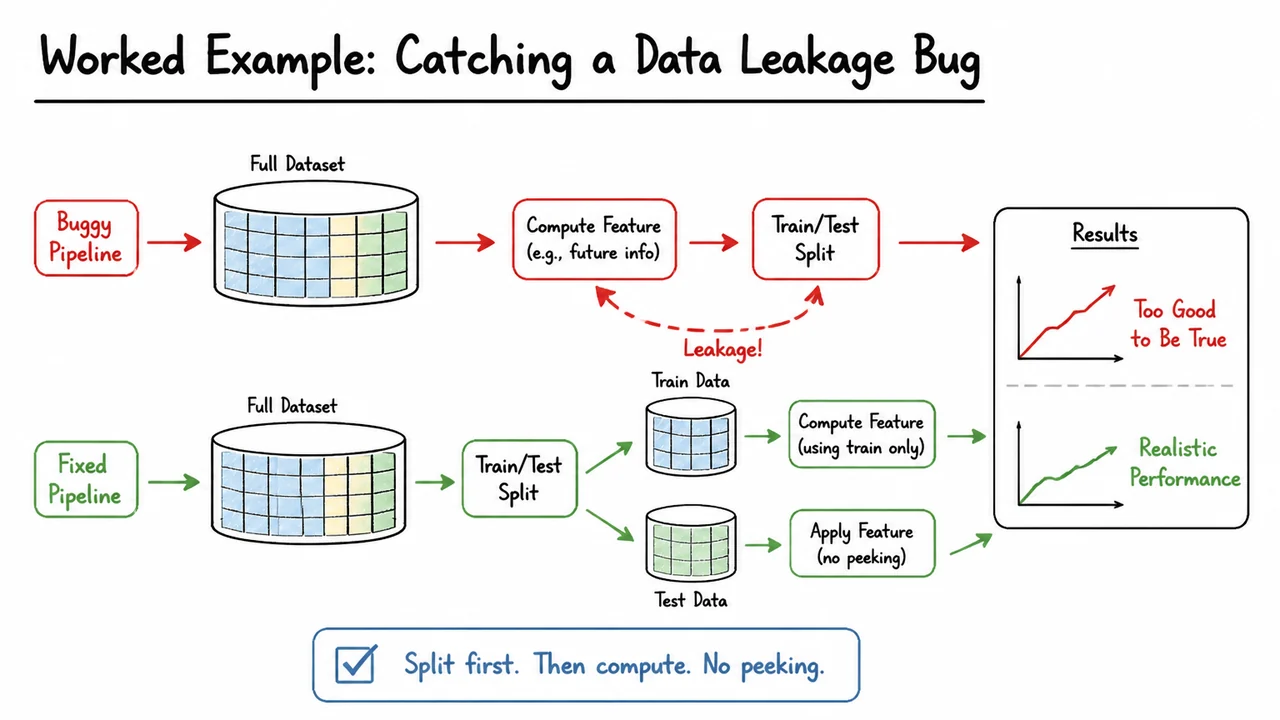
The minimal mental model is: fit only on train, transform everywhere. That sounds simple, but it has teeth only if the harness enforces it mechanically. For example, suppose we compute the mean and variance of every feature on the full dataset before splitting. Then a standardization step becomes contaminated by evaluation statistics. Even though the transformation is “unsupervised,” it has still seen the test distribution, and that can change the geometry of the input space in ways that make the task easier than it should be.
A more pernicious case is target leakage through a derived feature. Imagine a feature that is supposed to summarize prior behavior, but the summary window accidentally includes events after the prediction timestamp. The feature may be highly predictive because it is effectively carrying future information. Similarly, if you build a vocabulary or categorical encoding on the entire corpus before splitting, rare labels or identifiers from the validation set can influence the representation seen by the model during training. That is not merely a bookkeeping issue; it changes the hypothesis space the model is optimizing over.
This is where assertions and invariants become more than defensive programming. The harness should encode questions like:
These checks are valuable because leakage often hides in pipeline glue rather than in the model itself. A model can be mathematically sound while the surrounding evaluation apparatus quietly invalidates the experiment.
The practical workflow for catching the bug is to force the harness to expose provenance at every step. Each artifact should know where it came from, what data it was fit on, and which split it is allowed to touch. When the evaluation metric looks suspiciously good, the first response is not to tune the model further; it is to inspect lineage. Did a transformer get serialized after seeing all data? Did a cached feature table survive across folds? Did a join use a field that should have been stripped from the evaluation set? The harness should make these answers easy to verify, not dependent on forensic guesswork.
The visual below condenses that diagnosis into a compact story: a clean data split, a suspicious path where information crosses the boundary, and the harness checks that stop the leak before the metric can be trusted. It is useful precisely because leakage is hard to reason about from prose alone; the diagram makes the forbidden flow of information concrete. Once you can see the leak as an arrow that should not exist, the role of harness safeguards becomes obvious: they are not bureaucracy, they are the mechanism that preserves the meaning of the evaluation itself.
Building on assertions and invariants , the key question is no longer whether the harness can detect something is wrong, but what kind of wrongness each check is designed to expose. In ML systems, that distinction matters because failures are often layered: a metric implementation can be mathematically correct while the surrounding pipeline is broken, or the pipeline can execute cleanly while still producing a version-dependent drift that only appears when compared against a known baseline. Testing in harness engineering is therefore not a single technique but a stack of complementary probes.
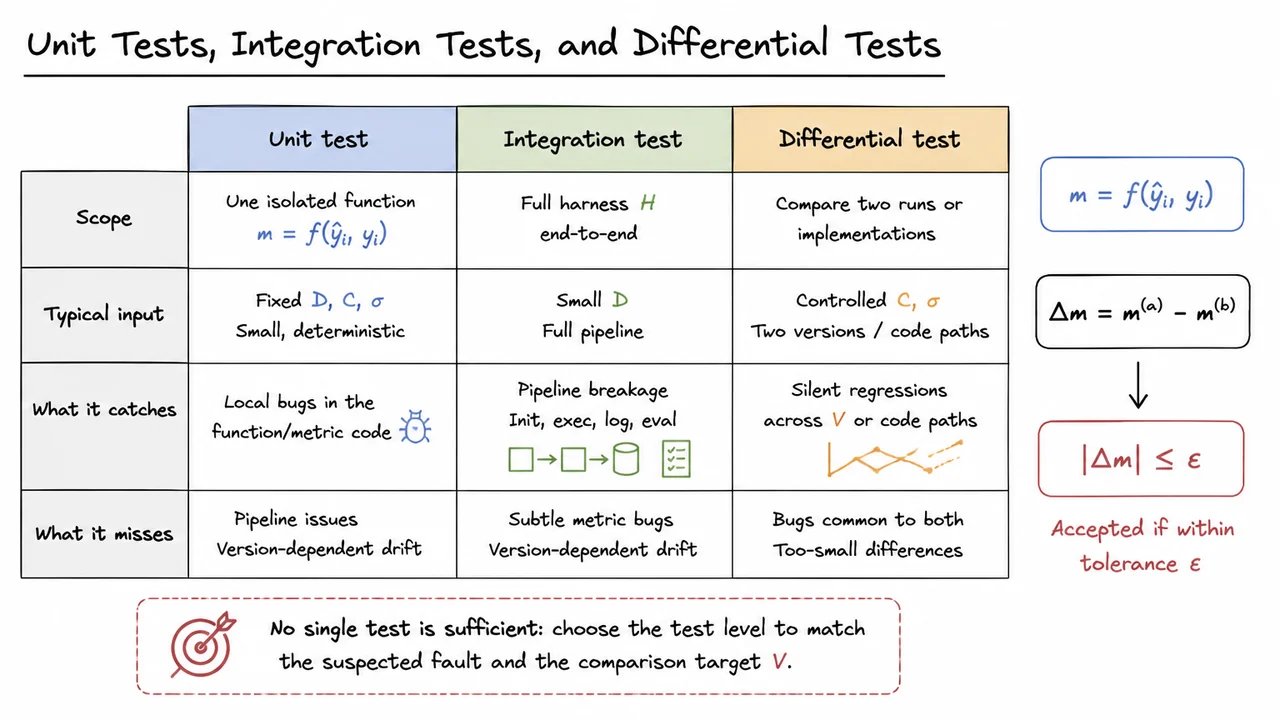
A useful way to think about the stack is in terms of scope. At the smallest scale, we want to validate one function in isolation. If the metric is defined by
then a unit test should pin down the inputs , control the environment , and eliminate randomness so that the function is judged only on its local logic. This is where you catch off-by-one errors, swapped arguments, wrong averaging conventions, dtype mistakes, and silent edge cases. The critical assumption is that the test is narrow enough that a failure points to a specific code path; if too much of the pipeline is involved, the signal gets blurred.
But isolated correctness is not enough. A metric function can be perfect and still be useless if the harness never feeds it the right predictions, logs the result in the wrong place, or evaluates a stale artifact. That is why integration tests exist: they run the full harness on a small dataset and verify that initialization, execution, logging, and evaluation all cooperate. Integration tests are less about numerical precision and more about wiring correctness. They catch broken paths, serialization issues, missing config fields, incompatible library versions, and ordering bugs that only emerge when components interact.
The third layer, differential testing, is the most ML-specific of the three because it targets regression across versions or implementations. Here the harness compares two runs, or two candidate implementations, under controlled and , and inspects the change in metric:
Instead of asking, “Is this output absolutely correct?”, we ask, “Is it sufficiently close to a trusted reference?” The comparison is accepted when
where is chosen according to the metric’s scale and the expected stochasticity. This is especially useful when a change is intended to be behavior-preserving—say, refactoring evaluation code, migrating a data loader, or swapping execution backends—and you want to detect silent drift rather than obvious breakage.
The subtle point is that each test family has a different blind spot. Unit tests are excellent at local logic bugs, but they do not tell you whether the function was called with the right tensors or whether the logs were persisted correctly. Integration tests confirm that the system runs end-to-end, but a single passing run can still hide a version-dependent shift in metric semantics. Differential tests are powerful for catching these shifts, but they require a trusted comparator and a tolerance that is neither too tight to absorb harmless noise nor too loose to miss real regressions.
That is why harness design should map the suspected fault to the test level:
This mapping is not just a convenience; it is how you keep evaluation reliable as the system evolves. Without it, teams often overuse one kind of test and under-detect the others. For example, a repository can boast extensive integration coverage while a metric bug quietly changes reported performance by 2–3 points, or it can have a beautifully tested metric function while the production harness still logs the wrong model artifact.
The visual below condenses that idea into a comparison table because the structure itself is the lesson: same harness, different fault model. The three columns correspond to three different questions the harness can ask, and the rows align those questions across scope, input, and failure mode. The differential criterion and appear as a compact reminder that regression testing is fundamentally about bounded deviation, not perfect identity.
Read the table as a decision aid rather than a taxonomy. If you suspect a local implementation bug, the unit-test column should be the one that lights up. If you suspect the evaluation job itself is malformed, the integration-test column is the right lens. And if a change is supposed to preserve behavior across code paths or versions , the differential-test column tells you whether the new run still lies within tolerance.
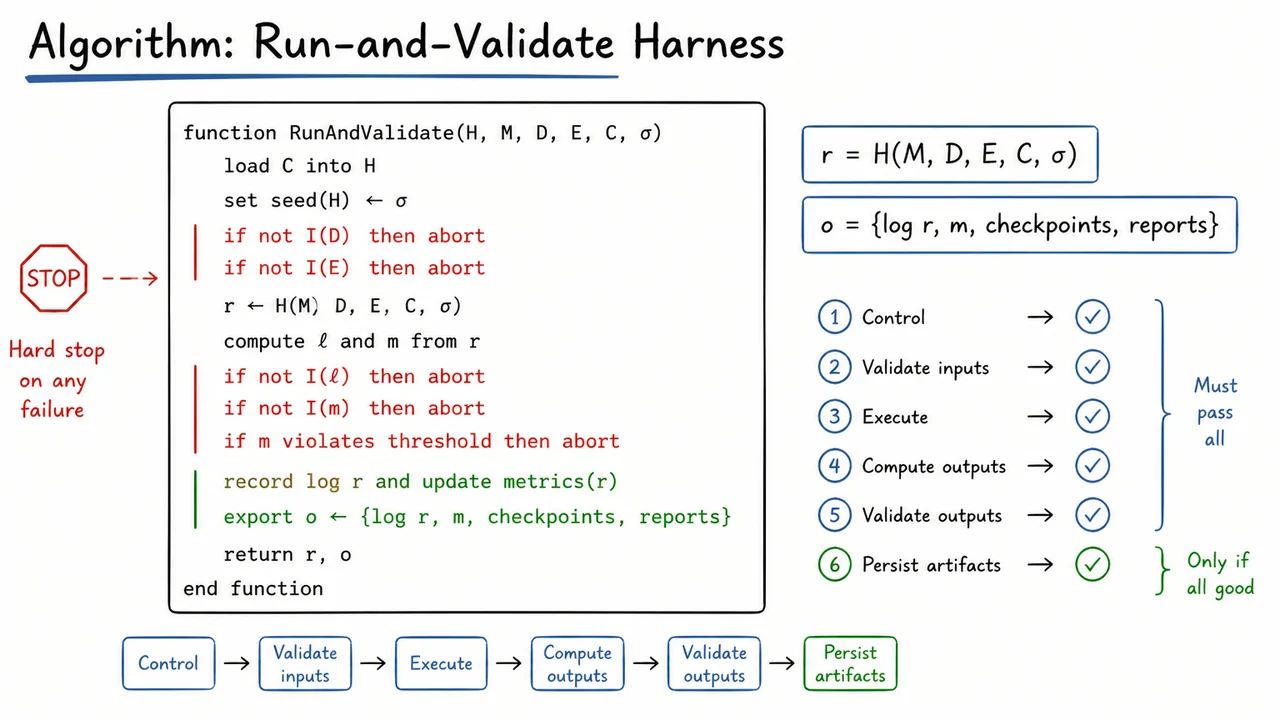
We can now turn the abstract idea of a harness into an executable control pattern. The key shift is that validation is no longer treated as a separate post-hoc step; it becomes part of the run itself. That matters because most ML failures are not “model math” failures in the narrow sense—they are pipeline failures: malformed inputs, stale configuration, seed drift, incompatible environments, metric corruption, or outputs that look numerically plausible but violate a contract.
Formally, a run is not just “the model was trained” but a controlled computation where is the harness, the model or training procedure, the data, the environment, the configuration, and the seed. This notation is important because it makes a subtle point explicit: the harness owns the execution context. The model is only one input to the process. If we let touch files, random generators, metrics, or logging directly without oversight, then reproducibility and failure detection become accidental properties rather than guarantees.
The run-and-validate pattern therefore has a specific order. First, load configuration into the harness and set the seed. Then validate the inputs—both data and environment. Only after those checks pass do we execute the model. After execution, we compute outputs and derived quantities, then validate those outputs before anything is persisted. That ordering is not cosmetic; it is the difference between a harness that can prevent bad evidence from being recorded and one that merely documents a failure after the fact.
A compact way to think about the control flow is:
This sequencing protects against several common failure modes. If is corrupt or incomplete, the run should abort before training begins. If is incompatible—say, a library version changes numerical behavior or a GPU kernel differs unexpectedly—the harness should stop rather than produce misleading metrics. If the computed loss or metric is invalid, missing, NaN, or outside an allowed threshold, the run must also stop. The core idea is that failure is local and immediate, not something that gets silently absorbed into logs.
That “hard stop” behavior is what separates a production-grade harness from a convenient wrapper. A permissive system often records everything and hopes downstream analysis will catch issues later, but by then artifacts may already have been exported, dashboards updated, and bad checkpoints copied into long-term storage. In contrast, a run-and-validate harness enforces a strong invariant: only a run that satisfies all critical assertions reaches logging and export. In other words, the harness does not merely observe correctness; it actively gates correctness.
This is also why the artifact contract matters. The outputs are not just model predictions. They are the full recorded result Here, preserves the execution trace, captures the validated metric state, and checkpoints and reports become trustworthy precisely because they were produced after the run cleared the harness checks. If something fails before that point, the correct outcome is not “partial success”; it is no export at all.
The visual below summarizes that control discipline as a single production loop. The boxed pseudocode is not meant to be read as source code to copy directly, but as a compact statement of the harness contract: validate inputs, execute, validate outputs, then persist. The red-marked paths emphasize the immediate abort behavior, while the green path marks the only route that reaches logging and artifact export. The two equations nearby reinforce the same logic from a systems perspective: the harness defines the run, and the run defines what can safely be stored.
Seen this way, the diagram is not just a recipe; it is an argument. It says that reliable ML evaluation is achieved by turning correctness checks into first-class control flow, so that every run either cleanly succeeds under the harness or fails early before it can contaminate the record.
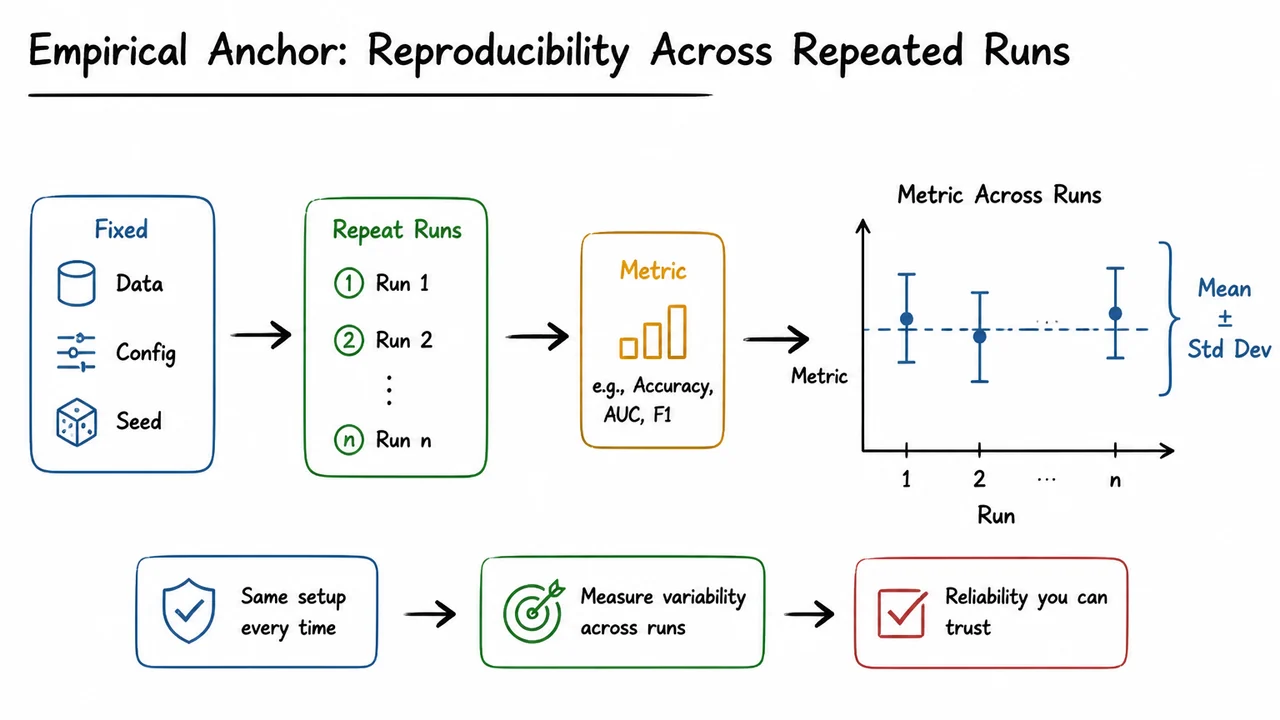
Once a harness is in place, the next question is not whether it runs, but whether it runs in a way that produces stable evidence. In ML systems, that distinction matters enormously: a single “good” result can be a coincidence, while repeated agreement across runs is often the first sign that the pipeline is actually measuring the model rather than its own randomness.
That is why reproducibility across repeated runs is an empirical anchor. It does not prove correctness by itself, but it tells us whether the harness has enough control over sources of variation to support trustworthy conclusions. If the same code path, same data snapshot, and same configuration produce meaningfully different outcomes from run to run, then the system is still too noisy to support regression detection, ablation studies, or even honest model comparison.
The subtle point is that reproducibility is not binary. In real ML workflows, you rarely get identical numbers unless you deliberately freeze every source of stochasticity and nondeterminism. Instead, you should ask whether the variation is small, explainable, and bounded. For example, a tiny fluctuation from floating-point reduction order may be acceptable; a large swing in validation accuracy is a sign that your harness is leaking randomness somewhere in the stack.
This is why robust evaluation harnesses treat randomness as something to be managed, not ignored. Common sources include:
A good harness makes these sources explicit. It should record the exact seed, data version, code version, and environment metadata for every run, and it should make it easy to rerun the same experiment without changing anything except the intended variable. If the harness does its job, then repeated runs become a diagnostic tool: they reveal whether observed differences are due to the model or merely due to the surrounding machinery.
There is also an important statistical interpretation here. If the variance across repeated runs is large relative to the effect you are trying to measure, then the experiment is underpowered. In that case, the right answer is not to overfit your interpretation to the best run, but to improve the harness or to aggregate more runs. This is especially important when comparing two model variants whose true difference is small; without repeatability, a “winner” may simply be the luckier sample of the random process.
A production-ready harness therefore needs a reproducibility protocol, not just a script. At minimum, it should:
These safeguards do not eliminate variability in principle, but they make variability legible. Once you can explain run-to-run differences, you can decide whether they are acceptable noise or actionable instability. That is the practical value of reproducibility: it turns a vague feeling of “this seems flaky” into a concrete engineering signal.
The visual below compresses that idea into a compact empirical story. It treats repeated runs as parallel probes of the same pipeline: when the harness is healthy, the outputs cluster tightly around a stable result; when something is leaking randomness, the spread widens and the signal becomes harder to trust. In that sense, the diagram is not just decorative—it summarizes the central lesson that repeatability is evidence of harness quality, and that evidence is what makes downstream regression analysis possible.
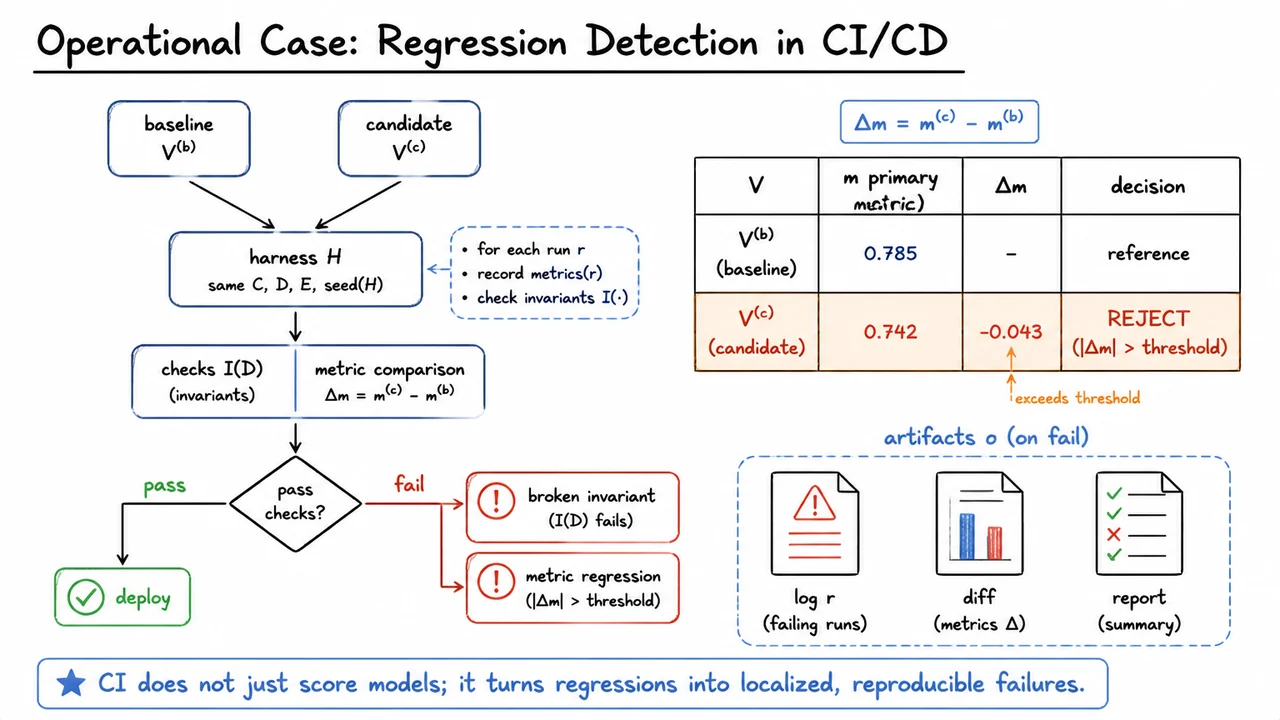
Once the harness has established that repeated runs are stable, the next question is operational rather than statistical: how do we turn that stability into a gate that catches bad changes before they ship? In CI/CD, the goal is not to “score” a model in the abstract. It is to compare a candidate version against a baseline under the same harness conditions so that any difference is attributable to the code or data change, not to uncontrolled noise.
That requires holding the comparison fixed along the dimensions the harness controls: the configuration , the dataset slice , the execution environment , and the harness seed . If those drift, then a metric delta is ambiguous. A worse score could reflect a real regression, but it could just as easily come from a different tokenizer version, a changed preprocessing rule, a nondeterministic GPU kernel, or a reordered evaluation set. The harness exists precisely to make the comparison causal instead of merely correlational.
The operational rule is simple: first check invariants, then interpret metrics. Let denote the critical constraints that must hold for the run to be trusted at all—schema checks, label alignment, input validity, shape constraints, leakage checks, and any domain-specific sanity tests. If fails, then is not trustworthy, because the candidate was not evaluated on a valid input regime. In that case the build should stop immediately, before deployment and often before even bothering to compare scores.
If the invariants hold, then the harness can treat metric movement as evidence. A common choice is the signed difference This is intentionally modest: the point is not to make the comparison fancy, but to make it traceable. The acceptance rule is typically threshold-based. If exceeds the tolerated bound, the candidate is rejected even if nothing “crashes.” That is important, because many production regressions are quiet: a small change in ranking quality, calibration, latency, or recall can be enough to hurt users even though the pipeline still runs end to end.
There are two distinct failure modes here, and a good harness separates them cleanly:
This distinction matters for debugging. A broken invariant usually points to data plumbing, preprocessing, or environment drift. A metric regression usually points to a model change, feature shift, or subtle training/evaluation mismatch. Collapsing both into a single “failed build” obscures the diagnosis and slows down response.
The other essential piece is artifact generation. When the harness rejects a candidate, it should export actionable evidence: failing logs, metric diffs, and the exact / pair needed to reproduce the issue. Without these artifacts, CI becomes a dead end—you know something regressed, but not why. With them, CI becomes a controlled experiment: every failure is localized, reproducible, and inspectable.
This is why harness engineering is a first-class ML systems problem. The harness is not just a wrapper around evaluation; it is the mechanism that turns uncertain model behavior into a binary operational decision backed by evidence. In practice, that means the CI pipeline is enforcing two levels of protection at once: it blocks invalid runs through invariants, and it blocks degraded-but-valid runs through metric thresholds.
The visual below condenses that logic into one compact workflow. The left side emphasizes the controlled comparison: baseline and candidate both enter the same harness, the same checks are applied, and the outcome splits into pass or fail. The right side summarizes the numerical decision with a tiny baseline/candidate table and the corresponding , making it clear how a metric difference becomes a release decision rather than just a report.
The artifact stack at the bottom is the operational punchline. It reminds us that the output of CI is not merely “green” or “red,” but a set of reproducible materials that let engineers trace the regression back to the exact run. That is what makes CI/CD a reliable ML safeguard instead of a fragile scoreboard.
By the time a team has a working model, the tempting mistake is to treat the surrounding evaluation code as “just glue.” In practice, the harness is where many of the most expensive ML failures are born: a model appears to improve because the validation split leaked, a metric changes because preprocessing drifted, or a regression sneaks through because the benchmark was not reproduced exactly. Harness engineering is the discipline of making those failures hard to express and easy to detect.
At a high level, a harness is the contract between what you intend to measure and what actually gets executed. That contract has to isolate the model from everything else that can vary: the data snapshot, random seeds, environment versions, metric definitions, and even the way results are logged and compared. If any one of those pieces is implicit, the system becomes fragile. Two runs that “should” be identical may differ for reasons that have nothing to do with model quality.
A useful mental model is to think of the harness as controlling three sources of noise:
The goal is not to eliminate all variation—that is impossible in real systems—but to make every meaningful source of variation explicit. Once a source is explicit, it can be versioned, tested, and audited. Once it is implicit, it becomes a debugging tax paid later under deadline pressure.
That is why a production-ready harness starts with configuration as a first-class artifact. The harness should be able to answer: which dataset snapshot was used, which model artifact was evaluated, which preprocessing pipeline was applied, which metric implementation ran, and under which runtime settings? If those choices live only in command-line history or notebook state, reproducibility becomes accidental. A stronger design stores them in a structured config, checks them into version control, and records the resolved values with every run.
Reproducibility also depends on seeding, but seeding is often misunderstood as a magic wand. It is only effective when the entire execution path is compatible with determinism. That means controlling pseudo-random number generators across libraries, fixing data-ordering behavior, and being aware of GPU or distributed operations that may remain nondeterministic. The practical rule is: seed what you can, and detect what you cannot. If a pipeline cannot be fully deterministic, the harness should at least quantify run-to-run variance and make regressions visible relative to that baseline.
The next pillar is logging, but not the vague “print some metrics” kind. A good harness logs enough structure to reconstruct the run later: inputs, outputs, timestamps, version hashes, hyperparameters, intermediate summaries, and any assertion failures. This is especially important when validation or offline evaluation sits between training and deployment. Without rich logs, you can tell that a score changed; with them, you can usually tell why it changed. In other words, logs are not merely for observability—they are the memory of the harness.
The most underrated component is assertions. Metrics are descriptive; assertions are preventative. A metric may tell you that accuracy dropped by 0.7 points, but an assertion can stop the pipeline when class coverage collapses, when label distributions drift beyond tolerance, when example counts unexpectedly change, or when a supposedly immutable dataset hash no longer matches. Assertions encode invariants about the system, and those invariants are often more valuable than the final score itself.
Versioning ties all of this together. A harness without versioned datasets, feature schemas, evaluation code, and metric definitions cannot answer a basic question: what exactly was compared to what? This matters because many failures are not model failures at all—they are artifact mismatches. A model trained on one feature schema and evaluated on another may look “bad” while simply being miswired. Versioning makes the comparison space explicit and therefore testable.
A minimal but production-ready harness usually has the following shape:
The best harnesses also define clear boundaries between training, validation, and offline evaluation. Training can be stochastic and exploratory; validation should be stable enough to compare checkpoints; offline evaluation should be the most controlled of all, because it is often used for release decisions. If those boundaries blur, teams end up optimizing for whichever number is easiest to move, rather than for actual deployment quality.
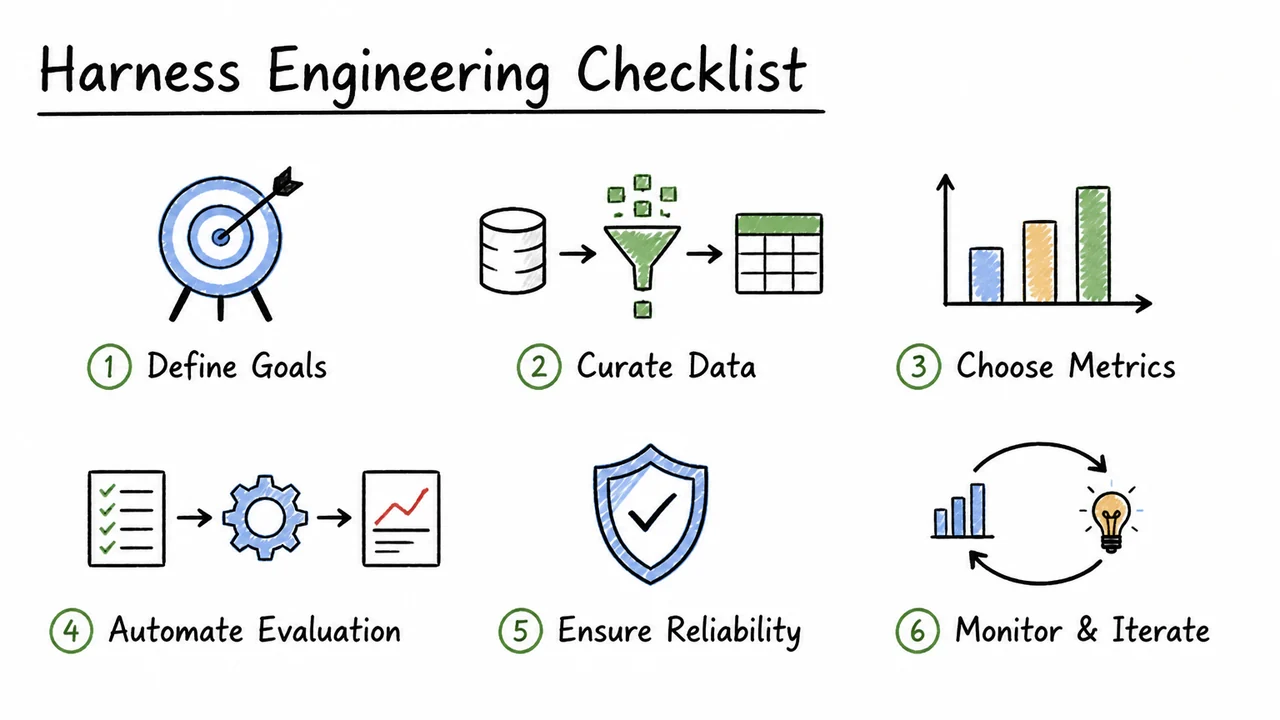
The visual below condenses this checklist into a compact systems view: the harness sits between model code and the surrounding environment, with configuration, seeding, logging, assertions, and versioning acting like guardrails around the pipeline. That structure is the point. A reliable evaluation harness is not a single script; it is a set of explicit control surfaces that make comparison meaningful and failure modes legible. Once you can see those surfaces together, the larger lesson becomes clear: in ML systems, measurement infrastructure is part of the model’s reliability story, not an afterthought.