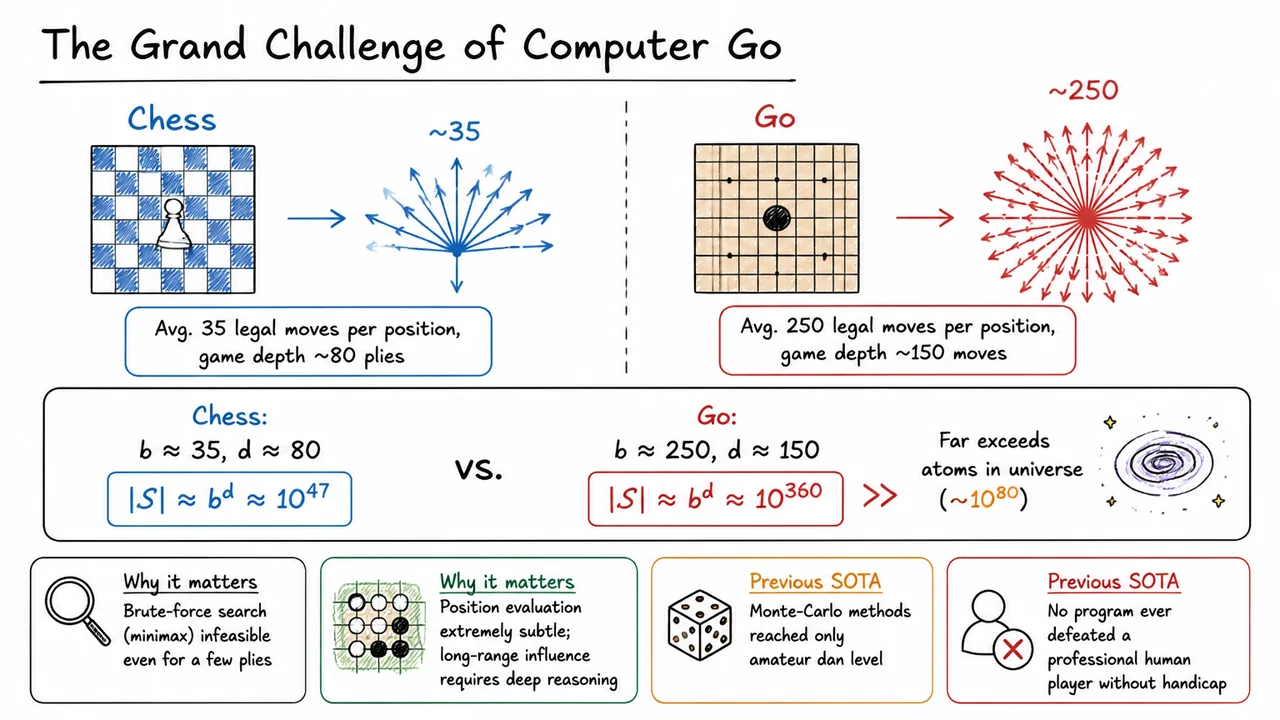
For decades, building a computer program that could play Go at a competitive level stood as one of the most tantalizing unsolved problems in artificial intelligence. The game seems straightforward—two players alternately place black and white stones on a 19×19 grid—but beneath this simplicity lies a combinatorial explosion that makes brute-force reasoning utterly impotent. The fundamental difficulty is not a lack of hardware, but the sheer scale of the search space, which forces us to rethink what it means to evaluate a position and to select a move.
To appreciate the magnitude of the challenge, consider the raw numbers. In a typical Go position, a player must choose among roughly legal moves. A full game lasts around moves. If we naively multiply these to estimate the total number of possible board states, we obtain an astronomical figure:
Even if we could examine a trillion states per second, the age of the universe would be a negligible fraction of the time required to explore a meaningful portion of this space. The estimated number of atoms in the observable universe—a mere —is dwarfed by Go’s state-space by some 280 orders of magnitude. This is not just a “hard” problem; it is a category of scale that resists any approach based on exhaustive enumeration.
The crushing complexity of Go becomes even clearer when contrasted with chess, the historical benchmark for game-playing AI. Chess offers an average branching factor of and a typical game length of plies, yielding a state-space estimate around
Though is still an enormous number, it is over three hundred orders of magnitude smaller than Go’s . This gap has profound practical consequences. In chess, deep minimax search combined with clever pruning and endgame tables enabled programs to outplay human champions by the late 1990s. In Go, however, even a three‑ply search from a mid‑game position would require billions of evaluations, and the tree continues to explode with each additional move. The minimax–alpha‑beta paradigm, so successful in chess, is effectively useless here.
The difference is not merely quantitative. In chess, material balance provides a reliable heuristic signal; a queen is almost always better than a pawn. In Go, the value of a stone depends on subtle, long‑range interactions that unfold across the entire board. A group that appears solid may become vulnerable thirty moves later due to a distant opponent stone that has been quietly exerting influence. Position evaluation in Go demands a kind of holistic, almost intuitive reasoning that statistical or rule‑based evaluations have historically failed to capture. This conceptual depth is what allowed strong amateur players to easily defeat the best computer programs for many years.
Before the advent of deep neural networks, state-of-the-art Go programs relied on Monte‑Carlo methods—randomized playouts from a position to estimate the winning probability of each move. This approach could occasionally produce surprising configurations, but it plateaued at the level of a strong amateur. No program ever defeated a professional human player in an even game; the best systems required large handicaps to be competitive. The inference was clear: generating random sequences of moves, even with clever biases, could not substitute for a genuine understanding of the game.
The story of Go therefore encapsulates a classic AI dilemma: how do you make decisions in a domain whose complexity annihilates search-based methods and whose evaluation function cannot be written down by human experts? The solution—the marriage of deep neural networks with tree search—required learning to imitate human moves, learning to evaluate positions from self-play, and then fusing these learned capabilities inside a non‑brute‑force search algorithm. The following sections will unpack each piece of that pipeline, but first we need to internalize exactly why this challenge existed for so long.
The visual below distills this entire argument into a side‑by‑side comparison that makes the exponential gap visceral. On the left is chess, with its modest branching and manageable state‑space; on the right, Go explodes into a branching tsunami of possibilities. The diagram’s color coding—calm blue/green for chess, aggressive red/orange for Go—reinforces the impossibility. The callout formulas versus anchor the abstract numbers, and the tiny icon of the observable universe next to Go’s estimate serves as a humbling reminder that even the entire physical cosmos is many orders of magnitude too small to contain all possible Go boards. By presenting the data graphically, the slide transforms an already staggering numerical comparison into an intuitive recognition: to conquer Go, we need to stop searching the universe and start learning it.
The sheer branching factor of Go—far exceeding that of chess—makes exhaustive search impossible. To tackle this, the community turned to Monte‑Carlo methods, eventually converging on a framework that could navigate the immense search space without looking even a handful of moves ahead in the traditional minimax sense. That framework is Monte‑Carlo Tree Search (MCTS), and it became the backbone of every strong computer Go program in the decade before AlphaGo. To understand why those programs ultimately stalled, we need to understand exactly how MCTS works and where the information that drives it comes from.
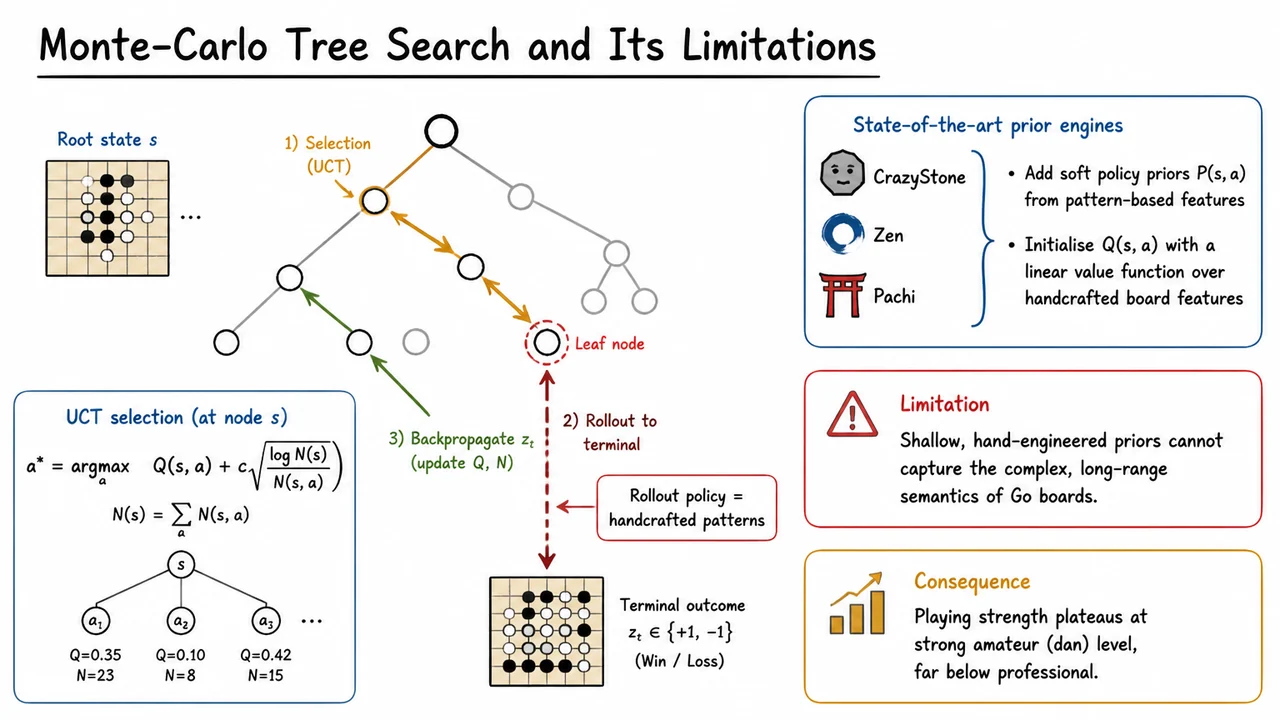
At its heart, MCTS builds an asymmetric search tree by repeatedly sampling complete games from the current state. Each simulation consists of four steps: selection, expansion, simulation (rollout), and backpropagation. Starting from the root node , the algorithm recursively selects child actions until it encounters a node that is not yet fully expanded, or it reaches a leaf. The selection is guided by the Upper Confidence Bound for Trees (UCT) formula, which treats each state–action pair as a multi‑armed bandit problem:
Here is the estimated value of taking action in state (initially zero or a heuristic), counts how many times that action has been tried from , and is the total number of visits to the node. The constant balances exploitation of arms with high average reward against exploration of less‑tried actions. Once a leaf node is selected, it is added to the tree (if not terminal), and a rollout is performed: a lightweight policy plays moves—often uniformly at random, or using a few handcrafted rules—until the game ends, yielding a binary win/loss outcome . That outcome is then backpropagated up the path, incrementing visit counts and updating values for every edge traversed. After many simulations, the action with the highest visit count (or highest ) becomes the engine’s move.
This elegant scheme, by itself, produces a weak Go player. Random rollouts are blind to even elementary tactical motifs, and the resulting value estimates are extremely noisy. To improve performance, pre‑AlphaGo state‑of‑the‑art engines such as CrazyStone, Zen, and Pachi augmented MCTS in two crucial ways. First, they introduced soft policy priors , often derived from pattern‑based features that capture local stone configurations. These priors bias the UCT selection toward moves that are deemed promising before any rollouts take place, typically by initializing visit counts or blending the prior into the exploration term. Second, they replaced the purely empirical —which is not even defined for unvisited actions—with a linear value function over hand‑engineered board features. That function gives every action a reasonable starting estimate, greatly reducing the number of simulations needed to separate good moves from bad ones.
These enhancements pushed playing strength into strong amateur (dan) territory, and for a time it seemed that the limiting factor was simply the number of simulation rollouts per move. Yet even with massive computational resources, progress stalled. The fundamental limitation is that the priors and value functions were shallow and handcrafted. Pattern‑based priors only consider local correlations—shapes like ladders, nets, and common corner sequences—while a linear value function can at best approximate a linear combination of explicitly programmed features. Go is a game defined by global interactions: a single stone played on the opposite side of the board can transform the status of a distant group dozens of moves later. Handcrafted features cannot capture such long‑range semantics, nor can they automatically reconfigure themselves to new strategic contexts. The result is a knowledge ceiling: the engine cannot generalize beyond what its human designers explicitly encoded.
This ceiling manifests concretely. The linear value function, even when fed hundreds of thousands of labeled game positions, will fail to represent the nonlinear evaluation of whole‑board situations; it will mis‑evaluate moyo (frameworks of influence), subtle life‑and‑death problems, and complex ko fights unless a feature engineer anticipates them. The soft policy prior, though useful as a local suggestion, is static and cannot adapt its recommendations based on the global state. Consequently, playing strength plateaus well below professional level—the 1‑dan to low 7‑dan range—and no amount of CPU doubling can bridge the gap. The search algorithm itself is not the obstacle: MCTS provides a principled way to combine exploration and exploitation. The bottleneck is the quality of the evaluation function that sits at the leaf nodes and the prior knowledge that guides the search.
The visual below captures this state of affairs in a single schematic of a Monte‑Carlo tree search simulation. On the left, a small Go board icon marks the root state; a bold gold path traces the UCT selection down to a leaf node, where the search is about to reach the boundary of what has been explored. From that leaf, a dashed red rollout arrow descends into a terminal board showing a final win/loss outcome, labeled “Rollout policy = handcrafted patterns,” emphasizing the reliance on shallow, local heuristics. Green backpropagation arrows then flow backward along the tree, updating and values. An inset equation box displays the UCT formula next to a miniature tree annotated with and , reinforcing the mechanics of exploration–exploitation. Crucially, the diagram highlights an absence: a dashed red circle around the leaf node marks the spot where, in later slides, a deep value network will be substituted—but here it remains empty, a node evaluated only by the average of noisy random samples and a linear heuristic. That gap between what the engine can see and what the game demands is precisely why traditional MCTS, for all its ingenuity, could never break into professional‑level play.
In the previous section we examined Monte‑Carlo Tree Search (MCTS) and the reasons it struggled to conquer the 19×19 board. MCTS builds a search tree by iteratively selecting promising nodes, expanding the tree with random rollouts, and propagating the outcome back up. The fundamental bottleneck is the quality of the leaf evaluation. Random rollouts are computationally cheap per step, but they require thousands of playouts to reduce variance, and even then the signal remains noisy. Worse, in Go the branching factor is enormous (~250 legal moves per turn), so any tree search that relies on blind sampling quickly spreads its budget too thin. MCTS works decently for small‑scale problems, but on a full board it lacks the depth and positional judgement to match human experts—let alone to beat them.
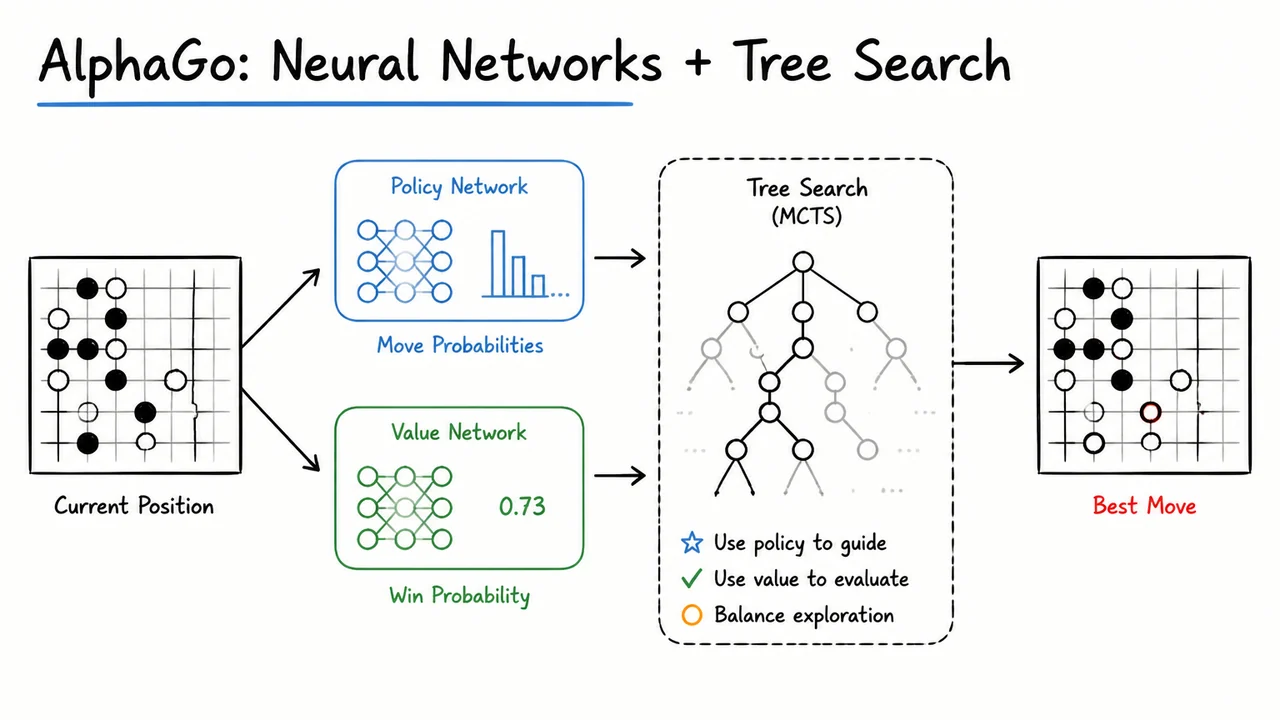
The key insight of AlphaGo is that the shortcomings of MCTS can be overcome by injecting learned intuition directly into the tree search. If a lightweight neural network can tell us which moves are worth exploring and approximately how good any board position is, then the search can focus its computation on the most promising lines, simulating far fewer rollouts while gaining more accurate evaluations. The architecture that emerges is a symbiotic pairing: a policy network narrows the search by proposing a small set of candidate moves at each node, and a value network provides a fast, position‑specific estimate of the win probability without requiring a single random rollout. Together they transform MCTS from a brute‑force sampling algorithm into a knowledge‑driven planner.
The policy network is trained to imitate human expert play—it takes the current board state as input and outputs a probability distribution over legal moves. During the tree search phase (the APV‑MCTS variant, short for Asynchronous Policy and Value MCTS), this distribution is used to bias the selection step. Instead of exploring all legal moves uniformly, the search algorithm preferentially expands moves with higher prior probability, effectively pruning the tree before any simulations are run. This alone dramatically sharpens the search: the algorithm spends its limited rollout budget only on moves that are plausible under human‑like judgement.
Complementing the policy network is the value network, which predicts the game’s eventual outcome for any board position—typically as a single scalar representing the probability that the current player will win. When the tree search reaches a previously unvisited leaf node, instead of launching a slow Monte‑Carlo rollout from that state, AlphaGo queries the value network. The result is a low‑variance estimate that captures long‑range strategic patterns rollouts cannot, because rollouts must play out the remainder of the game with random moves, often devolving into tactical blindness. The value network, trained on millions of self‑play games, learns to recognize subtle territory balances and life‑and‑death statuses that would take thousands of rollouts to deduce by chance.
The synergy between policy and value networks inside MCTS follows a clear algorithmic rhythm. During selection, each edge accumulates a visit count and an action value, but the prior from the policy network strongly steers the upper‑confidence‑bound formula. When a new node is expanded, the value network is evaluated once, and its prediction is backed up through all ancestor nodes, much like a rollout result. This means the tree grows deep in the most promising directions, while the value network’s fast, global evaluations provide a stable reward signal. The combination lets AlphaGo allocate its thinking time where it matters, achieving a level of play far beyond what either component could reach in isolation.
The visual below, titled “AlphaGo: Neural Networks + Tree Search,” condenses this integration into a readable schematic. It typically shows the tree structure with a node being expanded, an arrow from the policy network feeding move probabilities into the selection step, and an arrow from the value network feeding a position evaluation into the backup phase. This diagram captures the essence: neural networks supply the what (which moves to consider) and the how good (resulting position value), while the tree search provides the where (which lines to explore deeper) and the how to combine evidence across many look‑ahead paths. The image becomes a compact summary of why AlphaGo’s search is not just “better MCTS” but a fundamentally different hybrid that leverages both data‑driven pattern recognition and principled planning.
What makes the diagram especially instructive is the way it emphasizes the loop: the policy network is not frozen after training; it continues to guide the search, and the search’s aggregated visit counts can be fed back to improve the policy in later reinforcement‑learning stages (though that falls under subsequent sections). For now, the picture reinforces that every MCTS phase—selection, expansion, simulation, backup—has a neural‑network counterpart, making the search far more efficient. This fusion allowed AlphaGo to evaluate only a few thousand positions per move while playing at super‑human level, a feat that stands in stark contrast to the millions of rollouts earlier Monte‑Carlo Go programs required for barely intermediate play.
Before AlphaGo, Monte Carlo tree search in Go had already achieved strong amateur play, yet the search tree remained enormous: typical branching factors exceed 250 and games routinely last over 150 moves. Even with clever heuristics and pattern databases, MCTS alone could not produce a professional‑level player. The key insight of the AlphaGo project was that a learned prior over moves—what the authors called a policy network—could dramatically shrink the effective search space by focusing MCTS on moves that a human expert would plausibly consider. The first training stage defines this prior purely from human games, without any self‑play or reinforcement, through supervised learning (SL).
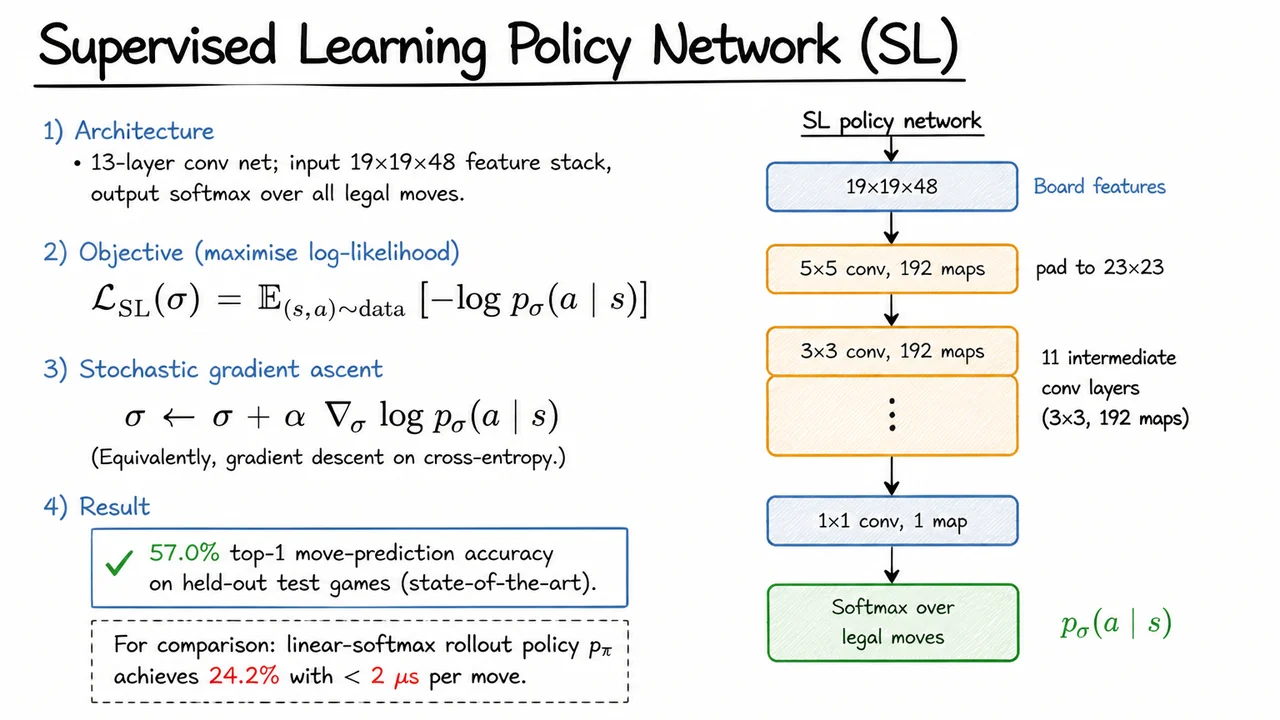
The SL policy network is a 13‑layer convolutional neural network that takes as input a feature stack encoding the raw board state (stone positions, liberties, captures, and a few historical planes) and outputs a probability distribution over all legal moves in state . The architecture is deliberately deep and purely convolutional: an initial convolution with 192 feature maps processes the board with generous padding, followed by eleven intermediate convolutions (also with 192 maps) and a final convolution that collapses to a single logit map. A softmax over the spatial grid then yields a move probability for each board intersection. This design respects translational equivariance—a principle that is natural for Go—and uses ReLU nonlinearities throughout, which help optimization in deep networks.
Training is cast as a maximum likelihood estimation problem on a massive dataset of approximately 30 million expert positions, sampled from the KGS Go Server and other human sources. For each state–action pair in the dataset, we wish to maximize the log‑probability that the network assigns to the human move . This is equivalent to minimizing the cross‑entropy between the expert’s empirical action distribution (a one‑hot vector) and the network’s predicted distribution. The per‑example loss function is the negative log‑likelihood:
where the expectation is over the empirical data distribution. Parameters are updated by stochastic gradient ascent on the log‑likelihood:
which is, up to sign, gradient descent on the cross‑entropy objective. This update drives the network to make the expert move more likely under , directly matching the intuition that the network should mimic human decision‑making.
Training for approximately three weeks on a cluster of 50 GPUs produced a policy network that achieved a top‑1 move prediction accuracy of 57.0% on a held‑out test set of professional games. This number is remarkable when you consider that the average legal move in a typical position is one out of roughly 200 possibilities, and even professional players do not agree on a single “best” move in many situations. For comparison, a fast linear‑softmax rollout policy , which uses a much simpler set of features and completes a move evaluation in under 2 microseconds, reached only 24.2% accuracy on the same task. The SL policy therefore extracts a far richer signal from the board, and that signal directly quantifies how human‑like a candidate move is—a perfect ingredient to guide tree search.
The purpose of this stage is not to produce a standalone superhuman player. Even with 57% accuracy, the SL network alone plays at a weak amateur level, largely because it models human decision‑making without any lookahead. Instead, its true value lies in providing a strong initialisation for subsequent reinforcement learning and an effective action prior for MCTS. By learning from millions of expert games, the network internalises a vast number of tactical patterns and strategic principles, compressing them into a fixed‑size function that can be queried in milliseconds. This enables the later RL stage to start from a policy that is already competent, avoiding the need to explore the full combinatorial expanse of Go from scratch.
The visual below consolidates the architecture and the learning principle into a single readable scheme. On one side, the convolutional pipeline is drawn as a vertical stack: the input feature “cube” at the bottom, the initial layer, a repeated stack of layers with an ellipsis, and the final convolution that feeds into the softmax. Labels like “” next to the softmax block make the output interpretation explicit. On the other side, the two core equations are presented in large font, emphasising that the entire deep net is trained end‑to‑end by stochastic gradient ascent on the log‑likelihood of the expert action. This compact graphic reminds us that the architecture’s complexity is entirely driven by the need to approximate a high‑dimensional conditional probability, and that the resulting 57% accuracy is a tangible measure of how well the network succeeds in encoding human Go knowledge.
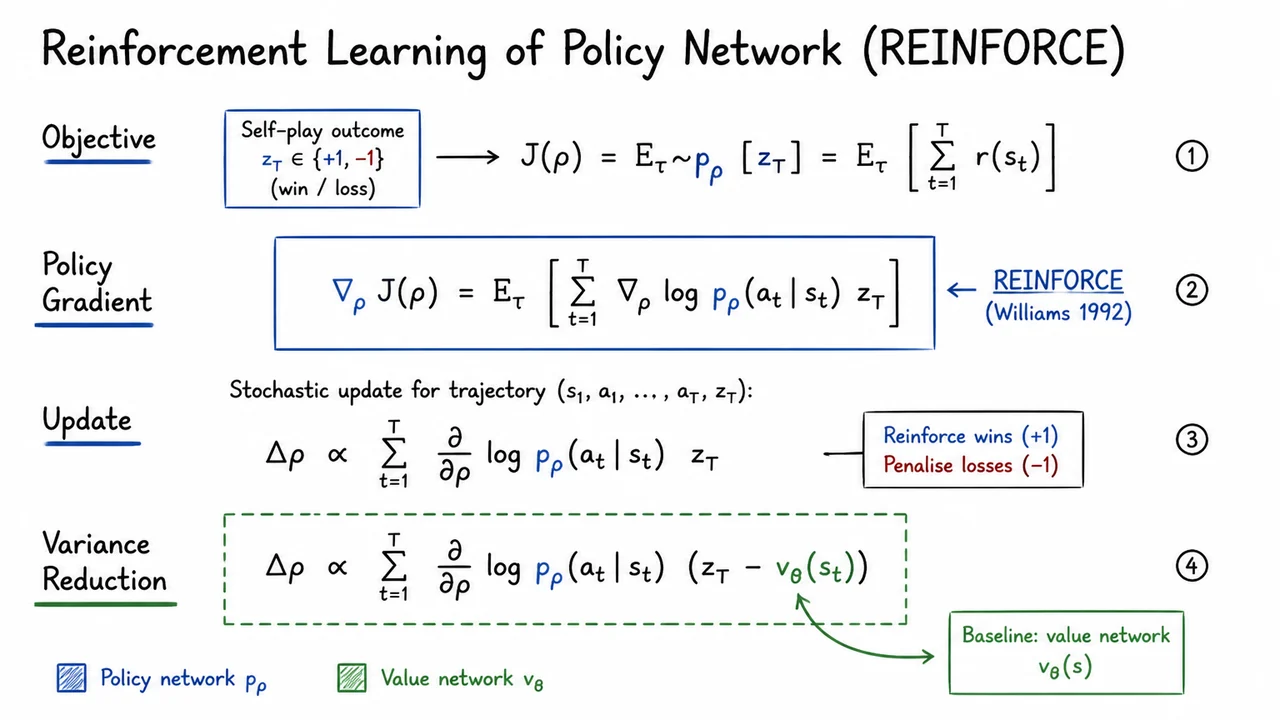
The supervised policy network we examined previously learns to imitate human experts—a powerful first step, but insufficient by itself. A policy that merely replicates human play will never move beyond the consensus of its teachers. To reach superhuman strength, we must let the network explore and discover moves that are not merely human-like, but winning. This is where reinforcement learning enters: we treat self-play games as episodes where the only reward is the binary terminal outcome (win or loss). The objective is to maximise
with for all non‑terminal states and . Because intermediate moves offer no immediate reward, the optimisation landscape is sparse—every decision in a game receives exactly the same scalar feedback: the final result. The challenge is to assign credit to individual moves across hundreds of time steps.
A classic solution is the REINFORCE algorithm, which directly estimates the gradient of the expected return with respect to the policy parameters . For a trajectory sampled from the current policy , the gradient is
Each action’s log‑probability is multiplied by the game’s final result , so winning sequences are reinforced (the log‑probability of moves that led to a win is increased) and losing sequences are suppressed. In practice, we update the parameters after each complete game using a stochastic ascent step proportional to the sum of these per‑time‑step contributions:
While this update is unbiased, its variance can be painfully high—the same final outcome is used to adjust every move, even when a brilliant early move was undone by a blunder much later. One effective way to tame this variance is to subtract a baseline that estimates the expected outcome from state . As long as the baseline does not depend on the action (or its expectation over actions is zero), the baseline does not bias the gradient. The natural choice in AlphaGo’s architecture is the value network , which predicts the probability of winning from the current board state. The variance‑reduced update becomes
Now each move is evaluated against a state‑dependent reference point: if the actual outcome is better than expected, the move is reinforced; if worse, it is penalised—even if the overall game is won, a move that reduced the expected win probability receives a negative signal. This advantage‑style weighting accelerates learning and stabilises the policy, and it forms a tight coupling with the value network that will later be used directly in the tree search.
The visual below consolidates this derivation into a compact equation sheet—exactly the kind of reference you would keep in front of you when implementing the RL policy network. It places the objective at the top, then presents the REINFORCE gradient in a prominent, boxed expression that emphasises the product of score function and final outcome. The proportional update follows, and a dashed box highlights the variance‑reduced form with the baseline , coloured in green to contrast with the blue policy terms. Arrows and consistent colour coding make the logical flow from the maximisation goal to the practical parameter update instantly clear, reminding us that the final outcome alone drives the credit assignment, while the value network refines the signal without changing its direction in expectation.
After establishing that the policy network can be tuned through self‑play reinforcement learning using the REINFORCE algorithm, the natural next question is: how much does this tuning actually improve raw move selection?
It is tempting to measure the RL policy’s performance by plugging it into a full tree‑search engine and reporting a tournament result against other Go programs.
However, that approach would conflate the quality of the policy with the power of lookahead.
To isolate the effect of RL training, we must evaluate the policy without search – in pure head‑to‑head games where the network selects a move directly from the probability distribution over legal moves at each turn, with no roll‑outs, no tree building, and no Monte‑Carlo averaging.
Only then can we truly see how much stronger the policy’s internal representation has become.
The experiments compare three key entities:
The first and most direct comparison pits the RL policy against its own supervised predecessor.
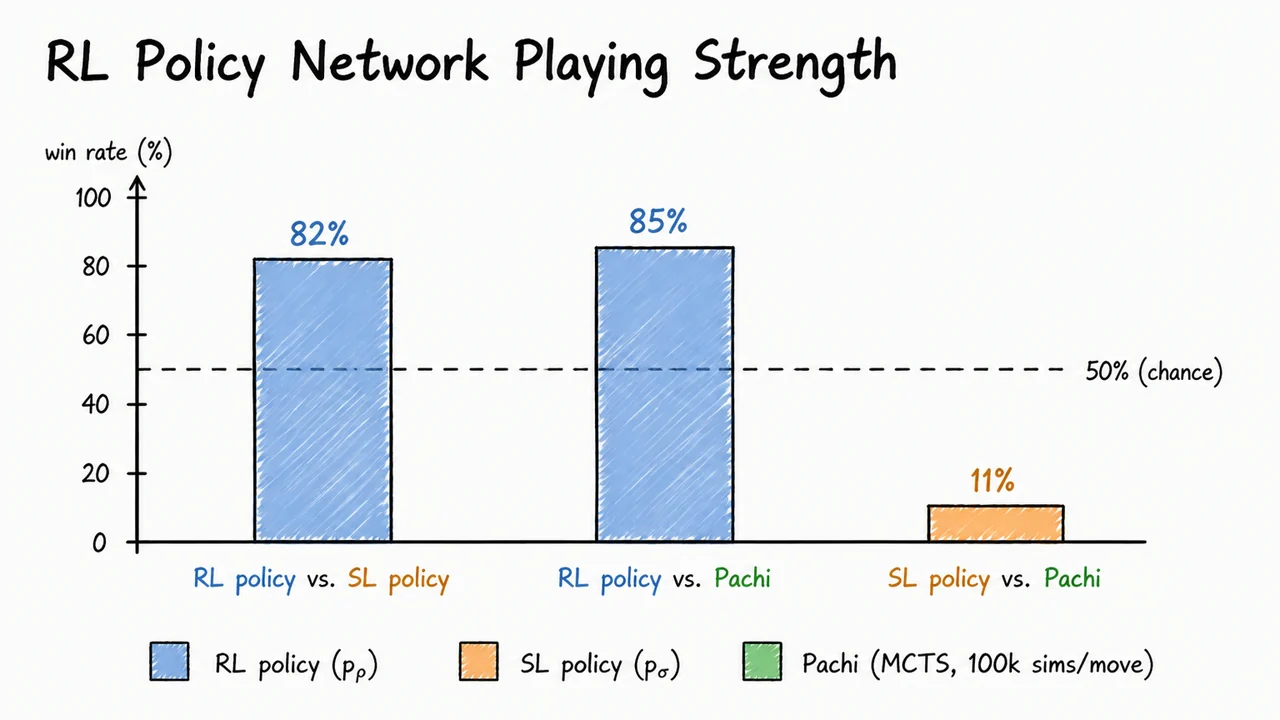
Playing without search, wins more than 80% of games against .
This is a massive leap: the supervised network, which already approximates the moves of strong human amateurs, is thoroughly outclassed by a version that has fine‑tuned its policy through millions of additional self‑play games.
The >80% win rate demonstrates that the policy gradient process is not merely memorising patterns from self‑play but genuinely discovering new strategies and correcting systematic weaknesses in the imitation‑taught prior.
A far more astonishing result emerges when we compare each policy against Pachi.
With its 100 k MCTS simulations per move, Pachi has formidable lookahead, yet the raw RL policy achieves an 85% win rate against it, again with no search whatsoever.
In stark contrast, the supervised policy manages a mere 11% win rate against the same Pachi engine.
The supervised network alone is so weak that even a conventional search‑based opponent with no deep learning can defeat it almost every game.
But after RL training, the same network architecture – now acting purely reactively – comfortably dominates Pachi.
This reversal underscores that self‑play RL has elevated the policy from a modest imitator of human moves to a near‑professional level of play without a single lookahead step.
Why is an 85% win rate over Pachi so significant?
Pachi was a top‑tier MCTS program that, through clever heuristics and large simulation counts, already played at a strong amateur dan level.
Beating it with a raw policy network means that the RL‑tuned model has internalised a positional judgement and a tactical awareness that rival what thousands of simulated roll‑outs can produce on the fly.
The policy is essentially pre‑computing what Pachi discovers only by searching.
This property is crucial for the later AlphaGo integration: a policy that can already “see” many moves ahead without search will guide Monte Carlo tree search far more efficiently than a weaker policy ever could.
The jump from an 11% to an 85% win rate also illustrates how imitation learning alone hits a ceiling.
The supervised policy tries to reproduce human moves, but humans make mistakes; moreover, the network’s capacity to generalise beyond the training set is limited.
Self‑play RL lets the policy explore states beyond the human corpus, corrects its own blunders through trial and error, and gradually sculpts a value‑aware policy that maximises the probability of winning, not just the likelihood of matching a human move.
Thus the RL policy’s raw playing strength is the first concrete proof that neural networks can, with enough compute, bootstrap themselves beyond the teacher signal.
The diagram below makes this performance gap immediately graspable.
It presents a grouped bar chart with three pairwise comparisons on the x‑axis: RL policy vs SL policy, RL policy vs Pachi, and SL policy vs Pachi.
The y‑axis shows the win rate in percent, with bars rising to roughly 82%, 85%, and 11% respectively.
A dashed horizontal line at the 50% mark separates mere advantage from clear superiority.
The blue bars for the RL policy dominate the two match‑ups where it is the active player, while the orange bar for the SL policy against Pachi barely rises above the floor, highlighting the dramatic improvement.
Data values are annotated above each bar, making the numbers impossible to miss.
The title “Playing Strength Without Search” reinforces that these victories are achieved entirely by a network that selects a single move in a single forward pass, without any tree search.
This chart serves as a compact summary of the findings: self‑play RL transforms a weak‑amateur policy into a near‑professional one, delivering an 8‑fold win‑rate increase against a strong MCTS opponent and setting the stage for the next piece of the puzzle – the value network.
Having trained a reinforcement learning policy network that can defeat the supervised-only policy 80% of the time, AlphaGo still faced a critical efficiency problem during live play. The RL policy by itself selects moves well, but Monte‑Carlo tree search (MCTS) needs evaluations of the many leaf positions it encounters, and doing this with multi‑step rollouts is computationally expensive. A natural idea is to learn a fast value network that directly predicts the expected outcome of a position – essentially compressing hundreds of simulated games into a single forward pass. But what target should this network be trained to approximate?
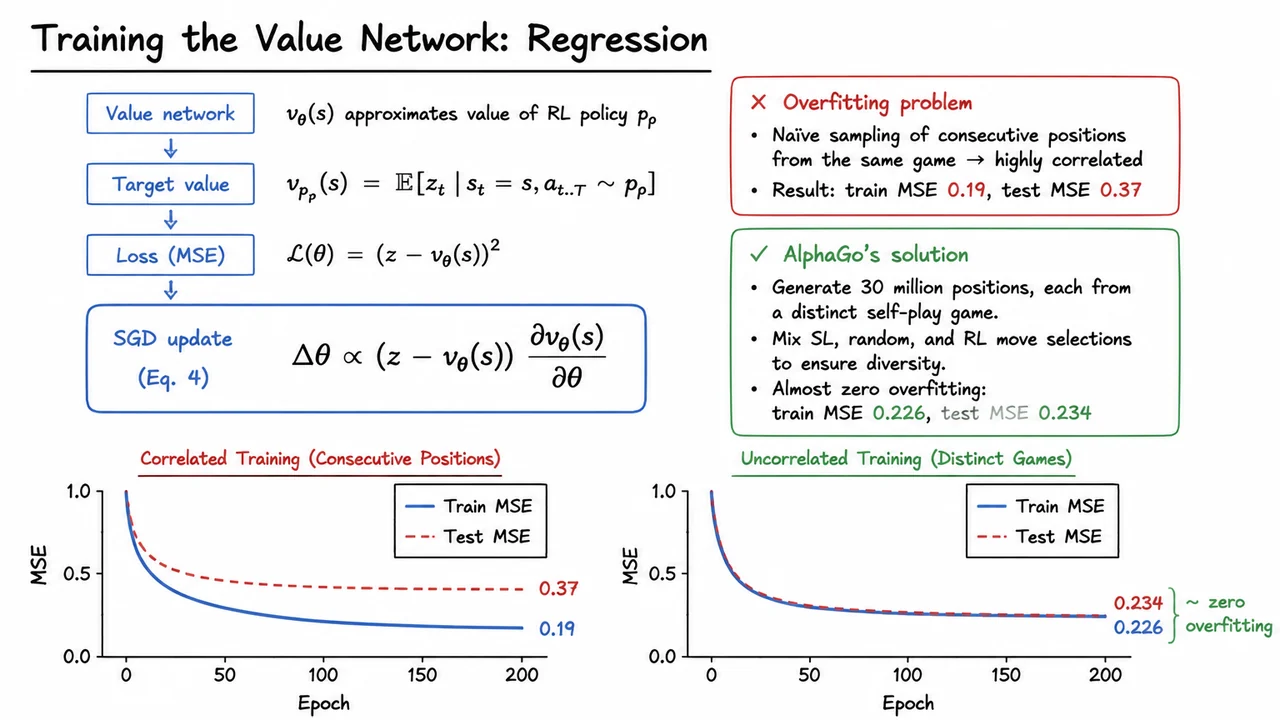
The value network does not try to estimate the optimal minimax value of a state. Instead, it aims to predict the expected outcome when both players follow the RL policy for the remainder of the game. Formally, for every board state that occurs during self‑play with the RL policy, the target is the final game outcome (win/loss). The target value is defined as the conditional expectation
where the actions from time to the terminal step are sampled from the policy . This design choice is crucial: the value network learns to judge how promising a position is given the current policy’s own style of play, not an abstract absolute goodness. During tree search, this estimate blends naturally with the policy biases that shaped the search tree, providing a consistent evaluation signal.
Training becomes a straightforward regression problem. Given a dataset of self‑play positions and their eventual outcomes , the network is trained to minimise the mean squared error:
A stochastic gradient descent update on a single example follows the familiar delta rule, scaling the gradient of the network output by the prediction error:
In practice, the minimisation is performed with mini‑batch gradient descent, but the core idea is simply to push the network’s output toward the observed outcome whenever it deviates. So far, this looks like any supervised learning task, but a subtle danger lurks in how the training examples are collected.
If we naïvely sample positions from consecutive time steps of the same self‑play game, the training set becomes heavily correlated. Adjacent board states differ by only one move, and the sequence of play often keeps the evaluation of the position stable for many steps. A neural network trained on such data quickly memorises the idiosyncrasies of the few thousand games in the buffer rather than learning generalisable features. The tell‑tale sign is a large gap between training and test error. Indeed, when AlphaGo’s team experimented with correlated sampling, the training MSE dropped to 0.19 while the test MSE stalled at 0.37 – a clear case of overfitting.
AlphaGo’s solution is disarmingly simple but demands enormous scale: create a dataset of 30 million positions, each drawn from a distinct game of self‑play. No two training examples come from the same game, which breaks temporal correlations entirely. Furthermore, the moves in these games are not generated exclusively by the RL policy; the dataset mixes positions from games where moves were selected by the supervised policy, by the RL policy, and even by random sampling, ensuring that the network sees a diverse distribution of board states. With this careful de‑correlation, the overfitting virtually vanishes: train MSE reaches 0.226 and test MSE 0.234 – a negligible gap of only 0.008.
The visual below distills this lesson into a compact diagrammatic summary. At the top, it reproduces the key equation that defines the value network’s target and the gradient update, anchoring the mathematical form of the regression objective. The lower half then presents two line plots on the same axes: the left one shows the correlated training regime, where the train curve dives optimistically while the test curve stays stubbornly high; the right one shows the uncorrelated training, where train and test metrics cling tightly together across epochs, never diverging. The stark contrast between a 0.18 overfitting gap and a 0.008 gap makes the argument for decorrelated data immediately tangible. It reminds us that in large‑scale deep learning, the statistical quality of the dataset – its independence structure – can matter as much as its sheer size.
After the value network has been trained to predict game outcomes from raw board positions, a natural question arises: how does its accuracy compare to the traditional engine of Monte Carlo tree search—the rollout? Both estimate the same quantity (the expected win rate from a given state), but they do so in fundamentally different ways. Understanding their relative strengths and weaknesses is the key to designing a hybrid evaluation function that balances speed, bias, and variance.
A rollout evaluates a leaf node by simulating a complete game to the end using a fast, stochastic policy. Because the outcome is a binary win/loss, a single rollout is essentially a noisy, unbiased sample from the true distribution of outcomes under that rollout policy. Its variance is large, but by averaging many rollouts we can drive the standard error down. The cost scales linearly with the number of simulations; in a large search tree, this cost quickly becomes prohibitive. In contrast, the value network performs a single forward pass and directly outputs a scalar win‑rate prediction. It is blazingly fast—comparable to the time needed for just a handful of rollouts—but its output may be biased because the network is an imperfect function approximator, trained on a finite dataset and potentially overfitting to the SL policy’s priors.
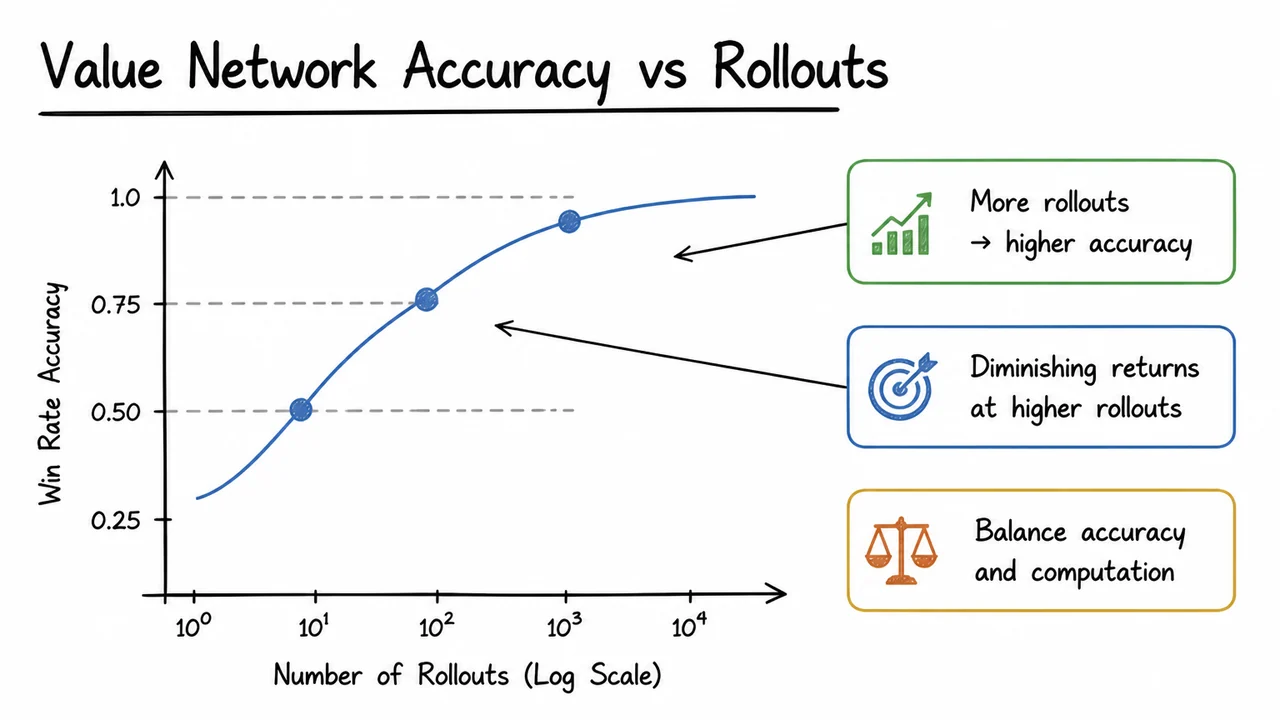
The central empirical question, therefore, is at what computational budget does the value network surpass the accuracy of rollouts, and how far does its accuracy continue to scale? A single rollout is cheap but highly variable; 1,000 rollouts are precise but expensive. Could the value network, after a careful training pipeline, achieve an accuracy that matches the average of dozens or even hundreds of rollouts? The answer determines whether the value network can replace heavy rollout evaluation or must be used only as an auxiliary signal.
In practice, the accuracy of a rollout‑based evaluation improves roughly with the square root of the number of simulations, thanks to the central limit theorem. A value network, however, offers a fixed accuracy cost: once trained, it always produces its estimate with the same computation, no matter how critical the position. This creates an asymmetric trade‑off. For quick evaluations deep in the tree, where many leaf nodes must be scored, the value network gives a low‑variance, possibly slightly biased signal at a fraction of the cost of a meaningful rollout average. For top‑level root moves, where we can afford thousands of rollouts, the high‑precision rollout average may still be valuable to correct the network’s bias.
The AlphaGo architecture reconciles these characteristics by combining the two estimates. In the search, a leaf node’s value is computed as a weighted average of the value network’s prediction and the outcome of a single rollout (plus eventual outcomes from deeper searches). But before the blending occurs, the team needed to quantify exactly how the value network compared with different numbers of rollouts. The visual below captures that comparison. It plots the mean squared error (or classification accuracy) of the value network’s predictions against the true game outcomes, placed side by side with the accuracy of rollouts using 1, 10, 100, or more trajectories. A typical finding—echoed in the AlphaGo paper—shows that the value network outperforms a single rollout by a wide margin, roughly matches the accuracy of about 10–30 rollouts under the fast policy, and continues to lag behind the precision of hundreds of rollouts. Yet because the network cost is equivalent to roughly 5–10 rollouts, its accuracy‑per‑computation is dramatically superior in most search scenarios.
This analysis had a profound influence on the final search algorithm. It justified using the value network as the primary evaluation signal for all but the shallowest, most visited nodes, with rollouts acting as a “safety net” to correct occasional blind spots. As the diagram makes clear, the value network is not a universal replacement for rollouts, but it shifts the sweet spot of the accuracy‑efficiency curve by orders of magnitude, allowing the search to reach deeper and wider states than ever before. In the next section, we will see how this combined evaluation is integrated directly into the tree search through PUCT selection, finally linking the policy and value networks into a unified, world‑class Go player.
The previous discussion established that a value network can provide accurate position evaluation, but even the best evaluator is wasted if the tree search squanders its budget on irrelevant variations. In Go, the branching factor regularly exceeds 200 legal moves; a naive uniform exploration of all moves is hopelessly inefficient. The evolution from flat Monte‑Carlo rollouts to tree‑based MCTS already improved exploitation of the most visited paths, but the search remained blind to move plausibility before accumulating statistics. What if the tree could be biased from the very first simulation toward moves that a strong policy network considers promising? This is exactly the role of policy priors in the selection step, and it transforms MCTS into a highly targeted, sample-efficient search procedure.
Every edge in the current search tree, corresponding to a state‑action pair , now stores three quantities beyond the parent‑child pointers:
The prior is static during the tree growth; it serves as a fixed guide, not an evolving estimate. The central innovation is the way these three numbers are combined at each decision node to select the next action to simulate.
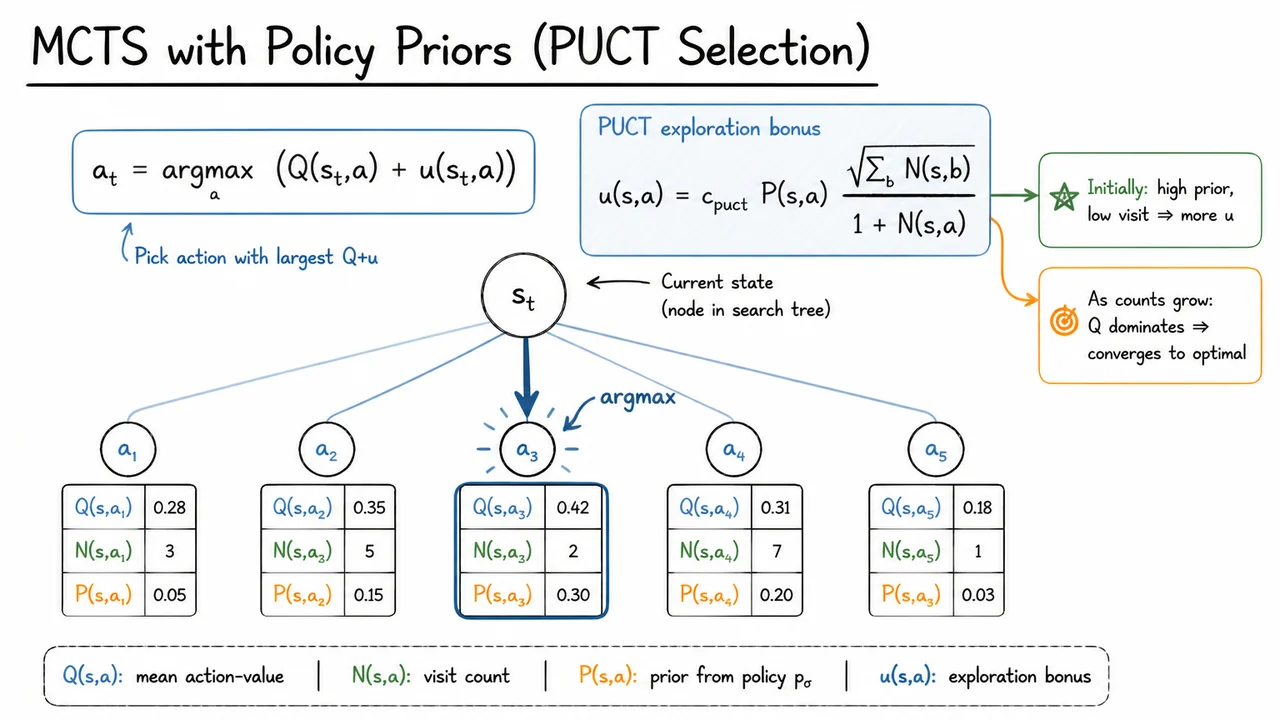
During an in‑tree simulation, when the search reaches a node representing state that already has children, the next action is chosen greedily by
where is an exploration bonus that depends explicitly on the prior. The specific formula adopted in AlphaGo is a variant of the PUCT (Predictor + UCT) algorithm:
The constant is a hyperparameter that scales the overall level of exploration. Structurally, the numerator grows with the total visits to the parent node, ensuring that actions at rarely visited parents still receive adequate exploration drive. The denominator acts per action: it sharply reduces the bonus as a specific move accumulates visits, gradually ceding control to the empirical action‑value .
This design beautifully resolves the exploration–exploitation dilemma in a way that respects human‑like intuition. Early in the search, when is tiny, the term is dominated by . Moves with high prior probability receive a substantial bonus and are eagerly explored, even if their estimates are still noisy or even mediocre. Conversely, actions assigned low prior probability by the policy network must overcome a much smaller initial bonus, causing the search to ignore most of the enormous move space until the high‑prior avenues are exhausted. As the visit counts climb, the denominator chokes off the term, and the values—now based on many rollouts and value network evaluations—become the primary driver of selection. In the limit of infinite simulations, the exploration bonuses vanish and the search converges to the moves with the highest true action‑values, i.e., optimal play, yet it arrives there without having to investigate every terrible move equally.
Notice that the formulation retains the classic UCT spirit of balancing exploitation and exploration but injects the policy prior directly into the exploration term. This contrasts with a naive approach that might simply use to initialise or to directly prune the search; the PUCT rule softly biases selection while preserving the asymptotic correctness guaranteed by the visit‑dependent decay of .
The visual at the end of this section concisely summarises the mechanics. A parent node labeled with the current state fans out into several action edges, each annotated with a compact callout listing its stored triplet . The action that maximises is highlighted with a bold arrow and an “argmax” callout, instantly conveying that the selection is a one‑step optimisation over augmented values. Above the node, the PUCT formula floats in a semi‑transparent box as a ready reference, while a legend decodes the symbols and . The colour intensity of the edges varies according to the prior strength , making it effortless to see how the policy network’s beliefs steer the search. This diagram transforms the equation into a spatial, comparative view: the search is no longer a diffuse probe into a vast game tree but a concentrated beam that follows learned human‑like plans until the evidence from actual simulations takes over.
In PUCT-based Monte Carlo tree search, the selection stage guides the tree traversal toward promising leaf nodes using a policy prior, but it does not decide how those leaves should be valued once they are reached. The leaf evaluation step is where the algorithm converts a newly expanded state into a scalar outcome signal that will be backpropagated up the tree. In classical MCTS, this signal came from a single source: the average result of random rollouts played to termination under a lightweight, fast policy. That approach, while unbiased in the long run, suffers from enormous variance—especially in a game as combinatorially vast as Go, where random playouts may grossly misrepresent the true strength of a position.
AlphaGo’s key innovation was to complement the high-variance rollout estimate with a low-variance, learned value network . This deep convolutional network was trained to predict the game outcome (win or loss) directly from a board state, bypassing the need to simulate forward. Its predictions are far more accurate per evaluation than a handful of rollouts, but they are biased because the network is an imperfect function approximator and may neglect rare, tactically sharp sequences that a brute-force rollout would eventually discover. Relying solely on the value network risks systematic blind spots, while relying solely on rollouts wastes the speed and pattern‑recognition capability of deep learning.
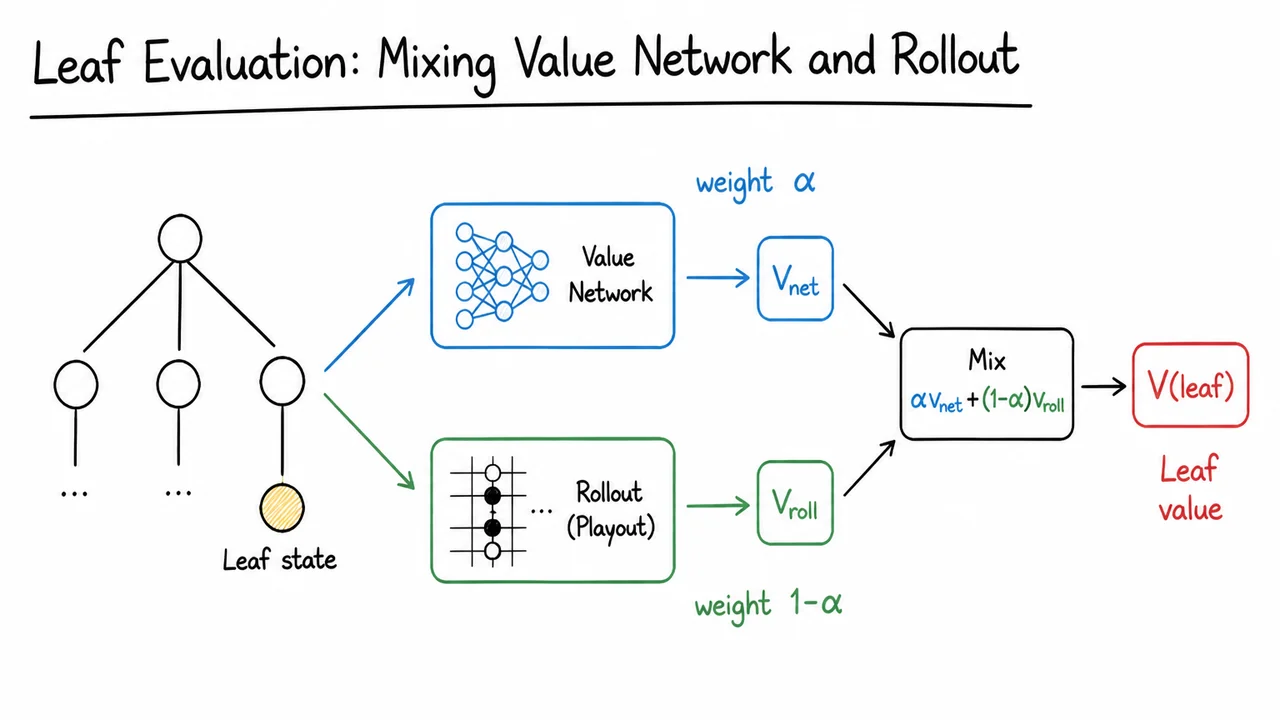
The solution is a mixed leaf evaluation that blends the two signals pointwise. When an MCTS leaf node is reached, the algorithm first queries the value network to obtain a predicted win probability . In parallel, a small number of fast rollouts are executed from using a simplified rollout policy , and their average outcome is computed. The final leaf value is
where the mixing weight is a hyperparameter chosen to balance the two sources. As the value network becomes more accurate over the course of training, can be reduced, placing greater trust in the network and making the search faster—since rollouts, even fast ones, are a computational bottleneck.
Why does this mixture work better than either extreme? The behavior can be understood through a bias‑variance trade‑off lens. Rollouts are unbiased but have high variance because individual games can diverge drastically from optimal play; their average only becomes reliable after many samples. The value network provides a single deterministic prediction that has low variance but a non‑zero bias relative to the true minimax value (especially in complex middle‑game fights). The linear combination effectively shrinks the estimate toward the network’s prediction, reducing the variance at the cost of introducing a small, controllable bias. Empirical experiments in AlphaGo showed that even a modest weight on rollouts () substantially improved tactical robustness without slowing the search excessively.
A further nuance is that the mixing is done per leaf, not globally, which means the blend naturally adapts to the position. In quiet, settled positions where the value network generalizes well, its prediction dominates; in chaotic, tactical positions, the rollout outcome may shift the blended value significantly, injecting the local fight information that the network might miss. Later AlphaGo variants (AlphaGo Zero, AlphaZero) eliminated rollouts entirely once the value network became sufficiently powerful, but in the original AlphaGo training pipeline, mixing was essential to bridge the gap between supervised learning of human games and the reinforcement‑learning‑based value network that was still improving.
The visual below distills this leaf‑evaluation architecture. It shows an MCTS leaf node from which two evaluation pathways branch out in parallel. On one side, a value network icon processes the board state and emits a single win‑probability . On the other side, a cluster of rollout trajectories (fast, random games) is simulated, and their average outcome is taken. Both signals feed into a mixer block, explicitly labeled with the factor , which combines them into the final leaf value that will propagate upward through the tree. The simple, hand‑drawn arrangement underscores the idea that leaf evaluation is no longer a monolithic oracle but a carefully engineered fusion of learned and simulated information—a central design decision that enabled AlphaGo to outperform both pure‑rollout and pure‑network baselines.
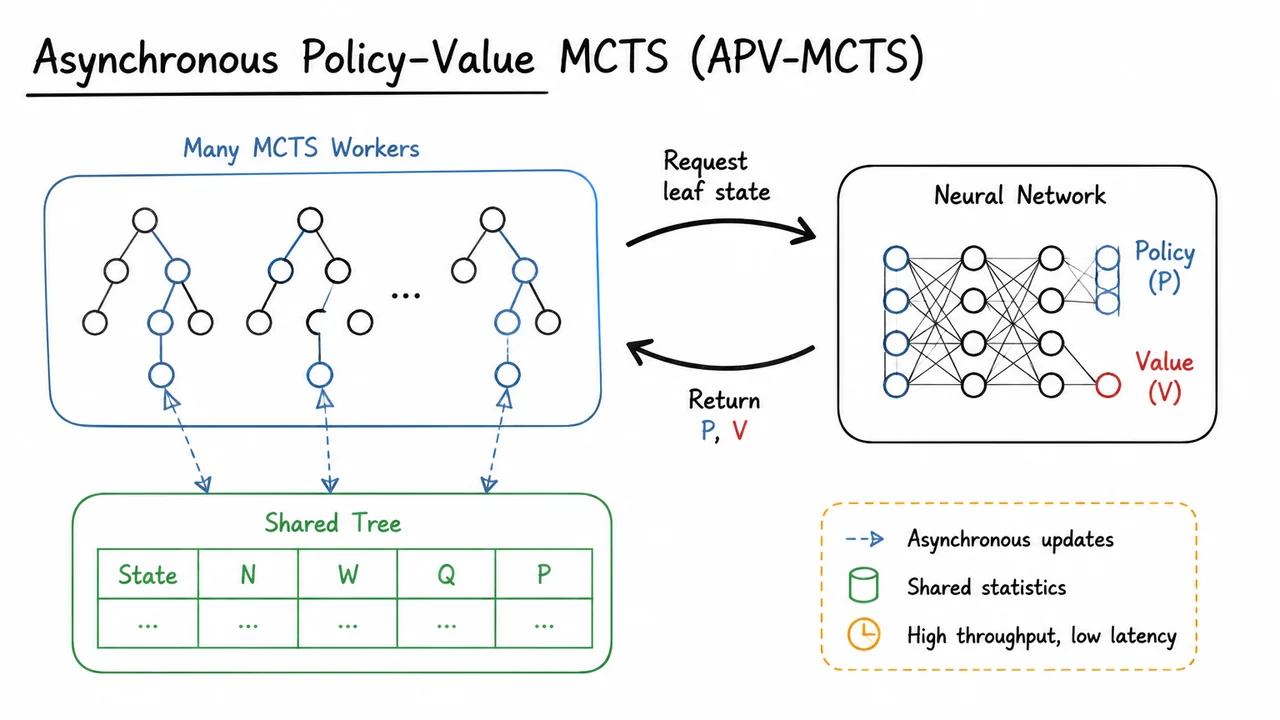
Even with a clever leaf evaluator that blends neural network predictions and random rollouts, tree search in Go remains a formidable scheduling problem. The branching factor is around 250, and the search depth can exceed 200 moves. A sequential MCTS would waste enormous time waiting for a single neural network forward pass—especially the value network, which is a deep convolutional net that takes several milliseconds on a GPU—while the CPU lies mostly idle. The solution that Silver et al. devised is an asynchronous, massively parallel version of MCTS that interleaves policy-network-guided selection, leaf expansion, and mixed evaluation across many worker threads. They called it Asynchronous Policy-Value MCTS (APV-MCTS), and it is the full search engine of AlphaGo.
At the heart of any MCTS variant is the selection policy that decides which branch to explore next inside the tree. AlphaGo replaces the usual UCT formula with a variant that incorporates the policy network’s prior probabilities. Recall that the supervised learning (SL) policy network was trained to predict expert moves from human games, achieving about 57% accuracy on a hold-out set. This network outputs a probability distribution over legal moves, and those probabilities serve as domain priors that guide search away from initial uniform exploration. The APV-MCTS selection step uses a PUCT (Polynomial Upper Confidence Trees) rule:
Here is the mean action value estimated so far, is the visit count, is the prior probability from the SL policy network, and is an exploration constant. This is analogous to UCT but with the prior nudging the search toward moves that a human expert would plausibly consider. The policy network thereby injects a human‑like shape bias that substantially reduces the effective branching factor during tree search.
Once the selection policy reaches a leaf node, the algorithm must evaluate the position. This is where the mixing from the previous section becomes part of a larger loop. APV-MCTS creates a new node, initializes its statistics, and then performs a leaf evaluation that combines two signals: the output of the value network , which estimates the win probability from that position, and the result of a fast rollout policy (a shallow, pattern-based policy) played to the end of the game. The final leaf value is a weighted average:
with controlling the mixture. This blended value is then backed up through all edges on the path from the leaf to the root, updating each action’s and counts. Because the value network is accurate but slow and the rollouts are fast but noisier, the mixture yields a superior evaluation that remains feasible within a few milliseconds.
The real engineering mastery appears in the parallelisation. Instead of a single search thread that updates a global tree sequentially, APV-MCTS uses many asynchronous worker threads, each executing independent simulations on a shared tree structure. Every thread runs the PUCT selection, reaches a leaf, and asks for a leaf evaluation. To avoid overwhelming the GPU with individual network calls, the threads batch their value‑network requests—multiple positions are evaluated in a single forward pass on a GPU, while rollouts continue to run on CPUs in parallel. To handle the tension of multiple threads exploring the same promising line, the algorithm employs a virtual loss: when a thread selects a node, it temporarily adds a small negative bias to , discouraging other threads from repeating the exact same path until the true evaluation returns. This lightweight coordination greatly improves search diversity without requiring heavy locking.
The entire APV-MCTS loop runs as follows: for a given time budget, worker threads continuously perform selection (using the SL policy network for priors and the current values), expand leaves, batch‑evaluate via the value network and rollouts, then back up the mixed value. When the time expires, the final move played is the one with the highest visit count at the root. Crucially, the RL‑tuned policy network—the one that was further refined by reinforcement learning from self‑play—is never used during search. Instead, it produced the training targets for the value network, and its stronger move patterns indirectly live inside the value estimates. This decoupling keeps the search consistent, because the SL policy provides stable, human‑like priors, while the value network and rollouts supply the win‑probability signal.
The visual below captures the asynchronous architecture of APV-MCTS in a single glance. It depicts a global game tree whose edges are decorated with prior probabilities from the SL policy network, while the PUCT selection rule guides each worker thread’s traversal. At the leaf, a node is expanded and evaluated through a mixture of the value network and rollout, with the result propagated upward. The parallel worker threads are shown feeding into a batching process for the value network, and virtual‑loss annotations mark nodes currently under evaluation. This diagram is not a new algorithm but a concise summary of how AlphaGo’s neural networks and traditional MCTS components combine in a high‑throughput, asynchronous engine—the very engine that, as we shall see next, enabled AlphaGo to dominate other Go programs in tournament play.
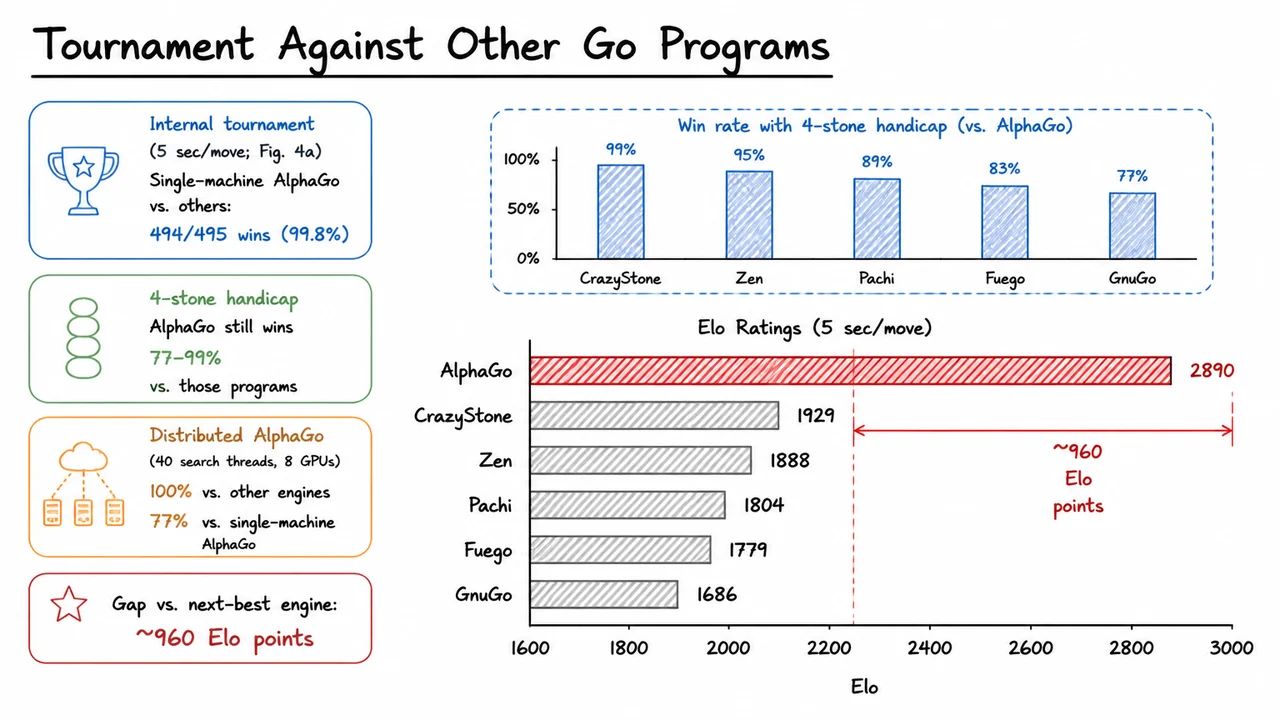
The asynchronous policy‑value MCTS algorithm promised a dramatic leap in playing strength. To substantiate that promise, DeepMind organized an internal tournament pitting AlphaGo against a gauntlet of the strongest existing Go programs—CrazyStone, Zen, Pachi, Fuego, and GnuGo. All matches were run under a strict time control of 5 seconds per move, matching the evaluation setting used during the reinforcement learning stage, and the single‑machine version of AlphaGo relied on 48 CPUs and 8 GPUs to execute the full APV‑MCTS. This controlled environment allowed a clean measurement of how much the learned deep networks and the hybrid search truly improved over the best handcrafted and Monte‑Carlo‑based engines.
The raw results were overwhelming. In a head‑to‑head series spanning nearly 500 games, single‑machine AlphaGo won 494 out of 495 encounters, a win rate of 99.8 %. The sole loss—a statistical blip—only underscored the consistency of the system. More revealing still, the tournament included 4‑stone handicap games, where AlphaGo gave the opponent a formidable starting advantage. Even under that severe constraint, AlphaGo’s win rate remained between 77 % and 99 % against the same programs. A traditional heuristic engine could barely hope to win a fair match, yet AlphaGo overcame a four‑stone gift almost effortlessly. This resilience signaled that the neural evaluators were capturing something far deeper than tactical hand‑patterns: they had internalized a robust sense of global win probability that could recover from gross material disadvantages.
The distributed version of AlphaGo, which harnessed 40 search threads and 8 GPUs to parallelise the tree search and network evaluations, further stretched the performance gulf. It achieved a perfect 100 % win rate against every other engine and even defeated the single‑machine AlphaGo in 77 % of their direct confrontations. The improvement from parallelizing the search, while sizeable, was dwarfed by the initial leap from prior state‑of‑the‑art to single‑machine AlphaGo—a clear sign that the fusion of policy and value networks, not merely raw compute, drove the breakthrough.
These match results were distilled into Elo ratings, a standard metric that translates win probabilities into a comparison scale. The Elo table revealed a staggering hierarchy:
The gap between AlphaGo and the next-best engine, CrazyStone, stood at ~960 Elo points. In chess terms, a 400‑point gap implies roughly a 90 % expected win rate; a 960‑point chasm corresponds to a near‑certainty of victory—AlphaGo would be expected to drop only about one game in every 250. That prediction aligned eerily well with the observed 99.8 % win rate. The entire prior competitive landscape, which had been advancing slowly over decades, was suddenly compressed into a narrow Elo band some 1000 points behind.
The visual below distills these tournament outcomes into a compact diagram. A horizontal bar chart of Elo ratings shows AlphaGo’s colossal lead, while an inset displays the handicap win percentages, reminding us that even a four‑stone head start could not close the gap. The stark separation between AlphaGo and the gray bars of its predecessors makes the magnitude of the advance intuitively clear: this was not an incremental improvement, but an order‑of‑magnitude jump, setting the stage for the ablation and scalability studies that follow.
Having witnessed AlphaGo’s dominance over the strongest specialized Go programs, a natural question arises: which ingredients in the architecture are truly responsible for its elite play, and how does its strength grow as we devote more computation to each move? The answers come from carefully controlled ablation studies and scalability experiments that dissect the neural networks and tree search, revealing a nuanced interplay between learned priors, value estimates, and simulated rollouts.
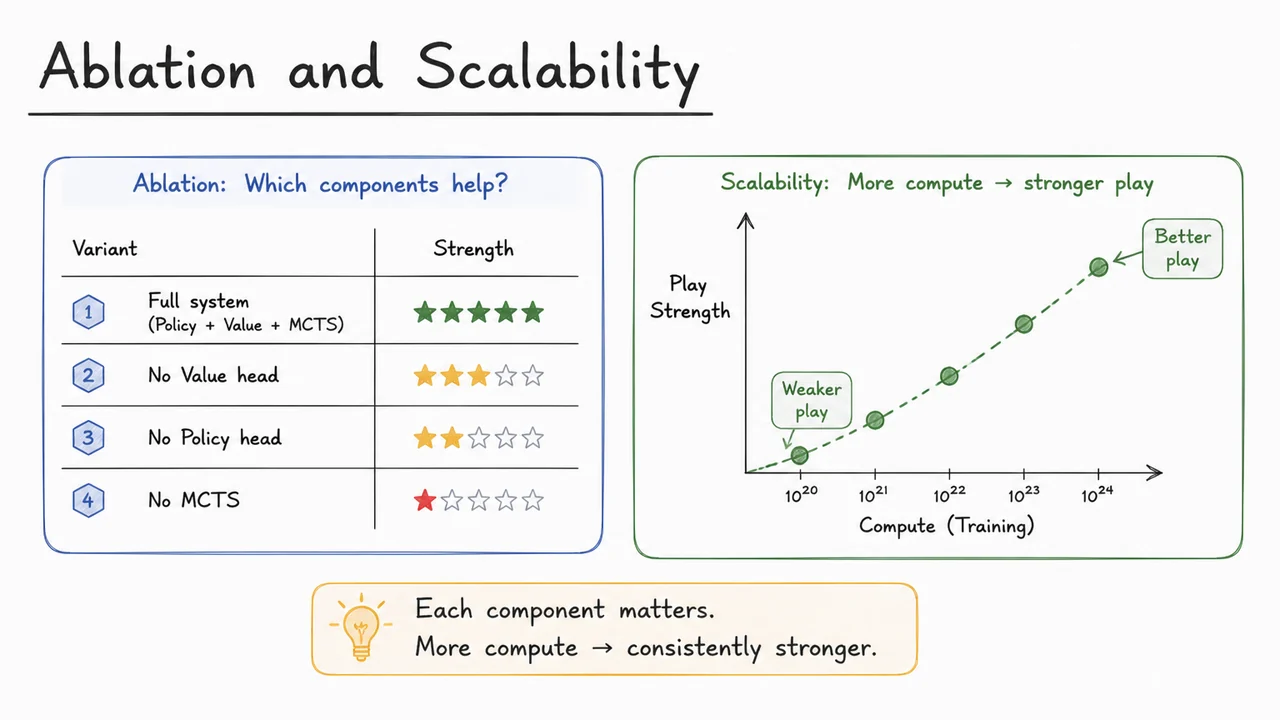
An ablation study removes one component at a time from a reference system and measures the resulting drop in performance, using a fixed metric such as Elo rating. In the AlphaGo evaluation, the full configuration combined a deep convolutional policy network, a value network, and fast Monte Carlo rollouts within an asynchronous policy–value MCTS. By comparing variants that disabled rollouts (relying solely on the value network for leaf evaluation), omitted the value network (using only rollouts for final scoring), or replaced the policy network with a simpler, shallower model, the team quantified each component’s contribution. The findings were decisive: the largest single degradation came from removing the rollouts, which caused a drop of several hundred Elo. Rollouts inject precise, local tactical knowledge that the value network alone could not fully replicate. Removing the value network also hurt, because the long‑horizon positional judgment provided by the learned evaluator is exactly what compensates for the noise and myopia of rollouts. Using a weaker policy—a linear softmax trained only on human moves rather than a deep residual network—further reduced strength, as the search relied on a less informed prior to steer its exploration.
These dependencies make sense when we consider how MCTS works. A strong policy prior narrows the search to plausible moves, so that even with a modest number of simulations the tree focuses on the most promising variations. The value network delivers a quick, high‑quality evaluation at leaf nodes, reducing the need to extend the tree many plies deeper. Rollouts, though slow and stochastic, model the extreme tactical complexity of Go and catch subtle capturing races and liberties that a single static evaluation might miss. Together, the three components create a complementary evaluation mechanism that is both broad and deep.
Scalability experiments examined how a player’s Elo rating improves as we increase the available compute per move, primarily by allocating more search threads (and therefore more MCTS simulations) within a fixed time budget. The results revealed that scalability depends critically on the quality of the neural networks. When the policy network was weak—say, a linear softmax—the benefit of adding threads quickly saturated; with a coarse prior, the search wasted many simulations on irrelevant moves, and doubling threads yielded only a modest Elo gain. In contrast, with the deep convolutional policy trained via supervised and reinforcement learning, the Elo curve continued to rise steeply as threads increased from tens to thousands. The strong prior effectively “unlocked” the potential of deeper search, concentrating the extra simulations where they mattered most. Similarly, incorporating the value network improved the efficiency of search: for a given number of simulations, the hybrid evaluation (value network plus lightweight rollouts) achieved a higher Elo than either alone, and it sustained that advantage over a wide range of thread counts. In essence, better neural networks make the search more sample‑efficient, enabling AlphaGo to extract more understanding from each additional simulation.
Another scalability dimension is the capacity of the networks themselves. When the policy network was made wider or deeper—by increasing the number of convolutional filters or layers—its prediction accuracy on expert moves improved, and that improvement translated downstream into a stronger overall player even when the tree search budget was held constant. This suggests that the system is far from saturating with network size and that investing in larger, more accurate models yields compounding dividends.
The visual below consolidates these insights into a compact reading. On one side it depicts the ablation results as a ranked bar chart, showing the relative Elo penalty of disabling rollouts, the value network, or the deep policy prior relative to the full AlphaGo configuration. On the other side it overlays scalability curves for multiple network setups, plotting Elo against the number of search threads. The steep, sustained slope for the strongest policy–value configuration contrasts with the flatter lines of ablated or weaker variants, vividly illustrating how neural network quality governs the return on computational investment. Taken together, the ablation and scalability evidence makes a strong case that the power of AlphaGo lies not in any single technical advance but in the deep synergy between learned knowledge and Monte Carlo tree search, and that this synergy scales gracefully with both model size and thinking time.
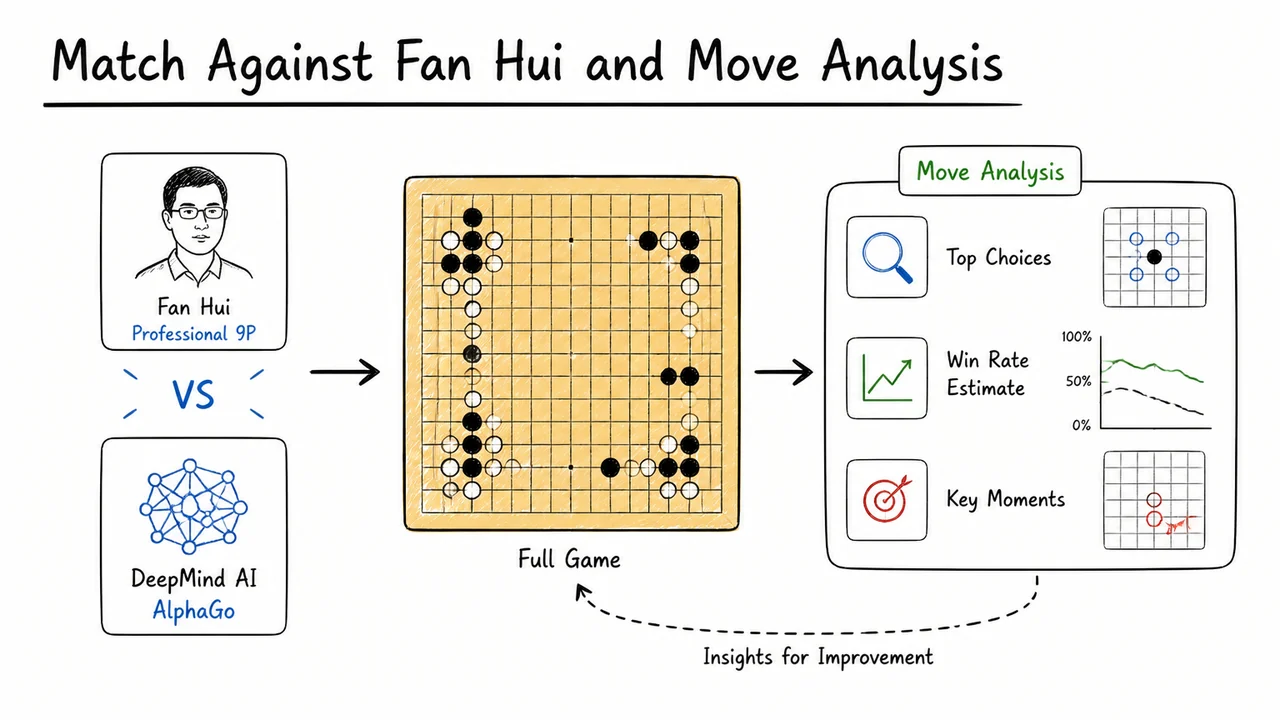
After thoroughly dissecting the individual components of AlphaGo and quantifying how each contributes to playing strength, the natural question is: how does the complete system fare against a professional human opponent? The ablation studies proved that removing any major piece—policy network, value network, or rollouts—crippled performance, but those experiments were conducted in self-play or against weaker bot configurations. The ultimate test of a Go program has always been a formal match against a strong, credentialed human player under tournament conditions, with even komi and no handicap. In October 2015, the AlphaGo team arranged a closed‑door match against Fan Hui, the three‑time European Go champion and a professional 2‑dan. The result sent a clear signal that a long‑standing AI grand challenge had been surpassed: AlphaGo won all five games, the first time any computer program had defeated a professional Go player in even games.
The 5–0 scoreline was more than just a headline; it was an existence proof that deep neural networks combined with Monte Carlo tree search could close the gap that had eluded classical programs for decades. Unlike previous top Go engines, which relied almost exclusively on fast, hand‑crafted rollout policies and massive brute‑force search, AlphaGo’s strength flowed from learned representations that captured human‑like intuition and accurate board evaluation. Yet, the raw numbers alone do not reveal why AlphaGo’s play was so effective. To understand the system’s decision‑making, the team (and later the Go community) analyzed specific moves that exemplified a new style of play—sometimes alien to human professionals, but objectively sound and often brilliant.
The most revealing moments came when AlphaGo chose moves that Fan Hui and other commentators initially considered slack, slow, or outright mistakes, only to discover later that those moves led to subtle advantages deep in the endgame. For instance, in one game, AlphaGo played a shoulder hit in an area that seemed to cede territory locally. A human player might reject such a move because it doesn’t immediately claim points or threaten a capture; instead it builds vague outside influence. The value network, however, estimated that the resulting global board position favored AlphaGo by a comfortable margin. Post‑game analysis confirmed that the move was a high‑level strategic choice, using thickness to devalue the opponent’s surrounding moyo while setting up a long‑term fight that AlphaGo’s precise tactics could navigate. This kind of move‑by‑move analysis underscored a core theme: the value network had learned to evaluate positions with a holistic, long‑horizon perspective that often surpassed human judgment at the professional level.
Why could the value network see what even a strong professional missed? One reason lies in the training signal. The value network was trained to predict the game outcome from any board position, using 30 million self‑play games and regressing on the final result. This provides a data‑driven, expectation‑based evaluation that is unbiased by human preconceptions about shape, territory, or standard joseki. In contrast, a human’s positional judgment is shaped by centuries of tradition and a limited set of pattern recognition heuristics. AlphaGo’s value function, though trained solely from self‑play, had discovered patterns and trade‑offs that deviated from orthodoxy but proved robust under the scrutiny of tree search. When the policy network suggested a candidate move and the value network approved it after lookahead, the resulting play could appear idiosyncratic yet was grounded in overwhelming statistical evidence.
Furthermore, the interplay between the policy and value networks in APV‑MCTS allowed AlphaGo to efficiently explore moves that a pure rollout‑based search would prune early. The policy network provided high‑quality initial priors, narrowing the search to promising candidates. The value network then assessed leaf positions directly, reducing reliance on noisy Monte‑Carlo rollouts for deep branches. This combination could home in on a move like the shoulder hit: the policy net gave it a non‑negligible prior (because similar moves had appeared in strong games from its training), and the value network’s evaluation after a short search confirmed its merit, even though a rollout might yield a low‑variance estimate due to the move’s long‑term nature. The move’s strength therefore wasn’t serendipity but a direct consequence of the architecture—a rare alignment of intuition, evaluation, and search.
The diagram that follows captures one such pivotal moment from the match. It presents a simplified board position with annotations that highlight the disputed area and AlphaGo’s unexpected move. The visual conveys, at a glance, the mismatch between human expectations and the program’s evaluation: the local situation may look like a loss, but the accompanying labels point out how the move builds global influence and how the value network’s estimated winning probability remained above 60% after the sequence. This snapshot becomes a compact summary of the move‑analysis argument: AlphaGo’s decisions, when viewed through the lens of its neural‑network‑based evaluation, are not random or weak—they are deliberate, long‑range investments that reward patience and accurate reading. By analyzing such moves, researchers and Go professionals alike came to recognize that the system had unearthed genuine strategic insights, some of which have since influenced human play. The 5–0 victory over Fan Hui was thus not just a statistical milestone; it was a window into a deeper understanding of the game itself.
The victory over Fan Hui was more than a competitive milestone; it was the public debut of a system whose architecture represented a fundamental departure from traditional game-playing programs. Before AlphaGo, the strongest Go engines relied on Monte Carlo tree search (MCTS) fed by simple, hand-crafted priors—a strategy that scaled poorly against the game’s state space. AlphaGo’s triumph rested not on faster hardware but on three learned components that rewired the search itself. Understanding how policy networks, a value network, and a novel search algorithm cohere is essential, because the resulting blueprint has implications far beyond the 19×19 board.
The first pillar was a deep policy network trained in two stages. A supervised learning (SL) model, denoted , was taught to imitate human expert moves from a corpus of 30 million positions drawn from KGS Go Server games. This gave the system a reasonable but myopic sense of which moves are plausible in a given position. To sharpen its judgment, the supervised network was then refined through reinforcement learning (RL) by playing 1.3 million games against itself. Starting from , this self-play procedure produced a stronger policy that maximized the probability of winning rather than mimicking humans. The RL policy network learned to explore moves that no human expert would consider, yet that proved decisive in high-level play.
The second pillar was a deep value network trained to estimate the expected outcome of a game from a position . The training data came from the same self-play process that generated the RL policy: positions were sampled from games, and the final result (win or loss) served as the target. Because consecutive positions are highly correlated, a single game could not be used naively; the value network was regressed on 30 million distinct positions, each coming from a separate game, to mitigate overfitting. The resulting function approximates the true minimax value far better than the heuristic rollouts of earlier MCTS programs, operating as a fast, learned evaluation oracle.
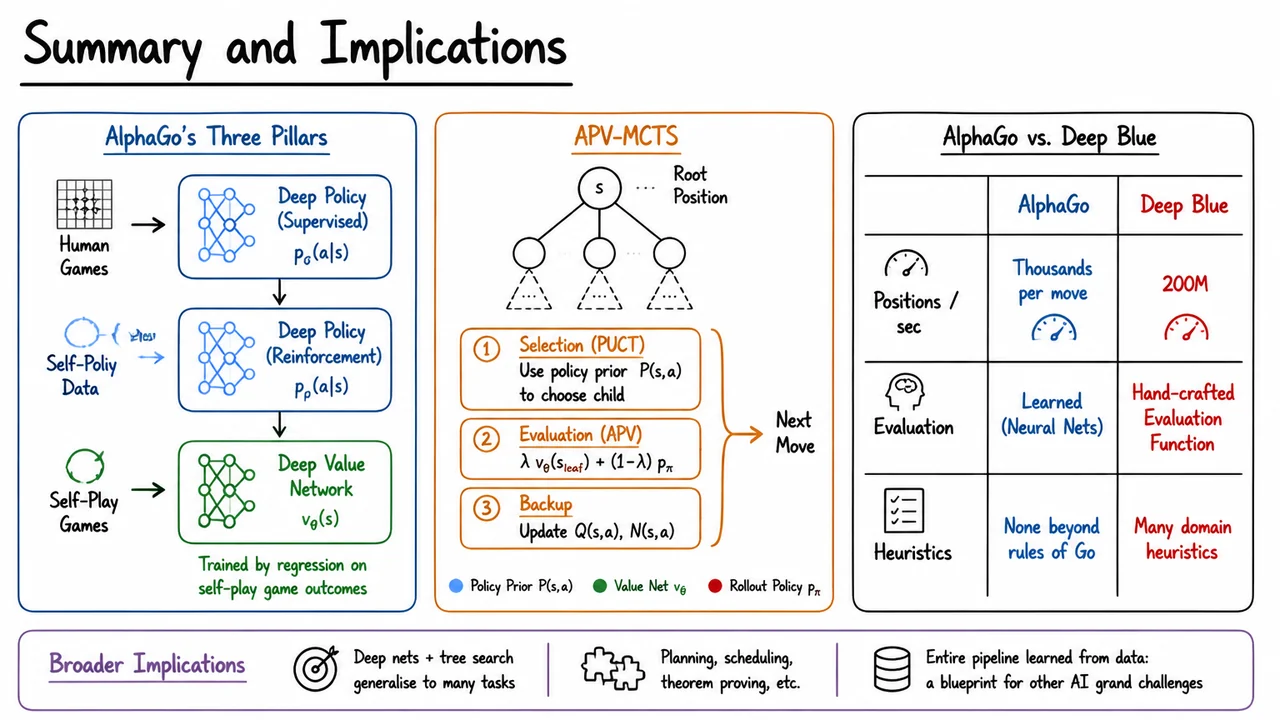
The third pillar was the search itself, known as APV‑MCTS (Asynchronous Policy and Value Monte Carlo Tree Search). Each node in the search tree accumulates a prior —coming directly from the RL policy —a value estimate , and statistics from fast, lightweight rollouts . During selection, the algorithm employs a variant of the PUCT (Predictor + UCT) formula that balances exploration and exploitation. Once a leaf is reached, its position is evaluated by a blended mixture: where is the outcome of a fast rollout using a shallower policy , and is a mixing coefficient. This blend preserves the tactical precision of rollouts while injecting the strategic depth of the neural value network. The backup then updates the action-value estimates that guide future selections. The result is a search that revisits a few thousand positions per move—not the 200 million explored per second by Deep Blue in chess—yet still achieves superhuman performance.
This stark contrast with Deep Blue is not incidental. Deep Blue’s strength came from massive hardware acceleration and an evaluation function painstakingly hand-tuned by chess experts over years. It searched 200 million positions per second but relied on a brittle, domain-saturated heuristic. AlphaGo searches orders-of-magnitude fewer positions because its evaluation function is learned, not engineered. The only domain knowledge it requires is the raw rules of Go. Everything else—what constitutes a good shape, how to judge influence, when to fight a ko—emerged from data through the interplay of policy and value networks.
The broader implications crystallize around a simple but powerful insight: deep networks can replace hand-coded heuristics inside combinatorial search, dramatically shrinking the effective search space. This co-design of learning and tree search is already being explored for planning under uncertainty, automated theorem proving, and molecular design. Because the entire pipeline—supervised imitation, self-play reinforcement, value regression—is data-driven, it provides a template for any domain where a simulator or generative model can produce training examples. In that sense, AlphaGo is less a Go-playing program than a proof-of-concept for how to marry learned pattern recognition with principled decision-making.
The visual below (a three-panel summary in clean diagrammatic style) captures these intertwined ideas at a glance. On the left, a compact training cascade shows the flow from human games to , then to the RL-upgraded , and finally to the value network trained on self-play outcomes. The center panel distills the APV‑MCTS loop: a search tree node branches through a PUCT‑based selection step, an evaluation box blending and fast rollout , and a backup arrow that updates . The right panel juxtaposes AlphaGo against Deep Blue across three dimensions—positions per move, evaluation source, and domain heuristics—each row reinforcing that AlphaGo replaces brute force and handcrafting with learned components. Soft color coding (blue for policy, green for value, orange for MCTS) helps the eye trace how these modules connect. Taken together, the diagram functions as a compact reference, reminding us that AlphaGo’s mastery was not an isolated engineering feat but a deliberate architectural advance whose components can be repurposed for the next grand challenges in AI.