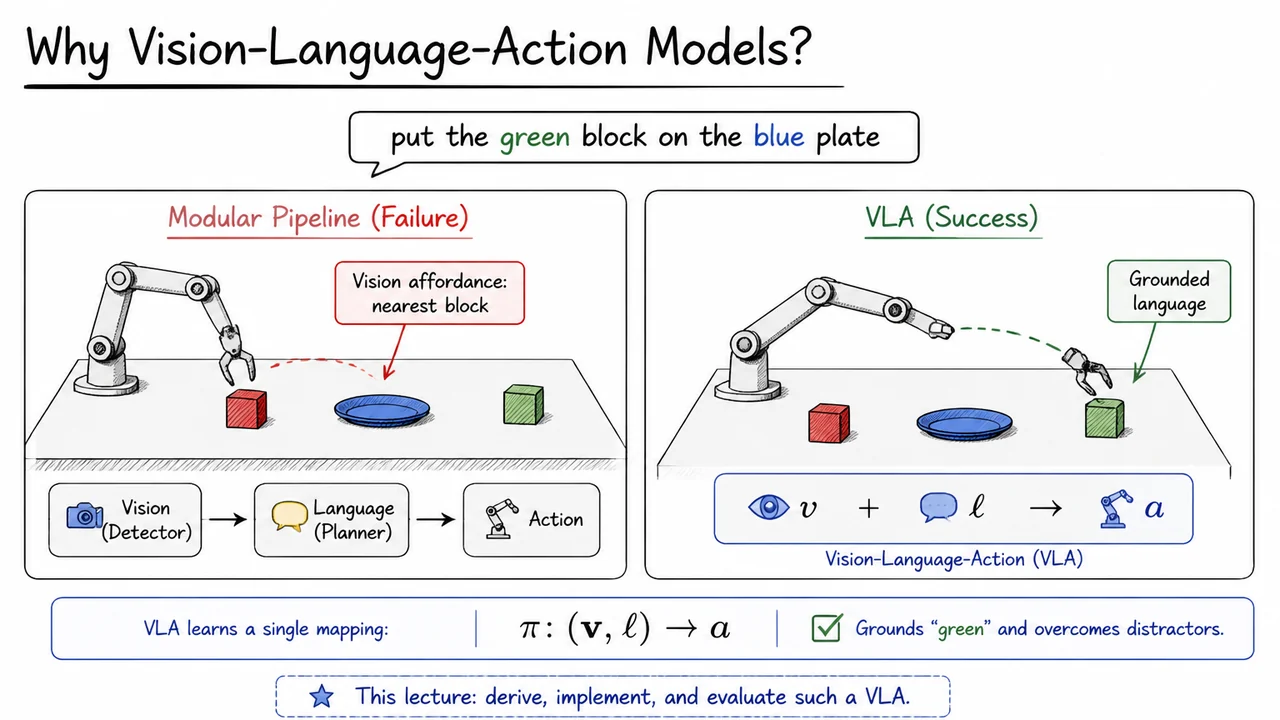
Consider a robot arm hovering over a table cluttered with colorful blocks. The instruction arrives in plain English: “put the green block on the blue plate.” A human would immediately scan the scene, ground the word green in the visual array, and ignore the other blocks. For a robot, this deceptively simple task unmasks a fundamental limitation of naïvely composing separate vision and language modules. If the system first runs an object detector that proposes candidates purely from visual appearance—say, by highlighting all reachable grasp points—the detector has no way to let the phrase “green block” steer its attention. It might rank a nearby red block as the best affordance simply because it is closer or more salient. A downstream language planner, receiving only the detector’s candidate set, then faces an impossible choice: it must map the instruction onto a set of decontextualized visual proposals, none of which correspond to the intended green block. The result is an action that satisfies a visual prior (“grasp the nearest block”) but violates the linguistic constraint—a brittle disconnect between seeing and understanding.
This failure mode is not an artifact of poor engineering; it is structural. A vision-only policy, trained with standard behavioral cloning, learns to map raw pixels directly to actions. When the training data contains varying language instructions, the model must implicitly discover which visual features correlate with which words. In practice, without explicit language conditioning, a visual policy often collapses onto visual shortcuts—object positions, sizes, or motion cues—that are only loosely coupled to the semantic content of an instruction. Conversely, a language-only planner that operates on pre-extracted symbolic descriptions of the scene is hostage to the fidelity of that symbolization. If the scene parser fails to detect or disambiguate the green block because its segmentation model has never been fine-tuned on tabletop clutter, the planner simply cannot issue a correct command. The core insight is that grounded language—the mapping from linguistic tokens to perceptual referents—cannot be reliably achieved when vision and language are processed in isolation and combined late.
Vision-Language-Action (VLA) models address this by collapsing the modular boundary into a single end-to-end function. Instead of a pipeline that commits to a perceptual abstraction before the language is fully consulted, a VLA model defines a direct mapping:
Here represents the visual observation (e.g., a history of camera images), is the natural language instruction tokenized into a sequence, and denotes the action—such as a 6-DoF end-effector displacement, a gripper command, or a tokenized motion primitive. The model jointly processes both modalities, typically through a transformer backbone that interleaves visual tokens and text tokens, so that every stage of representation learning can condition on both the image content and the instruction. When this single model is trained to maximize the likelihood of expert actions under a supervised imitation objective, it must learn to ground nouns and adjectives directly in pixel space: the latent activation pattern evoked by “green” becomes dynamically bound to the region of the image that contains the green block, even when other blocks are visually more prominent.
The advantage is not simply about accuracy on a single instruction. Because the model fuses vision and language at a low level, it can exhibit emergent reasoning that is difficult to orchestrate with modular pipelines. For instance, if the instruction says “put the block that is the same color as the sky in the painting on the plate,” a VLA can learn to chain visual attributes (the painting) with color references and object selection without explicit symbolic reasoning modules. The system implicitly learns that the phrase “the same color as the sky” modifies a search over objects, and it can back-propagate that linguistic constraint through its visual processing hierarchy. The failure case of the modular pipeline—the red block being grasped because it was nearest—is avoided because the model never commits to a set of “candidate blocks” without already understanding the linguistic goal. Instead, the joint embedding space makes the green block more salient under the phrase “green block,” effectively using language as a top-down attentional modulator for perception.
This theoretical elegance translates into concrete design requirements that we will unpack throughout this lecture: a tokenizer that discretizes robot actions so they can be treated with the same autoregressive machinery as language tokens, a multimodal transformer that preserves spatial structure from vision while attending across text tokens, and a training recipe that scales from dozens of demonstrations to internet-scale pre-training. But before diving into these components, it is vital to internalize why the simple, modular alternative breaks so predictably—and why the single-mapping view, , is not a minor tweak but a fundamental shift in how we think about robotic control.
The visual below distills this into a side-by-side comparison that will feel immediately familiar after the discussion above. On the left, a modular pipeline—with a vision-only affordance model—causes the robot arm to reach for the nearest block, which happens to be red, despite the instruction “put the green block on the blue plate.” The annotation “Vision affordance: nearest block” captures the failure: perception ignores the language constraint. On the right, a VLA model processes the same scene and instruction jointly, successfully selecting the green block and moving it toward the blue plate. The labels “Modular Pipeline (Failure)” and “VLA (Success)” set the stage for every subsequent section, reminding us that grounding language in perception is not an optional enhancement—it is the central challenge that a Vision-Language-Action model must solve.
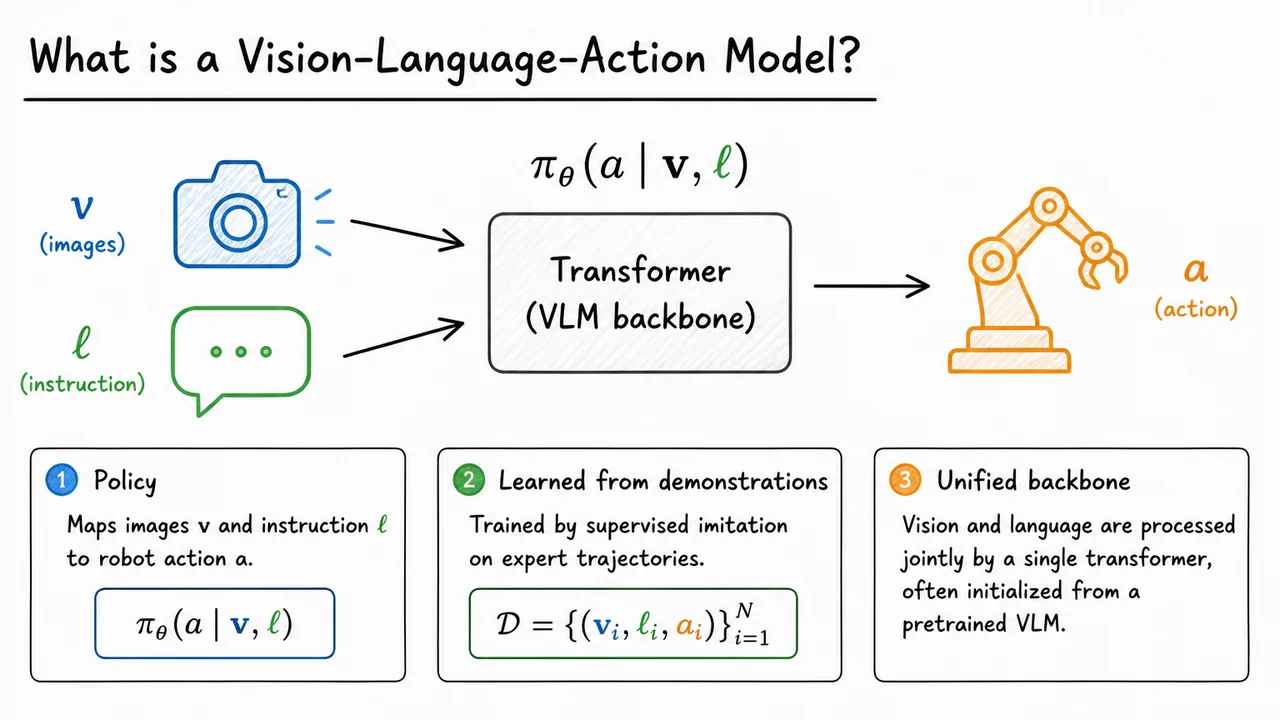
When we step away from modular pipelines and ask a single model to directly link raw sensory streams and language to physical behavior, a crisp definition emerges from the noisy search: a Vision‑Language‑Action model is a probabilistic policy
that jointly consumes a visual observation and a natural language instruction to produce a robot action . This joint conditioning is not a small architectural convenience; it fundamentally recognizes that neither pixels nor words alone contain the full specification of a task, and that the interaction between what the robot sees and what it was told to do is the real signal.
The first ingredient, , is deliberately kept raw. It can be a single RGB frame, a short history of frames, or even multiview images from head‑mounted, wrist‑mounted, and third‑person cameras. The key is that no explicit object detector, segmentation mask, or hand‑engineered feature extractor stands between the camera and the policy. By swallowing pixels directly, the VLA is forced to learn its own latent representations of geometry, affordances, and task‑relevant state — representations that are often more robust to visual distribution shift than brittle perception modules.
The second input, , is the natural language command: “pick up the green block from the left bowl”, “wipe the white‑board in a straight line”, “open the top drawer halfway”. Language brings a kind of compositional flexibility that pure visual imitation struggles to replicate. It lets a single model specialize its behavior according to the instruction while sharing visual understanding across tasks. A VLA that has learned to pick a red cube when asked can more easily learn to pick a green cube than a vision‑only policy that must rediscover the concept of “pick and place” for each new object.
The output can take two common forms. In tasks requiring precise manipulation, is a continuous end‑effector pose — typically a change in position, a delta in roll, pitch, yaw, and a gripper open/close command. In other settings, is a discrete primitive from a fixed vocabulary, such as “move forward 10 cm”, “rotate left 30 degrees”, or “grasp”. Many modern VLA systems discretize the continuous action space into thousands of bins for an autoregressive action head, which turns the policy into a next‑token prediction problem over a learned action codebook. This tokenized action representation is central to scaling, because it allows the same transformer backbone that processes vision and language to output actions with minimal architectural change.
The “θ” in denotes the learnable parameters, and these are tuned by supervised imitation on a dataset of expert demonstrations:
Each tuple pairs a visual observation and an instruction with the action that a skilled human tele‑operator or a scripted expert took at that instant. The training objective is simply to maximize the log‑likelihood of the expert action under the policy. There is no reinforcement learning reward signal: the model absorbs behavioral priors directly from the dataset, which is why the quality and diversity of the demonstrations are crucial. When done at scale, with tens of thousands of trajectories spanning many object types, furniture layouts, and lighting conditions, the resulting policy begins to exhibit surprisingly general behaviors, often described as emergent capabilities.
Crucially, the backbone that ingests and is a single, large transformer, typically initialized from a pretrained vision‑language model (VLM). Early layers encode image patches and tokenized language tokens together, and the shared self‑attention allows cross‑modal alignment from the very bottom of the stack. This design spares us from building an explicit “fusion” layer that must reconcile semantic gaps later; instead, the transformer learns that “blue cube” and the blue blob in the image refer to the same entity, and that a “grasp” action should target it. Initializing from a VLM pre‑trained on internet‑scale image‑text data gives the network a head start on grounding language in visual scenes, which is then fine‑tuned into grounding actions.
The visual below condenses this architecture into a single clean diagram. On the left, two distinct icons — a camera frame representing and a speech bubble representing — remind us that the policy’s world is built from pixels and text. Arrows carry both streams into a central block labeled “Transformer (VLM backbone).” The policy notation hovers just above that block, emphasizing that the transformer learns the entire conditional distribution. From the backbone, a single arrow exits rightward toward a robot arm, the physical embodiment of . The color coding — blue for vision, green for language, orange for action — subtly reinforces the three pillars of the VLA while the sketchy hand‑drawn style keeps the focus on the conceptual flow rather than implementation details. In one glance, the figure captures what pages of prose have just worked to establish: a VLA is a multimodal model that eats raw observations and instructions and predicts what the robot should do next, all within a single trainable function.
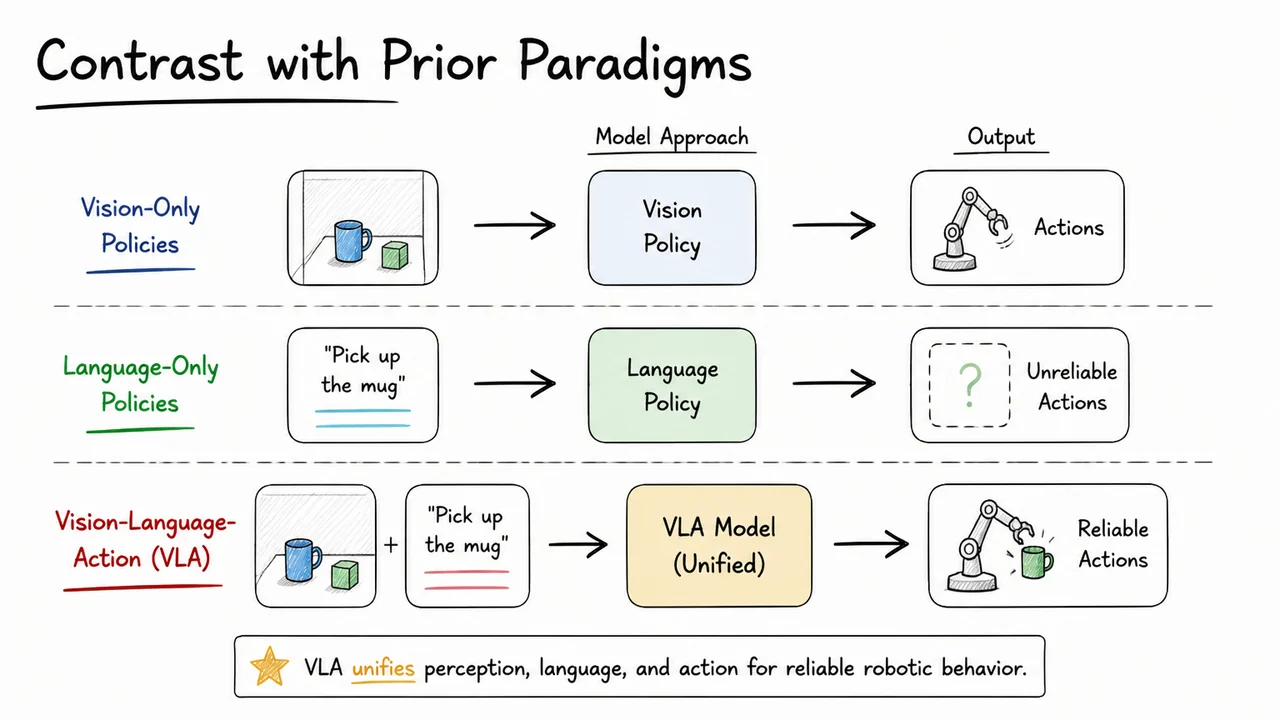
Before diving into how a Vision-Language-Action model actually predicts motor commands, it’s worth pausing to examine why we needed a new paradigm in the first place. For years, robot learning has navigated a fragmented landscape: some systems relied exclusively on vision, others on language, and many attempted to glue pretrained components together with a separate action head. Each of these approaches made sense in its historical context, but each also carried fundamental limitations that prevented the kind of broad, instruction-following generality we expect from human collaborators. Understanding these prior paradigms clarifies what a unified VLA model is really buying us.
Vision-only robotic policies—think of grasping from RGB images or navigating via depth maps—proved that raw perception can indeed drive useful behaviors. However, a pure vision policy has no mechanism to incorporate a user’s intent beyond what is already encoded in the demonstration data. If the task is “pick up the red block,” the model must have been trained on countless examples of that exact instruction implicitly, because the input is just pixels. There is no linguistic channel for specifying a new goal at inference time. As a result, vision-only policies tend to be single-task experts that fail catastrophically when asked to do something slightly different, let alone something articulated in words they’ve never seen.
On the opposite end, language-only planners—often built on large language models that output symbolic action sequences—can exhibit impressive compositional reasoning. Tell them to “open the fridge, then retrieve the butter,” and they can generate a sensible plan. The problem is that these planners lack any direct connection to the messy, high-dimensional sensory world of a physical robot. They might instruct the robot to “grasp the handle,” but they cannot locate the handle in a live camera stream or adjust the grasp if the handle is partially occluded. Grounding abstract symbols in real sensorimotor experience remains their Achilles’ heel.
Modular VL + action policy pipelines attempt to bridge this gap. A typical setup uses a pretrained vision-language model (like CLIP or PaLI) to compute a multimodal representation, then feeds that representation into a separate, often lightweight, policy network that outputs actions. At first glance this seems sensible—why not reuse powerful frozen backbones? In practice, the separation introduces an information bottleneck. The VLM is optimized for image-text alignment, not for the fine-grained spatial and dynamic cues needed for controlling a robot. The action policy must then extract task-relevant features from a generic embedding, and the two components are never tuned jointly. This not only limits precision but also prevents the emergence of synergistic capabilities where language understanding, visual attention, and action generation co-adapt.
A related baseline is vanilla behavioral cloning (BC), where a policy is trained to imitate demonstration actions directly from images, often without any language conditioning. Even when BC pipelines are extended to accept a language goal, they typically treat that goal as a simple concatenated token or an auxiliary input to a relatively shallow policy network. They lack the deep cross-attentional reasoning that modern transformers provide, and they struggle to generalize to novel task descriptions. Without large-scale pretraining on internet-scale data, these models rarely exhibit the kind of zero-shot instruction following that makes a robot truly reusable.
What all these earlier strategies share is a failure to internalize language as a first-class reasoning modality alongside vision, and a failure to let action prediction influence the feature representations all the way down. A VLA model instead treats the entire problem as a single next-token prediction task: a sequence of image tokens and text tokens (the task description) is fed into a large transformer, and it autoregressively outputs tokens that represent discretized actions. The same parameters that attend to “pick up the blue can” in the text also attend to the can’s location in the image and to the previous joint angles. This tight integration means the model learns to reason across modalities—emergently, without any hand-crafted interfaces—and crucially, it learns to do so under a single, well-understood imitation learning objective.
The visual diagram below crystallizes this contrast. It sketches the older paradigms as separate, sometimes disjoint components—a camera feeding a policy, a language model feeding a planner, or a VLM sending features to a frozen action head—each with a visible gap where information can be lost or misaligned. In the center, the VLA model collapses these blocks into one self-contained loop: vision and language flow in, and motor commands flow out, all mediated by a shared transformer that has been trained end-to-end. The image makes it easy to see why VLA is not merely an incremental improvement, but a fundamentally different way to combine perception, instruction, and control.
The previous contrast between monolithic end-to-end policies and modular perception–action stacks sets the stage for a more radical unification. Vision-language-action (VLA) models collapse the distinction between world understanding and motor control by treating actions themselves as just another modality in a multimodal token stream. This shift is elegantly simple: if a large transformer can already generate coherent text and interpret images, why not let it also produce the discrete symbolic tokens that drive a robot’s joints?
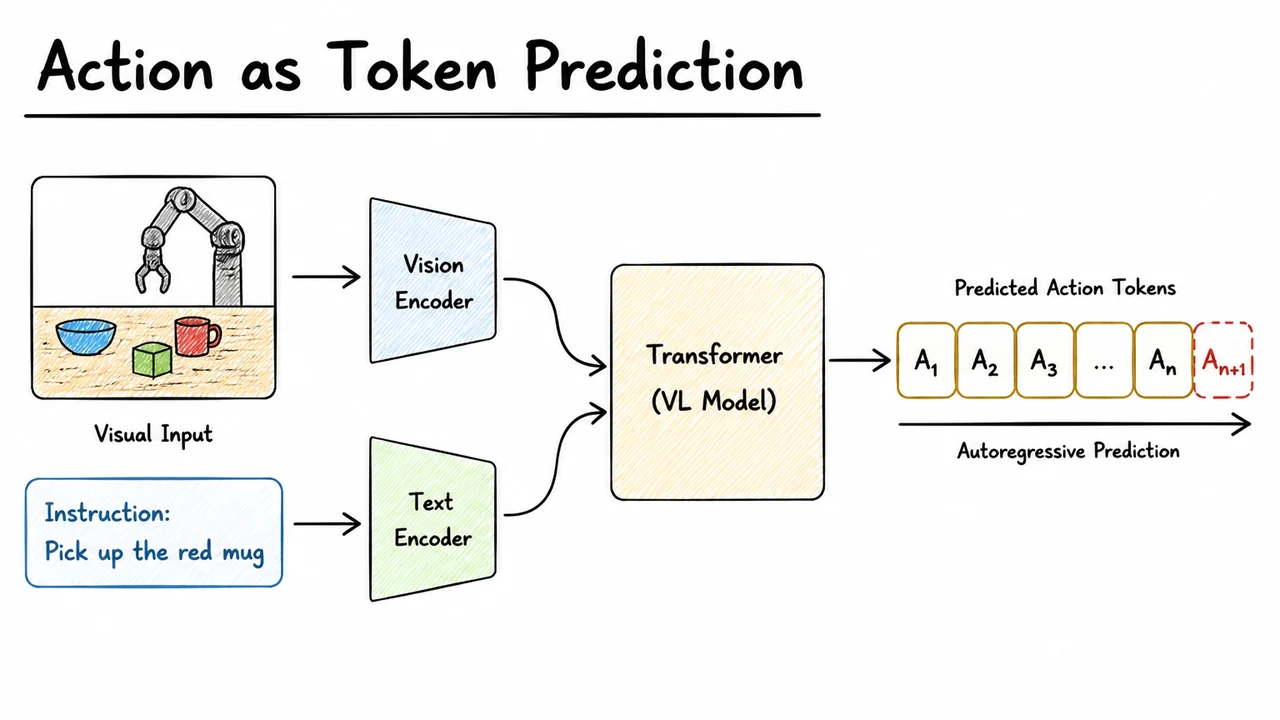
The core idea is to convert a continuous action — say the 6‑DoF delta pose of a gripper, the target joint angles, or even a binary open/close command — into a sequence of discrete tokens drawn from a fixed vocabulary. Each dimension of an action is independently discretized into a number of bins (e.g., 256 uniformly spaced bins covering the safe range). For a multi-dimensional action, the model predicts one bin ID after another, autoregressively, conditioned on all previous tokens and the multimodal context. This turns an action prediction problem into a standard next-token prediction task, identical in form to language modeling.
Why does this matter? In a traditional behavioral cloning pipeline, the policy directly regresses the continuous action values with an L2 loss, often using a separate head that processes visual and language features from frozen encoders. That approach tightly couples the representation to the specific action space and dataset, making it brittle to distribution shifts. By tokenizing actions, we replace that fragile continuous output with a discrete predictive distribution , where the context can be an arbitrarily long sequence of image patches, instruction tokens, and previous actions. The model is then trained with a simple cross-entropy loss over the action token vocabulary, exactly the same objective used for text tokens:
Here denotes the next action token (or the next bin of the current action), and the sum runs over all action tokens in the trajectory. This loss encourages the model to match the distribution of expert actions seen in the demonstrations while allowing it to share all its representational capacity with the vision and language streams.
The architecture that realizes this is a single transformer decoder (or encoder–decoder) that ingests a serialized sequence. Visual inputs are typically split into patches and linearly projected into embeddings, language instructions are tokenized as usual, and action tokens from previous timesteps are embedded with learned action embeddings. All token types are interleaved into a single long sequence, with position encodings preserving their temporal and spatial order. The transformer then processes the multimodal sequence and outputs logits for the next token at each position — but only the logits corresponding to action positions are used for the imitation loss. This is often called an autoregressive action head, because the very same decoder that models language and vision is now also responsible for generating the low-level control commands.
Training a VLA model in this way yields remarkably flexible behaviors. Because the model is exposed to web-scale pre-training on vision–language data (e.g., co-training on large image-caption datasets like LAION or WebLI), it already possesses rich semantic and grounded understanding. When fine-tuned on a modest set of robot demonstrations, the model can follow novel instructions that require compositional reasoning — picking up the “fallen” object, moving the “blue block next to the red cup,” or even understanding emojis and simple sketches. Experiments with the RT‑2 family show that the VLA approach consistently outperforms both modular VL + action policy schemes and vanilla behavioral cloning, especially when demonstrating emergent generalization to objects, backgrounds, and instructions not seen in the robot data. The tokenized action interface is what makes this feasible: it allows the model to leverage all of its pre-trained capacity to reason about visual scenes and language, while the supervised imitation loss fine‑tunes only the final output mapping without breaking the internal representations.
The visual below captures this entire pipeline in a clear, hand-drawn style. It distills the flow from raw pixels and instructions into tokenized inputs, then through a shared transformer that makes no distinction between modalities, and finally out to discrete action tokens that are decoded back into motor commands. The diagram highlights the key design choices — discretization into a fixed vocabulary, autoregressive prediction across dimensions, and the unified cross-entropy objective — that make action-as-token-prediction both architeturally elegant and practically effective. Seeing the diagram, you can immediately grasp how a VLA model collapses perception, language understanding, and control into a single sequence of tokens, with the same loss function driving all of learning.
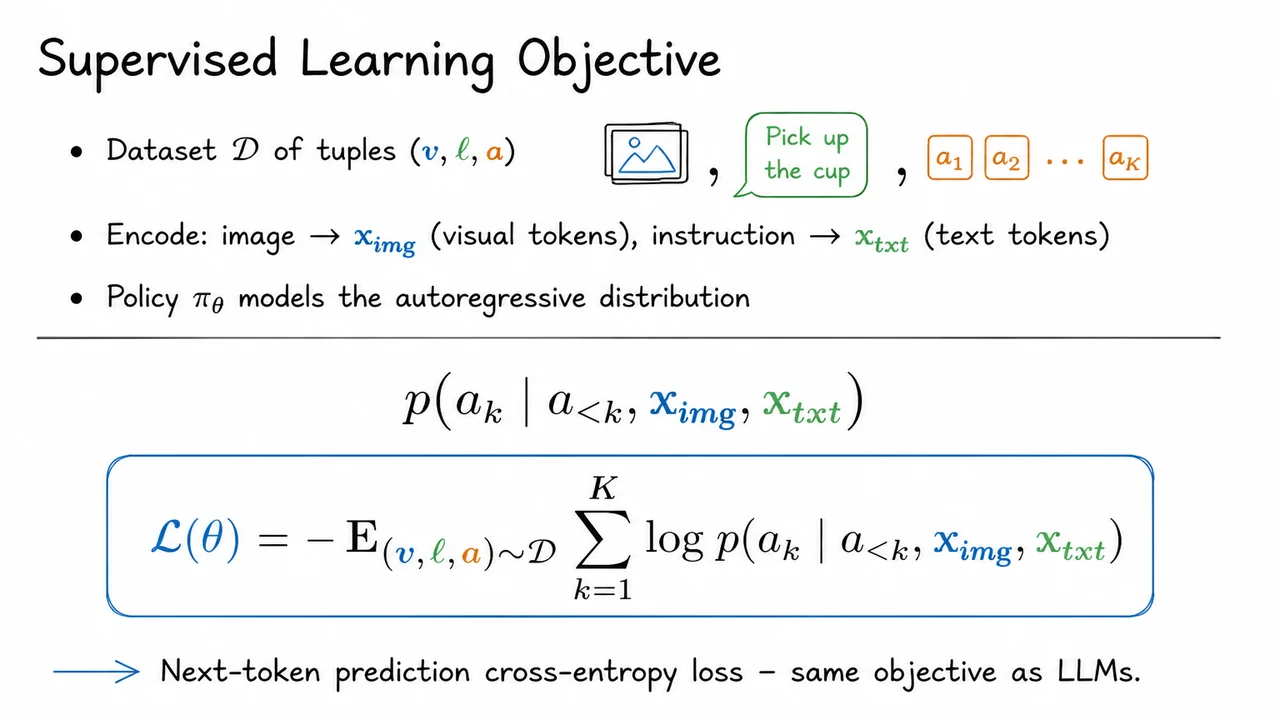
Having tokenized the robot’s actions into discrete units, the immediate question is how we teach a policy to generate the correct sequence. In a supervised imitation setting, we have access to a dataset of successful demonstrations — each sample consists of raw visual observations (a short history of images), a natural language instruction , and the corresponding ground‑truth action sequence . Our goal is to convert this into a purely supervised learning problem with a loss function that mirrors the next‑token prediction paradigm of large language models.
The first step is to embed the multimodal context. The visual stream is encoded into a set of visual tokens — for instance by passing frames through a pretrained vision transformer and extracting a compact sequence of patch features. Similarly, the language instruction is tokenized and mapped to text tokens using the model’s language backbone. Both token streams are concatenated to form a unified context prefix. The policy , implemented as a transformer decoder, then models the remaining sequence — the action tokens — one by one.
Crucially, the policy does not output raw motor commands in a single shot. Because actions have been discretized into a vocabulary of tokens (as discussed in the previous section), the policy predicts each token exactly like the next word in a sentence. At step , the model computes a probability distribution over the entire action token vocabulary, conditioned on all previous action tokens and the full context:
This autoregressive factorization decomposes a potentially complex action sequence into a series of small, manageable classification problems. The model never sees the future action tokens during training; teacher forcing feeds the ground‑truth prefix at each step.
To turn this into an optimization objective, we apply the principle of maximum likelihood. For a single demonstration , the model’s performance is measured by the total log‑probability it assigns to the correct action sequence under the given context. Because each token prediction is independent given the history, the likelihood factorizes, and the per‑sample loss becomes the negative sum of token‑level log‑probabilities:
Averaging this quantity over all demonstrations in yields the expected loss:
This is precisely a next‑token cross‑entropy loss — the same core objective used to train GPT‑style language models, only now the “text” to be generated is a discretized robotic action sequence. The policy learns to reproduce the expert’s actions by minimizing the surprise (log‑loss) of each ground‑truth token, effectively performing large‑scale supervised classification over the action vocabulary.
There is a subtle but important practical detail: action tokens are drawn from a finite, often compact discrete set. That means the softmax output over the action vocabulary directly yields a probability mass function, and the cross‑entropy ignores any notion of distance between tokens. This design choice discards ordinal relationships (e.g., token index 7 may represent a gripper close command, token 8 a slightly different angle) and forces the model to treat each action token as an independent class. While this may seem coarse, it works surprisingly well when the tokenization scheme is designed to keep the vocabulary small yet expressive. The loss surface becomes a well‑behaved convex‑like classification problem that benefits from the same optimization strategies and regularization techniques used in language modeling.
Notably, this objective requires no reinforcement learning, no online interaction with a robot, and no reward function — only a static dataset of demonstrations. The same transformer that processes visual and textual context can be directly fine‑tuned to predict action tokens, provided the architecture allows a unified autoregressive head. Over many examples, the model internalizes a mapping from raw sensory inputs and language goals to motor‑token sequences, capturing complex conditional patterns.
The visual below distills this objective into a compact equation‑slide format. You will see three short conceptual steps — tokenize, encode, model — followed by the central autoregressive distribution and the final boxed loss function. The clean layout reinforces the chain of reasoning: from a multimodal demonstration tuple, we construct a sequence prediction problem, and then we minimize the empirical negative log‑likelihood, exactly mirroring the training of large language models on text. The slide’s hand‑drawn aesthetic, sparse text, and soft blue highlighting of the key equation underscore that this is not a separate exotic algorithm but a straightforward adaptation of the same cross‑entropy machinery that has proven so effective in language and vision domains.
Once we have expressed the VLA training objective as a sum of per‑token negative log‑likelihoods,
the path from this loss surface to a concrete learning algorithm is remarkably straightforward.
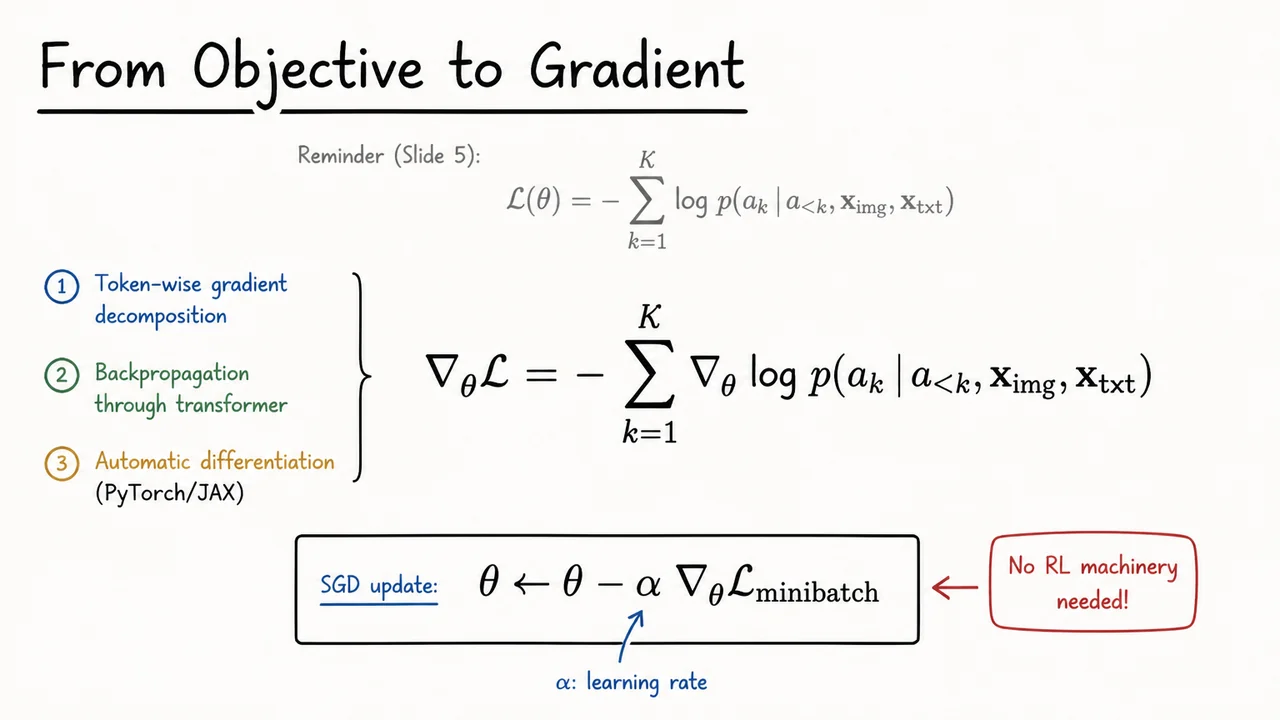
The core insight is that this loss is already a supervised objective – it measures how well the model’s predicted distribution over the -th action token matches the actual token from the demonstration, conditioned on all previous tokens and the multimodal context.
Because the model is a single, end‑to‑end differentiable network (a transformer that ingests images, text, and action prefixes), we can simply differentiate the total loss with respect to every parameter in the usual way.
There is no need to reach for policy‑gradient (RL) methods, importance sampling, or any other machinery from reinforcement learning; the demonstrations provide exactly the target actions for each timestep, so the problem remains strictly a conditional sequence prediction task.
The gradient of the loss follows directly from the linearity of differentiation.
Since the loss is a sum of token‑wise terms, the gradient is the sum of the gradients of those terms:
Each term is the gradient of the log‑probability of the correct action token at position , given the prefix.
In practice, this gradient is obtained by standard backpropagation through the entire transformer: the loss signal flows from the final classification head (which produces logits over the discrete action vocabulary) backward through the stacked transformer blocks, through the cross‑attention layers that fuse vision and language features, and finally into the vision and text encoders themselves.
Importantly, the autoregressive causal mask ensures that when computing the log‑probability for token , the model cannot attend to future action tokens – exactly the teacher‑forcing setup used in language modeling.
Thus every token contributes additively to the parameter update, and the gradient computation can be handled entirely by standard automatic differentiation frameworks like PyTorch or JAX with no special modifications.
Why is this gradient decomposition so powerful?
Once we have the full gradient over a single training example, we move to stochastic gradient descent (SGD) on minibatches.
We sample a minibatch of demonstrations, each consisting of an image, a language instruction, and an action sequence of varying lengths, pad or truncate them appropriately, and compute the average loss over the batch: .
The parameter update then follows the familiar rule
where is the learning rate.
Modern optimizers (Adam, AdamW, etc.) build on this basic update, but the conceptual backbone remains exactly the same as in any standard neural network training loop.
The visual below consolidates these three central ideas into a single compact figure:
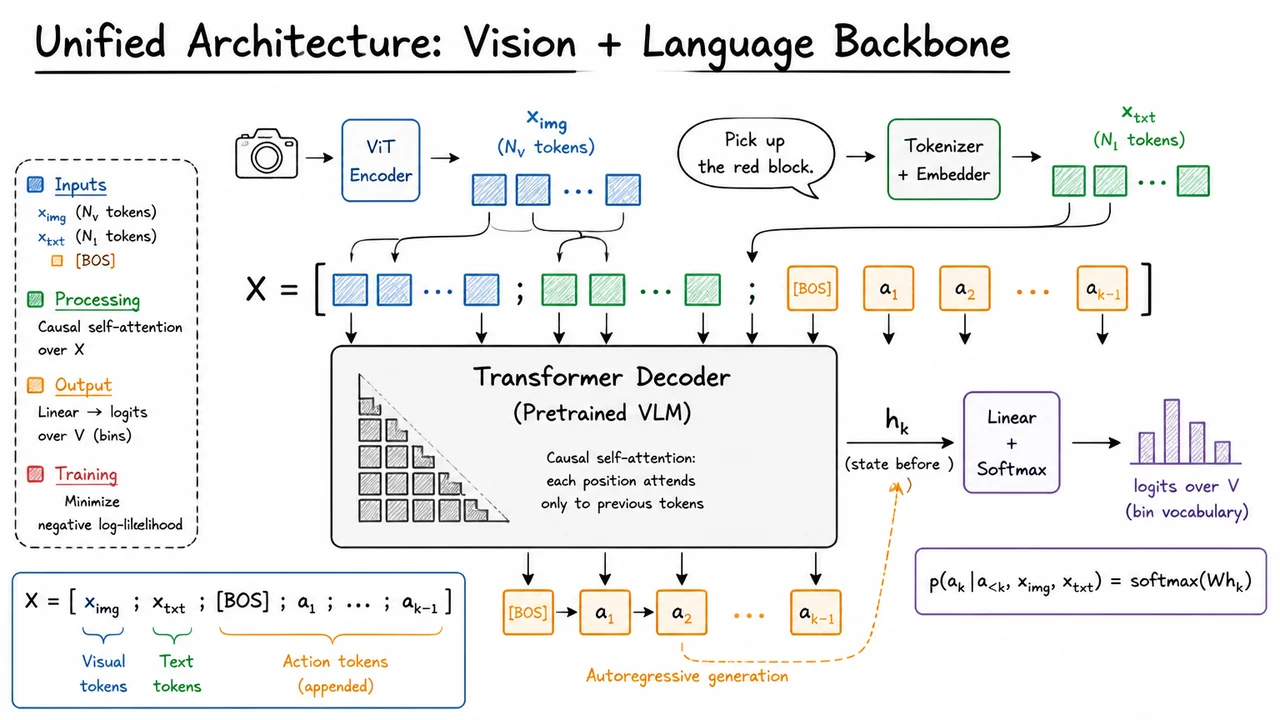
The gradient descent update from the previous section assumes we can compute the conditional probability of discretized action tokens given the current visual and linguistic context. But to actually compute that probability, we need a model—a concrete architecture that transforms raw pixels and instructions into a distribution over the next motor command. This is exactly what the Vision-Language-Action (VLA) policy does. Rather than stitching together separate perception, language, and control modules, a VLA treats the entire problem as autoregressive sequence modeling using a single transformer decoder. The backbone is initialized directly from a pretrained vision-language model (VLM), so the model already understands how visual concepts and linguistic instructions relate before it ever sees a single robot trajectory.
At the heart of the architecture is a unified token sequence that fuses all modalities into a format the transformer can consume. Visual input from a camera is first processed by a Vision Transformer (ViT), producing a set of patch embeddings we denote as —these are the visual tokens. Any text instruction (for example, “pick up the red block”) is tokenized by the language model’s native tokenizer into a sequence of text tokens . To signal the start of the action generation phase, a special <BOS> token is inserted. The full prefix before any action is simply the concatenation:
This flattened list of tokens is fed as the initial context into a causal transformer decoder. Because the attention mask is triangular (causal), each token may attend to all tokens to its left and never to future ones—crucially, the visual tokens can attend to one another bidirectionally within their own block (permitting dense spatial reasoning), but no token can peek ahead into the action tokens that have not yet been generated.
Action generation proceeds token by token. As described earlier when we discretized continuous actions into integer indices (bins), each action is represented by a sequence of discrete tokens. The model emits these one at a time, appending each newly sampled action token to the growing sequence. When predicting action token , the full input to the decoder is:
At the position immediately before —that is, at the last token of the sequence so far—the decoder produces a hidden state . We project this hidden state through a linear layer to obtain logits over the action vocabulary . The vocabulary consists of all discrete bin indices (typically 256 or 1024 bins per dimension, expanded across all action dimensions). The probability of the next token is then:
Because the model is causal, has attended to the entire visual scene, the language instruction, and every previous action token , but not to any future action. This ensures the autoregressive factorization matches the true conditional distribution.
Training mirrors the supervised imitation learning objective discussed earlier. The full sequence of ground-truth action tokens is appended after the <BOS> token, and the model is trained to minimize the negative log-likelihood of each action token given all preceding tokens. The loss decomposes per token position, and the gradient flows all the way back through the transformer layers, the vision encoder, and the text embeddings, jointly refining the entire stack. Since the backbone starts from a pretrained VLM, the early phases of training primarily adapt the representations to the low-level action prediction task while retaining the semantic understanding acquired from Internet-scale image–text data.
What makes this unified architecture particularly powerful is that it imposes no structural separation between vision, language, and action. The transformer decoder treats every token identically, learning attention patterns that entangle high-level semantics with fine-grained motor commands. A visual token from the robot’s gripper might directly attend to a text token containing the word “softly,” while simultaneously attending to the previous action token to maintain temporal coherence. This seamless fusion is impossible in modular designs that process vision and language separately before feeding features into an action policy network.
The visual below cements this abstract description into a concrete diagrammatic form. It shows how image frames are first converted into a grid of visual tokens (blue squares) by a ViT encoder, while the language instruction passes through a tokenizer to produce a chain of text tokens (green rectangles). Both streams merge into a central Transformer Decoder box, where a triangular causal mask is overlaid to reinforce the left-to-right attention constraint. Beneath the decoder, an orange <BOS> token initiates the action generation loop: each predicted action token a₁, a₂, … is fed back autoregressively via a curved arrow, and the final hidden state after each prediction passes through a linear projection and softmax to emit probabilities over the bin vocabulary. This compact schematic encapsulates the complete VLA design—a single autoregressive model that ingests pixels and words to produce robot actions.
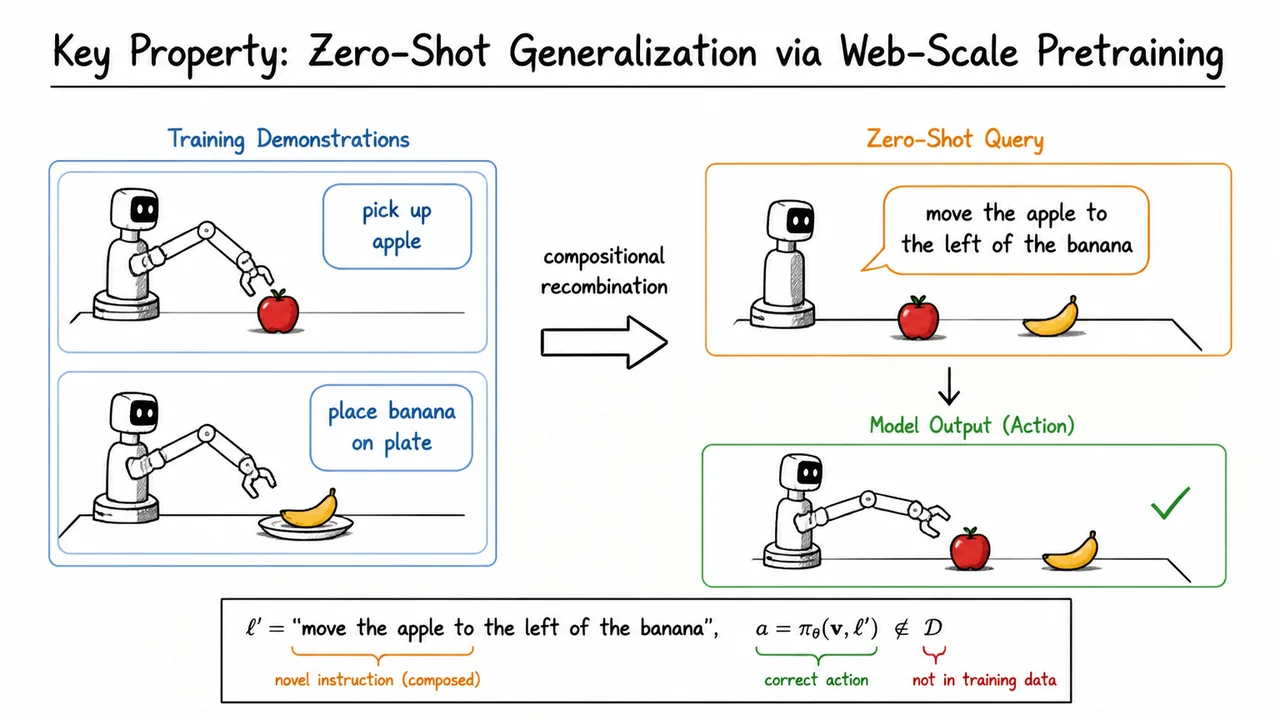
With a unified vision–language backbone in place, we can now turn to the property that genuinely separates large-scale vision–language–action models from more modular robotic pipelines: the ability to perform compositional zero‑shot generalization. Whereas a conventional behavior‑cloning policy can only regurgitate the specific task–instruction pairs it saw during training, a VLA initialized from a web‑scale VLM and co‑fine‑tuned on a modest set of robot demonstrations can follow instructions that combine visual concepts in novel ways—commands that never appeared in any training episode.
To see why this matters, consider the core limitation of vanilla behavioral cloning. If a robot has been trained to pick up the apple and to place the banana on a plate, it has no intrinsic mechanism to understand the completely new instruction move the apple to the left of the banana. The necessary constituents—the apple object, the banana object, the spatial relation “left of,” and the motor skill of arranging objects—are present in isolation, but the policy has never observed their particular conjunction. Standard imitation learners would either produce a meaningless action or default to a coarse nearest-neighbor behavior. VLAs overcome this barrier by inheriting the rich compositional representations that the VLM acquired from internet‑scale image–text data.
The underlying theorem can be stated crisply. Let be a VLA policy initialized from a VLM pre‑trained on massive web data and subsequently co‑fine‑tuned on a robot demonstration dataset . For any novel instruction whose constituent visual concepts—objects, attributes, spatial relations—have each appeared separately in , the policy correctly interprets given the visual input and outputs the appropriate action token sequence , even though the pair is not in . In other words:
yet the robot moves the apple to the left of the banana. This is the emergent zero‑shot generalization that large VLAs unlock.
The reason this works lies in the alignment of two learning phases. During web‑scale pre‑training, the VLM learns to map images and text into a shared representation space where compositionality is deeply encoded. The notion of “left of” is not merely a token; it is a geometric relation that the model has seen paired with millions of images, allowing it to ground spatial language in visual coordinates. Objects like “apple” and “banana” are already tied to visual features and semantic affordances. When the model is co‑fine‑tuned on robot data, it only needs to align this pre‑existing compositional space with the action output head. The fine‑tuning teaches the model to translate visual–linguistic patterns into motor commands, but it does not have to learn relational reasoning from scratch. As a result, a command that recombines familiar pieces—even if those pieces were never co‑occurring in the robot’s training set—can still be faithfully parsed and executed because the model’s internal representation already “understands” the novel combination.
This effect is fundamentally different from what happens in a modular system that pairs a frozen vision‑language model with a separately trained action policy. In a modular stack, the VL module might produce a symbolic scene graph or a task embedding, but the action policy is trained only on the limited pairs seen in the robot dataset; it cannot automatically reuse the internal compositional structure of the VL module. In a VLA, by contrast, the entire transformer processes the visual tokens and instruction tokens jointly, and the final token‑level losses backpropagate through the whole stack during fine‑tuning. This end‑to‑end alignment allows the action head to tap directly into the VLM’s latent representations, enabling the recombination of separately observed concepts into a previously unseen, coherent behavior.
The practical implications are profound. A VLA trained on a few hundred demonstrations that cover a modest inventory of objects and primitive skills can suddenly execute rich, open‑ended commands like “move the apple to the left of the banana and then place the banana on the red plate.” Such systematicity parallels the long‑standing challenge of combinatorial generalization in neural networks: a model should be able to recombine known building blocks in novel ways just as a child does. VLAs show that the scale and diversity of web‑data pre‑training are sufficient to bootstrap exactly this capacity, without requiring explicit compositional architectures or symbol‑grounding‑by‑design.
Stepping back, the diagram included with this section offers a clear visual summary of the generalization proof. On the left, two panels labeled Training Demonstrations show the robot performing the simple tasks it actually observed: picking up an apple and placing a banana on a plate, each with its corresponding instruction. On the right, a panel titled Zero‑Shot Query depicts the robot facing a table with both objects and a speech bubble containing the novel command “move the apple to the left of the banana.” A broad arrow bridging the two sides is annotated compositional recombination, signaling that the model internally fuses the separately learned concepts to produce a correct new action—here, the robot slides the apple leftward. The color palette (light blue for training, orange for the query, green for the output action) reinforces the transition from known fragments to a never‑before‑seen whole. The visual encapsulates the idea that the VLA does not merely remix examples; it performs a genuine semantic composition, grounding a novel instruction through a representation space that was already structured by web‑scale pretraining and refined by robot‑specific fine‑tuning.
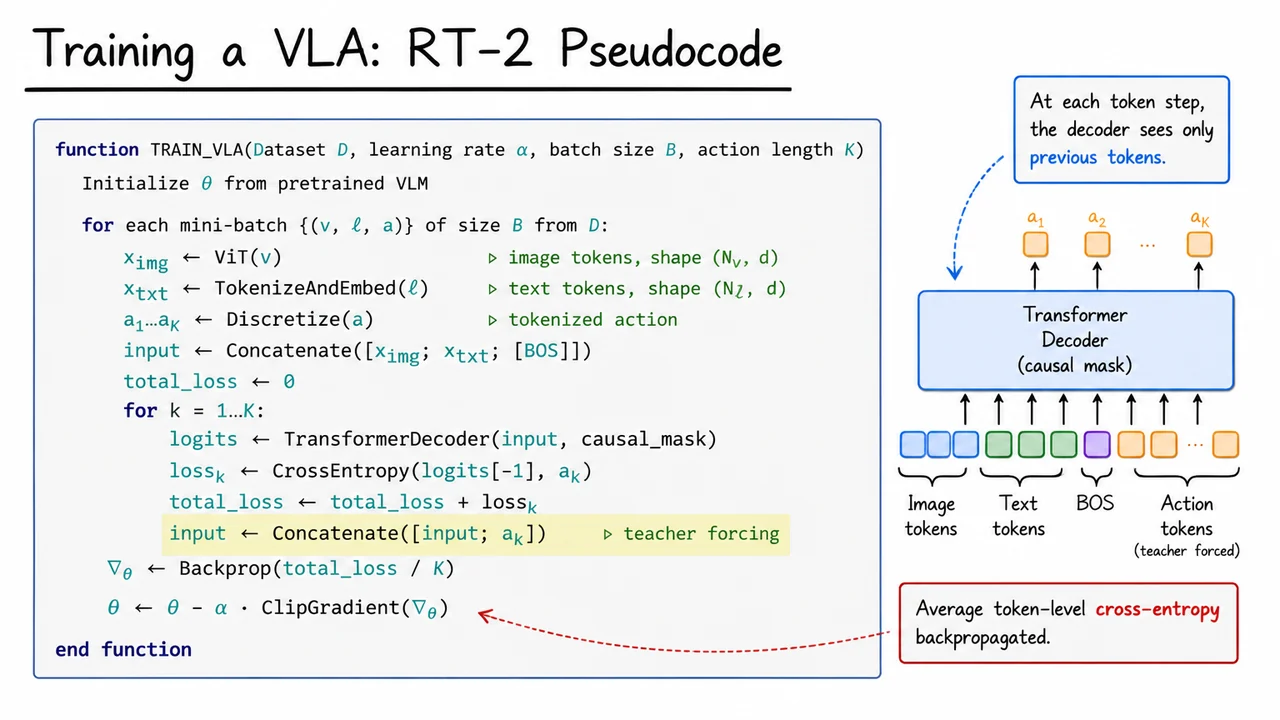
Having established that a VLA can inherit remarkable zero-shot generalization when it is built atop a vision–language model trained on web-scale data, we now turn to the concrete question: how do we actually train such a model to produce robot actions? The answer is an elegant extension of the autoregressive language modeling recipe, adapted to multimodal contexts and continuous motor commands. At its heart, the training procedure treats the robot’s action as a sequence of discrete tokens and simply maximizes the likelihood of those tokens given the image and text instruction—a supervised, end-to-end imitation learning loop that shares the same cross-entropy objective used to train the original VLM.
The first design choice is representing actions in a way that a Transformer decoder can predict token by token. A real robot action is usually a vector of continuous values—joint angles, end-effector velocities, gripper openness. To make this compatible with a next-token objective, each dimension is discretized into bins. For example, an angle in might be partitioned into 256 uniformly spaced bins, each assigned a unique token ID. The full action is then serialized into a fixed-length token sequence , where is the total number of tokens across all action dimensions. This discretization step, denoted in the algorithm, converts a heterogeneous, continuous motor command into a list of symbols that can be generated by the same vocabulary that already contains natural language subwords.
With discrete action tokens in hand, the training loop mirrors standard language modeling with teacher forcing. For a given episode sample—an image observation , a language instruction , and the demonstrated action —the image is embedded with a vision transformer into a sequence of feature vectors. The instruction is tokenized and embedded into of length . The two modality streams are concatenated together with a special beginning-of-sequence token, forming the initial input to the decoder. The decoder is a causal Transformer that can attend only to positions up to and including the current token, ensuring that when predicting action token , it has no access to future action tokens. At each step , we feed the ground-truth previous tokens (teacher forcing) to compute a logits vector, from which the cross-entropy loss for the -th token is derived:
The total loss for the action sequence is simply the sum (and later averaged) over all tokens:
This objective directly incentivizes the model to replicate the exact tokenized action sequence observed in the demonstration dataset. Because the decoder is causal, this training also naturally learns the conditional distributions required for autoregressive sampling at inference time.
While the loss formulation is straightforward, training large VLA models at scale requires careful optimization hygiene. The weights are initialized from a pretrained, frozen VLM checkpoint—the VLM itself is no longer updated on its original tasks, but its rich visual and linguistic representations provide the starting point for action fine-tuning. All parameters are then trained on the robotics data with mini-batch stochastic gradient descent. To prevent destructive large updates that could erase the valuable web-scale priors, gradient clipping is applied before the parameter update:
where is the learning rate and is the average token-level cross-entropy across a batch of demonstrations. Gradient clipping truncates the norm of the gradient vector to a maximum threshold, a technique that is especially important when fine-tuning a model already saturated with knowledge from diverse internet data.
A few practical nuances round out the picture. The teacher-forcing step—concatenating the ground-truth token back into the input before predicting —is highlighted as a distinct operation because it is the mechanism that keeps the training distribution aligned with the inference-time autoregressive generation. During backpropagation, the total loss is divided by to compute the average token-level loss, ensuring that the gradient magnitude does not implicitly scale with the number of action tokens, which could vary if different action spaces are used. The visual below captures the full RT-2 style training loop in a clean pseudocode block: the image tokens, text tokens, and discretized action tokens flow into a Transformer decoder with a causal mask, the token-level losses are accumulated, and the optimizer updates the weights after gradient clipping. Notice how the teacher-forcing line receives a subtle warm highlight—this is the core “scaffold” that allows the VLA to learn action generation as a faithful conditional language model, distilling demonstration data into generalizable robotic skills.
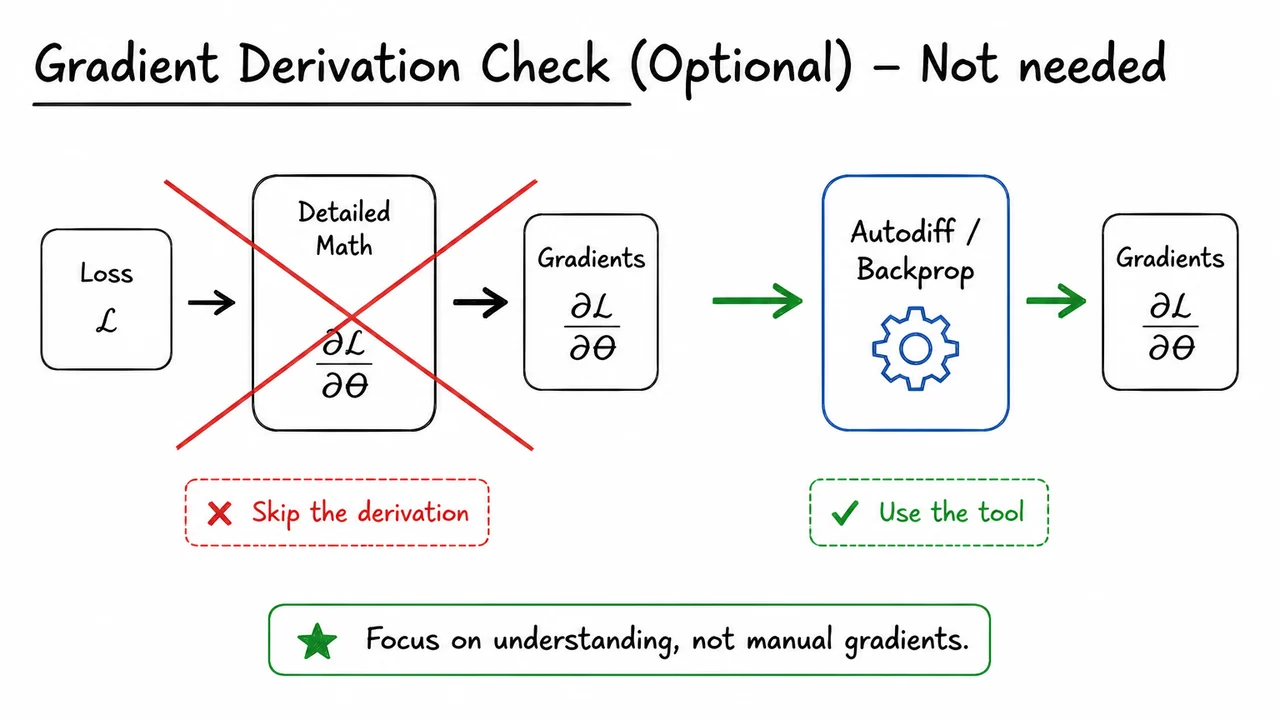
After walking through the pseudocode that assembles a training example—interleaving visual features, language tokens, and action tokens into a single sequence—you might expect the next step to be a detailed derivation of the gradients that flow through an RT‑2 model. In fact, if you are familiar with training autoregressive language models, you already know everything you need. The loss function remains the same token‑level cross‑entropy that powers every modern text generator, repurposed here for the specific action tokens that represent robot commands. The beauty of the VLA paradigm is that it does not invent a new training objective; it simply casts robot behavior as a language modeling problem and then lets a transformer learn the conditional distribution of actions given multimodal contexts.
Concretely, the model consumes a sequence of tokens that may include encoded image patches, text tokens from an instruction, and action tokens like “move left by 3 cm” or a bin identifier for a discretized velocity. At each position where a target token is provided (typically the action tokens and sometimes the language tokens if you continue to supervise instruction following), the model produces a vector of logits over the vocabulary of size . These logits are converted to probabilities via a softmax: The per‑token loss for the ground‑truth token (represented as an index) is the negative log‑likelihood: The total training objective is simply the average of these losses over all supervised positions: where is the set of token indices that we care about—typically the action tokens (and optionally language tokens) in the sequence.
The gradient of this loss with respect to the model parameters is obtained by standard backpropagation. For those who enjoy dotting every “i,” the local gradient of the cross‑entropy with respect to the logits is the well‑known “softmax minus target” form: where is 1 if and 0 otherwise. This gradient propagates backward through the transformer layers, through the visual encoder (if it is also fine‑tuned), and through the embedding layers exactly as it does in any language model that uses a softmax output layer. No part of the VLA formulation introduces a new loss surface or a nonstandard differentiation step. The fact that some input tokens are derived from pixels while others are text does not alter the computation; the network simply sees a sequence of embedding vectors, and the cross‑entropy supervision is applied only at selected output positions.
This transparency is one of the strongest arguments for the VLA approach. When RT‑2 successfully picks up a previously unseen object after a natural‑language command, it is not because someone crafted a clever robotics‑specific loss; it is because the same transformer that learned to continue sentences on the web also learned to continue a hybrid visual–language sequence into meaningful action tokens. The gradient derivation reduces to a routine exercise that most practitioners can safely skip. If you are implementing the training loop, you can simply call a standard CrossEntropyLoss on the predicted logits and target action tokens, then call .backward(). The framework will handle the rest.
For this reason, the lecture properly labels the derivation as “optional” and, with a touch of humor, “not needed.” The visual accompanying this point is deliberately minimal: a slide whose title declares exactly that. It probably contains nothing more than a clean, hand‑drawn box around the phrase “Gradient Derivation Check (Optional) – Not needed,” perhaps accompanied by a tiny note like “Cross‑entropy gradient = ” and a stylized arrow suggesting that we can move on. This at‑a‑glance reminder is not a denial of the underlying mathematics, but a statement that the machinery is so well understood that we can devote our attention to more pressing matters—like failure modes, sim‑to‑real transfer, and the emergent behaviors that make scaling laws for robotic manipulation so exciting.
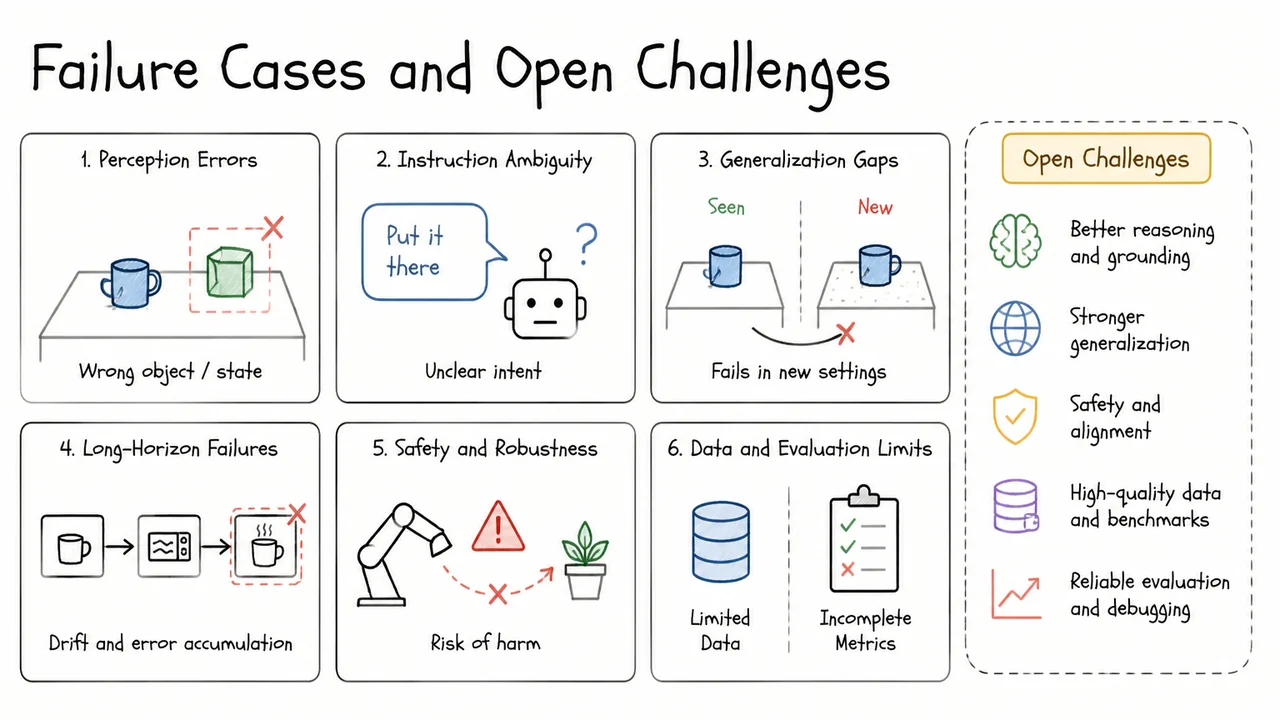
Having established the formulation and training objectives of vision-language-action models, it is tempting to survey the polished demos and conclude that the fusion of internet-scale pretraining with action prediction almost solves robotic control. But transferring a model from a dataset of static images and text to the kinetic, high-stakes, and unforgivingly continuous world of a physical robot reveals a set of failure modes that are both subtle and practically consequential. The very architecture that grants RT‑2 its remarkable semantic fluency — an autoregressive transformer decoding discretized action tokens conditioned on images and instructions — also brings with it a specific catalogue of brittleness. Understanding these limitations is not a footnote; it is essential for anyone who wants to deploy VLA models in real-world settings or to push the research frontier forward.
One of the most stubborn sources of failure is the mismatch between the pre‑training distribution and the deployment environment. VLAs inherit visual and linguistic knowledge from enormous corpora scraped from the web, but the robot’s camera feed, the texture of its gripper, the lighting in a kitchen, and the physics of object interaction are alien to that prior data. The model often relies on spurious visual shortcuts — such as the presence of a tablecloth correlated with a particular action in the training set — that do not survive a change of scenery. When a VLA encounters a scene that is semantically familiar yet visually out-of-distribution, the generated action tokens can drift toward a “nearest neighbor” behavior that is physically nonsensical: the robot might attempt to pick up a transparent bottle by its reflection, or it might plan a trajectory that passes straight through a table it has never seen rendered from a certain angle. These out-of-distribution failures are silent and confident, because the softmax output of the action head still assigns high probability to a wrong but well‑formed token sequence.
Compounding this is the fundamental fragility of supervised imitation learning on finite, expert‑trajectory datasets. The VLA is trained to maximize the likelihood of the next action token given the current image and language instruction, exactly as one would train a language model. But at deployment the model must generate entire action sequences auto‑regressively, feeding its own previous outputs as context. Small prediction errors drift the state into regions never visited by the expert, where the model has no corrective signal. This covariate shift is especially pernicious in robotics: a tiny over‑rotation of the wrist by a few degrees can change the visual scene just enough to make the next token utterly wrong, cascading into a failed grasp or a collision. Unlike language, where a slightly misspelled word may still permit a coherent sentence, a slightly wrong joint angle destroys the task’s geometry. In effect, the model’s causal chain makes it a high‑stakes open‑loop controller that only occasionally gets corrected by fresh visual observations; the lag between error and correction is often too long.
The discretization of continuous actions into token bins — a necessary step to reuse the transformer’s categorical prediction machinery — introduces its own class of errors. When the robot needs to move its end‑effector by exactly 3.2 cm, but the nearest bin centers correspond to 2.8 cm and 3.6 cm, the policy inevitably picks one and delivers a slightly wrong displacement. The resulting positional error may be tolerable for coarse manipulation but deadly for tasks like peg‑in‑hole insertion or threading a zip tie. Moreover, the fixed bin ranges must be chosen a priori; an action that demands a velocity exceeding the bin limit is clipped, turning a fast arm swipe into a hesitant inching motion or, conversely, an intended gentle nudge into a jerky burst. The loss of fidelity per token compounds across a multi‑step trajectory, so that even if individual token probabilities are well‑calibrated, the resulting end‑effector path can jitter, overswing, or stall entirely.
Safety challenges are inseparable from VLA deployment. An autoregressive action head has no intrinsic notion of danger; it only learns to imitate the expert’s cautious pauses or collision‑free trajectories because those patterns appear in the data. When the model generalizes to a novel instruction — say, “sort the fragile glasses by color” — it may generate a sequence of swift, forceful movements that, while statistically plausible under the language‑conditioned distribution, would shatter glassware. The model can also produce actions that are kinematically impossible or self‑damaging, like commanding a joint angle beyond the robot’s physical limit, because the token vocabulary of bin centers is not constrained by the robot’s true feasible set. Adding safety filters post‑hoc (e.g., a separate collision‑detection module) can reject dangerous tokens, but that breaks the end‑to‑end promise and can create a brittle, adversarial interplay between the policy and the filter.
Beyond individual failure snapshots, VLA models struggle with long‑horizon tasks that require memory, planning, and adaptation. The single‑camera image and text prompt at each time step provide only a thin slice of context. If a task involves “fetch the book from the shelf, then place it on the table, but only after clearing the cup from the table,” the model must remember its progress through sub‑goals, maintain a mental state of what has already been moved, and re‑plan if an object rolls away. Existing VLAs implicitly try to encode such state in the transformer’s hidden activations and in the past action tokens fed back as context, but this mechanism is opaque and unreliable. The result is often a robot that repeats an action, skips a step, or fails to detect that an earlier sub‑goal was not actually achieved. Sequence‑level planning capabilities that emerge in large language models do not automatically transfer to the action domain because the consequences of a wrong thought are not just an unhelpful next token but a physical mis‑step that changes the world irreversibly.
These observed failure modes point toward a set of open challenges that define the current frontier of VLA research. A central challenge is to move beyond pure imitation of static expert trajectories and incorporate forms of interactive or reinforcement learning that let the model experience the consequences of its own actions, either in simulation or through real‑world fine‑tuning. Another challenge is to design action representations that bridge the continuous–discrete divide more gracefully — for example, using hierarchical action tokens, diffusion‑based action heads, or learned residuals to recover fine motions lost to binning. Scaling laws for embodied data are poorly understood: we know that more internet text and images help language and vision, but we do not know how much real robot interaction data is needed to make a VLA robust, how the ratio of pre‑training to fine‑tuning determines generalization, or whether purely simulated interactions can ever suffice. Safety remains an unsolved problem, demanding not only better constraints but also interpretability methods that can explain why a particular action token sequence was emitted, so that an engineer can trust the policy enough to let it out of the lab.
The hand‑drawn summary below distills these failure cases and open challenges into a single glanceable canvas. Each sketch — a robot arm missing a grasp, a predicted trajectory colliding with an obstacle, an action bin overshooting a target — corresponds to one of the categories of limitation discussed above. The diagram does not attempt to reproduce the technical nuances verbatim; instead, it uses the visual vocabulary of Excalidraw’s imperfect lines and sparse labels to communicate that the path from pixels and instructions to safe, reliable robot actions is dotted with unsolved puzzles. The callouts remind us that while VLAs like RT‑2 represent a genuine breakthrough, the road ahead involves bridging the sim‑to‑real gap, closing the loop with physical feedback, taming compounding errors, and imbuing the model with a sense of bodily and environmental constraint that no amount of static internet text can teach.
We ended the previous section by confronting the failure cases that still haunt vision‑language‑action systems: fragile instruction following, brittleness under distribution shift, and a lack of common‑sense grounding. Those challenges are real and remind us that robotic learning remains far from solved. Yet they also set the stage for asking a more hopeful question: what happens when we simply scale the pretraining, both in data and model size, and then gently steer the result toward actions? The answers provided by RT‑2’s evaluation are striking, and they show that large‑scale vision‑language pretraining can give rise to capabilities that look almost emergent.
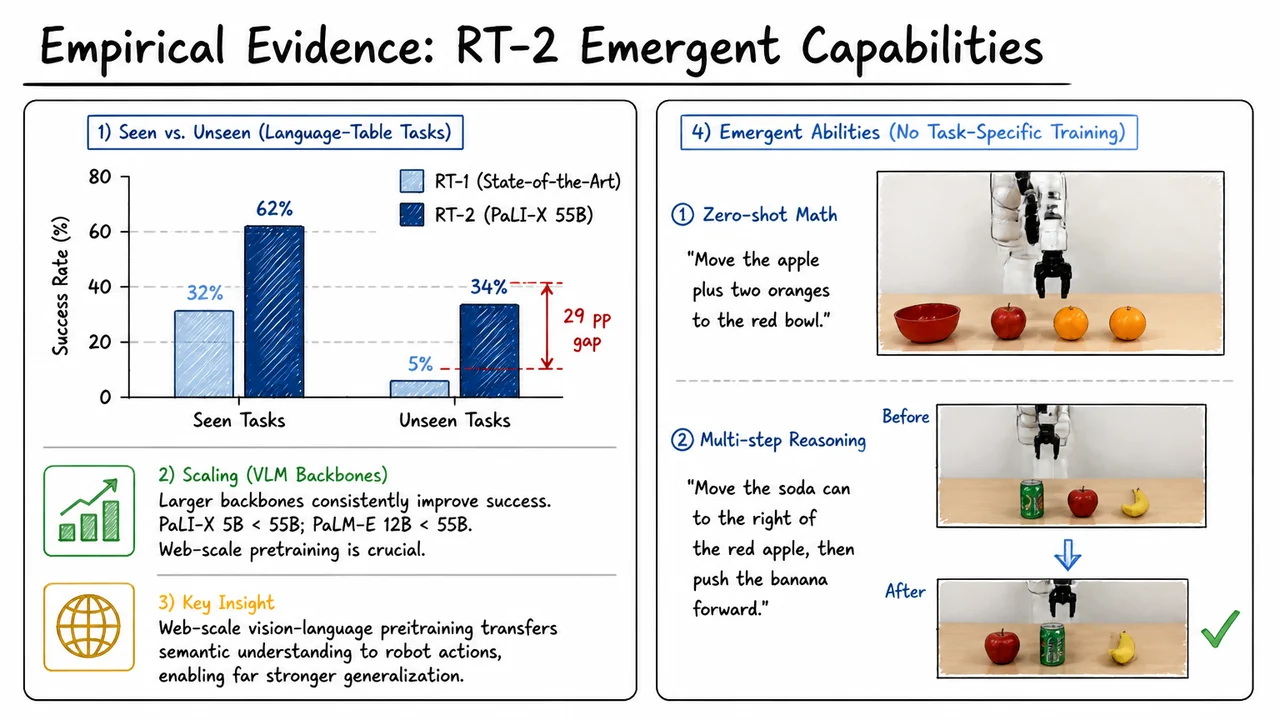
The core experimental apparatus is the language‑table benchmark, where a robot manipulates objects on a tabletop according to natural language commands. The tasks are deliberately split into two disjoint sets: seen instructions that appeared during fine‑tuning, and unseen instructions that require genuine semantic interpretation — sentences that the model never heard paired with robot actions but that a human would find trivial, such as “place the red block near the yellow mug” when only “put the block next to the cup” was in the training distribution. This split cleanly separates memorization from generalization. The metric is straightforward:
where an episode is successful only if the final object arrangement matches the instruction exactly.
When RT‑2 (using the 55B‑parameter PaLI‑X backbone) is compared to RT‑1, the previous state‑of‑the‑art model trained from scratch on robot data, the bar chart tells a dramatic story. On seen tasks, RT‑1 manages 32% while RT‑2 reaches 62% — a clear sign that web‑scale pretraining provides a stronger inductive bias even for known commands. The real revelation, however, lies in the unseen tasks: RT‑1’s success rate collapses to a mere 5%, barely above random, whereas RT‑2 achieves 34%. That 29‑percentage‑point gap is not merely a score improvement; it represents the difference between a model that has memorized a set of instruction–action templates and one that genuinely understands object relations, spatial terms, and compositional language — and can spontaneously map that understanding into robot motions it was never explicitly taught.
This leap in generalization is not a quirk of a single architecture. Ablation studies systematically vary the pretrained backbone: PaLI‑X at 5B and 55B parameters, PaLM‑E at 12B and 55B. In every case, larger models yield higher success rates, and any form of web‑scale vision‑language pretraining outperforms training solely on robot data. The key insight is that the semantic representations learned from Internet‑scale paired images and text are already close to what a robot needs; the remaining gap to action tokens can be bridged with relatively little robot‑specific data, and the resulting model inherits the flexible reasoning of its language‑vision foundation.
This brings us to the most exciting empirical findings: tasks that were never part of the robot training distribution yet succeed on the very first attempt — a phenomenon the authors call emergent capabilities. Two examples stand out:
These abilities are not taught directly; they emerge because the pretrained vision‑language model already handles math word problems, spatial reasoning, and instruction following in the text and image domains. When fine‑tuned to output action tokens, those capabilities remain and begin to operate on real‑world perceptual inputs and motor commands.
The visual below consolidates this evidence elegantly. On the left, a grouped bar chart contrasts the success rates of RT‑1 and RT‑2 on seen and unseen instructions, with the unseen‑task bar for RT‑2 prominently emphasized to underscore the generalization leap. The raw numbers — 5% vs 34% — are the empirical anchor for the claim that semantic understanding transfers to physical actions. On the right, a pair of video‑style stills illustrates one of those emergent multi‑step commands in action: an initial scene with a soda can, red apple, and banana on the table alongside the instruction, and the final arrangement where the can sits correctly to the right of the apple and the banana has been pushed forward. The green checkmark signals a successful trajectory that required zero task‑specific training. Taken together, the chart and the snapshot encode the central message of RT‑2: scale and multimodal pretraining unlock robotic generalization that looks, from any previous standpoint, like an emergent property of the full vision‑language‑action stack.
In the previous section we saw how large-scale VLA models like RT‑2 acquire surprisingly general visuomotor behaviors—chain‑of‑thought reasoning, symbol manipulation, and even multi‑lingual instruction following—by scaling the same simple training recipe. To understand why that recipe works at all, it helps to compress the whole pipeline into the smallest meaningful example that preserves the core mechanics: a pick‑and‑place task on a miniature grid. Doing so strips away the sensor noise, complex kinematics, and massive web‑scale corpora that usually obscure the fundamental learning problem. What remains is a clean supervised imitation learning setup where every design choice—tokenization, input concatenation, autoregressive decoding, and loss computation—can be examined in isolation.
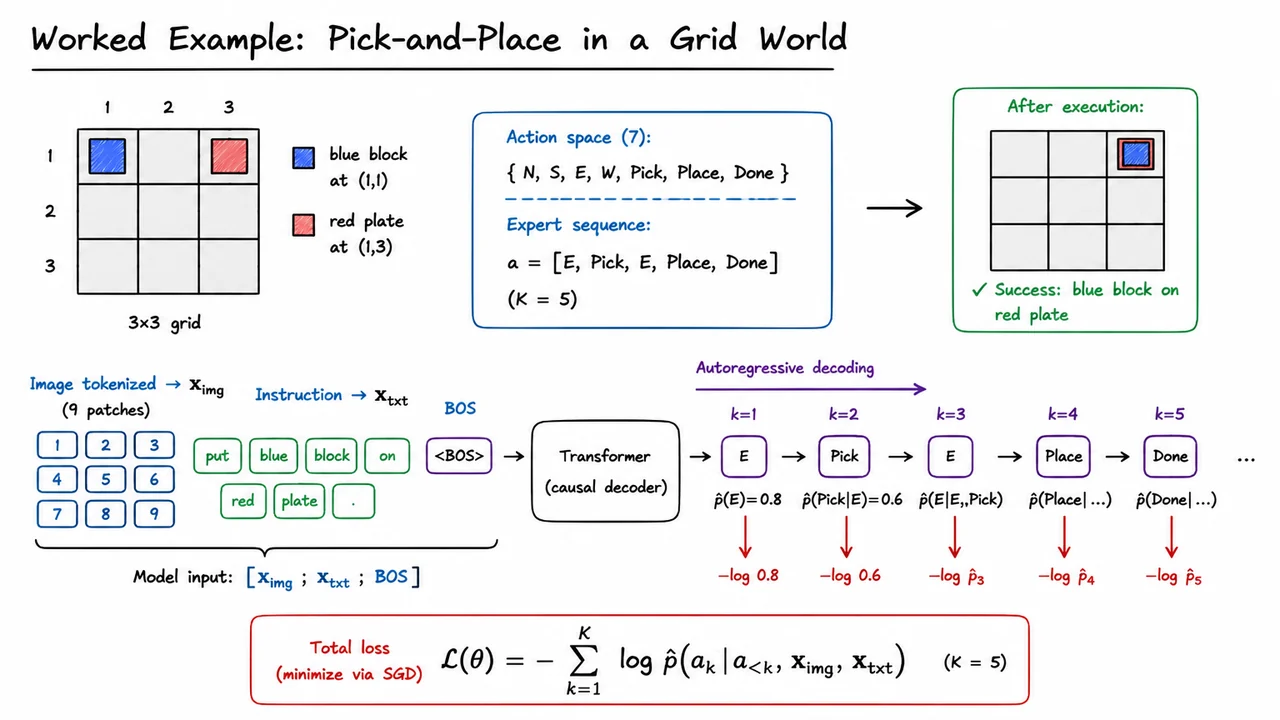
We start with a 3×3 board. A blue block sits in the top‑left corner at coordinates (1,1), and a red target plate occupies the cell three steps to the east at (1,3). The robot observes the scene through a camera; for our abstraction this single view is split into 9 equal patches, each mapped to a learned visual token that captures local appearance and spatial structure. These nine patch tokens together form the image conditioning vector . Separately, a language instruction—something as simple as “put the blue block on the red plate”—is tokenized into a sequence of text embeddings . The model never sees raw pixels or characters; it only sees these pre‑digitized token streams, exactly as a large VLA would after passing the same sensorimotor signals through a pretrained visual encoder and a frozen language model.
The action space is deliberately tiny: just seven discrete tokens {N, S, E, W, Pick, Place, Done}. Each token corresponds to a single motor primitive that moves the gripper one cell north, south, east, or west, closes the gripper to pick, opens it to place, or signals episode termination. The expert trajectory that successfully transfers the blue block to the red plate is the sequence —an eastward move, a grasp, another eastward move, a release, and a stop. With the board as drawn, this is the unique shortest successful path, making the supervision unambiguous. The training objective is to maximize the likelihood of this five‑step sequence given the image and language context, i.e., to solve a five‑class classification problem at each time step, but crucially with access to the previously predicted actions.
To construct the model input, the visual tokens , the text tokens , and a special beginning‑of‑sequence token BOS are concatenated into a single long sequence. This flattened sequence is then fed into a causal transformer decoder. Because the attention mask is causal, the model cannot peek at future action tokens; it must generate the next action solely from the multimodal prefix. At the first decoder step after the prefix, the model outputs a probability distribution over the seven action tokens, predicting which action should come first. The training signal compares this distribution to the ground‑truth token, using a standard cross‑entropy loss: . For example, given the prefix alone, the model might assign probability 0.8 to the correct “E”, giving a loss contribution of . This single scalar pushes the model to increase its confidence in the correct direction.
The crucial step is that the model subsequently consumes the previously predicted token (in training this is the ground‑truth token, teacher‑forced) and conditions the next prediction on the full history. After having “seen” the first E, the model is asked to predict the second action. Here it might assign probability 0.6 to “Pick”, incurring loss . The process repeats for all five time steps, accumulating a total loss , where . During training this quantity is minimized by stochastic gradient descent—the same SGD update rule introduced in an earlier slide—backpropagating through the transformer, the token embeddings, and ultimately into the visual and language encoders that produced and in the first place.
What makes this loss so powerful is that it forces the model to internalize the entire causal structure of the task. To assign high probability to “E” at the first step, the model must spatially ground the instruction: it must identify the blue block’s location, the target plate’s location, and the fact that moving east is the correct initial displacement. To then produce “Pick” after a successful E, it must understand the state change implied by the movement and apply the picking primitive when the gripper is positioned over the block. The autoregressive factorization ties these sub‑decisions together: a mistake early in the sequence makes later correct predictions nearly impossible, so the model is incentivized to learn a globally consistent plan, not just a bag of isolated classifications. If the predicted path ever diverges from the expert sequence, the cross‑entropy loss for the remaining steps becomes extremely large, heavily penalizing cascading errors.
After training, the same autoregressive mechanism is used for rollout: the model is given the image and text prefixes, a BOS token, and it greedily samples the action with highest probability (or uses temperature‑based sampling) one step at a time, feeding each predicted token back into the input for the next time step. The physical robot then executes the resulting discrete commands. In our grid world, the model ultimately outputs E, Pick, E, Place, Done, and the blue block ends up on the red plate. This tiny success proves that the training objective alone—cross‑entropy on tokenized actions conditioned on multimodal prefixes—is sufficient to learn grounded, sequential behavior when the model is expressive enough and the expert data is coherent.
The visual below takes this microcosm and renders it as a single flow diagram. On the left, the 3×3 grid with the blue block and red plate anchors the spatial setup. The image patch tokens and text tokens appear as small ordered blocks, followed by the BOS marker, all feeding into an arrow that moves step‑by‑step through the predicted action sequence. Each predicted token is annotated with its hypothetical probability—0.8 for E, 0.6 for Pick—mirroring the training‑time loss contributions. Beneath the sequence, the total loss equation is displayed in large type, underscoring that all the machinery we just described is ultimately measured by this one scalar. The diagram condenses the grid, the tokenization, the autoregressive decision chain, and the optimization target into a single glance, making the abstract training algorithm tangible before we step back and situate VLA training in the broader landscape of robot learning.
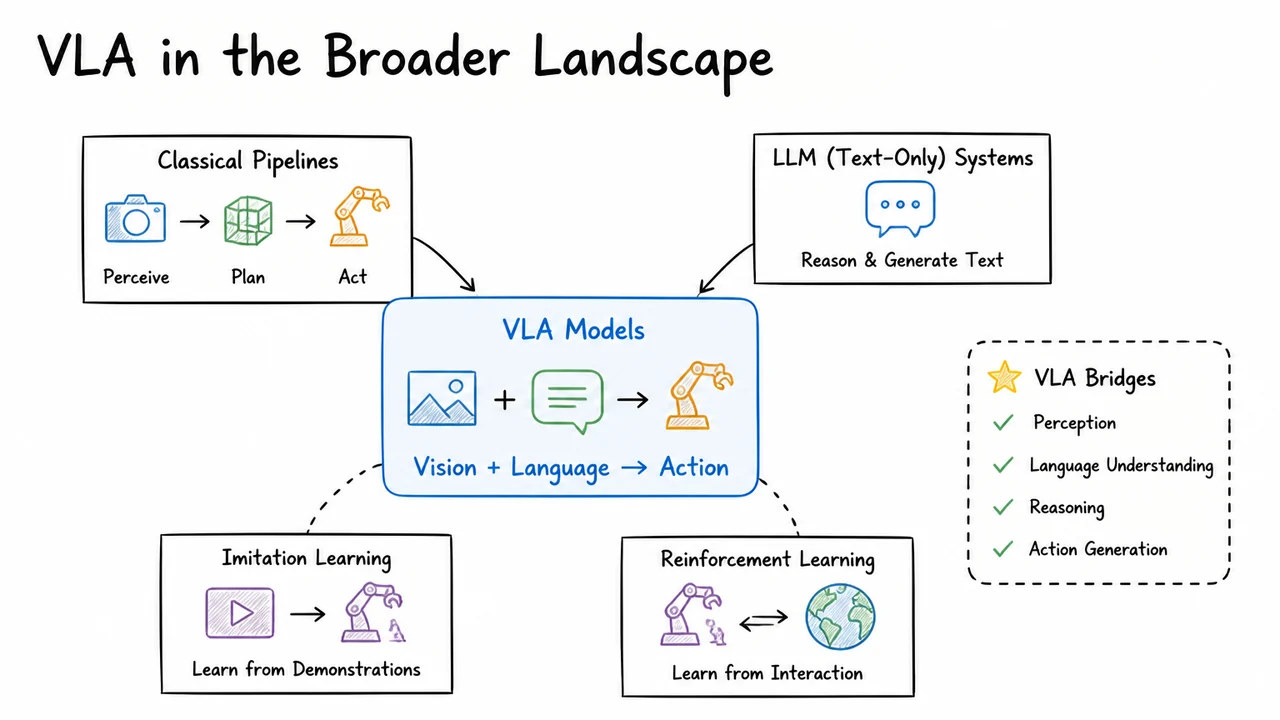
With a concrete picture of how actions can be tokenized and predicted token‑by‑token in a constrained grid world, we can now step back to place the VLA approach inside the broader robot‑learning landscape. For years, the dominant camps built either vision‑only systems that ignored natural language, or language‑only planners that assumed a perfect symbolic perception layer. Real‑world instruction‑following, however, demands a tight coupling between pixels, words, and physical motions: a “pick up the red block” command is meaningless if the robot cannot ground red in the sensor stream, and a generic grasping policy will fail if it has no way to connect the uttered verb pick with the correct affordance. The VLA design is a direct answer to this limitation, but it helps to compare it with the two most common alternative recipes that also attempt to unite vision, language, and action.
The first alternative is the modular VL + action‑policy pipeline. In this recipe, a pre‑trained vision‑language model (for instance, CLIP or a frozen Flamingo backbone) acts as a feature extractor that maps an image and a language instruction into a single embedding vector. A downstream, separately trained action policy—often a simple MLP, a recurrent neural network, or a behavior‑cloning (BC) head—then maps that embedding to motor commands. This modularity is appealing: it re‑uses powerful VL priors without requiring joint training on scarce robot data. Yet the fragility is equally clear. The frozen VL encoder was never optimized for the fine‑grained visual details that matter for manipulation—things like the exact pose of a grasped object, the geometry of a contact point, or the subtle depth cues that disambiguate a successful insertion. Moreover, there is no end‑to‑end gradient signal that can shape the visual‑language representations to be action‑relevant; the two stages are trained on different objectives and often on disjoint datasets. As a result, the system often exhibits brittleness when the scene differs from the VL training distribution, or when the instruction demands compositional understanding that the frozen encoder simply did not capture.
The second alternative, vanilla behavioral cloning from pixels, typically ignores language altogether. It collects a dataset of (observation, expert action) pairs and trains a deep network to map raw camera images and optionally a task‑specific one‑hot task‑id to low‑level motor torques or joint velocities. When successful, it can produce smooth, reactive policies for a fixed task. But without a language interface the robot is stuck in a pre‑defined repertoire; it cannot generalise to new task descriptions, follow previously unseen instructions, or even gracefully degrade when a user issues a command outside its training set. Language is the vehicle for compositionality and open‑ended task specification, and behavior cloning alone leaves that powerful capacity on the table.
The VLA paradigm unifies everything: a single, end‑to‑end model takes in pixels and a language instruction, then outputs a sequence of action tokens autoregressively—often the very same transformer backbone that next‑token‑predicts text also predicts discretised robot actions. This design lifts several constraints at once.
End‑to‑end gradients flow from the action prediction loss all the way back into the vision‑language backbone, aligning visual features with the ultimate motor command.
Discretising the action space (via binning, vector quantization, or mapping to a fixed‑sized codebook) transforms continuous control into a token prediction problem, which can be trained with the same maximum‑likelihood objective and the same scalable transformer machinery that have proven so effective in large language and vision‑language models.
Leveraging pre‑trained VLMs (as done in PaLM‑E, RT‑2, and others) bootstraps an enormous amount of world knowledge and visual‑conceptual grounding, and then a comparatively small amount of robot demonstration data suffices to fine‑tune that knowledge into a capable robot policy.
The experimental landscape strongly supports this integration. In large‑scale VLA models such as RT‑2, one sees emergent capabilities that modular pipelines and vanilla BC simply cannot reproduce. For example, when asked to “pick up the extinct animal” from a set of plastic figurines, RT‑2 correctly selects the dinosaur without ever having seen that precise phrase in its robot training data—a feat that depends on the web‑scale language grounding absorbed during VL pre‑training. The model also demonstrates robustness to visual distractors, an ability to follow chain‑of‑thought style reasoning when prompted, and a startling degree of generalization to new object instances, new verbs, and even new combinations of known concepts. The numbers tell the story: across a suite of novel instruction evaluations, RT‑2 significantly outperforms baselines such as a frozen PaLI‑X encoder followed by a BC policy, and even better models that co‑train vision‑language and action from scratch but lack the massive pre‑training scale. These results underscore that scale and integration, not merely clever feature re‑use, unlock the genuinely flexible instruction‑following behaviors we expect from a general‑purpose robot.
The visual below condenses this conversation into a side‑by‑side landscape. It contrasts the modular pipeline (a frozen VL model feeding a separate action policy) with the integrated VLA architecture, and it situates vanilla behavioral cloning as the language‑absent baseline. The diagram highlights the flow of information in each paradigm: in VLA, language and vision are jointly transformed into action tokens through a shared backbone, whereas the modular approach treats the VL encoder as a black‑box front‑end. Additionally, the figure emphasises the data scales involved—web‑scale VL pre‑training on images and captions, combined with a comparatively small set of robot demonstrations, stands in stark contrast to the purely robot‑only training data used by classical BC. The contrast makes obvious why VLA training is not just an incremental tweak but a fundamental shift in how we connect high‑level language understanding to low‑level physical control.
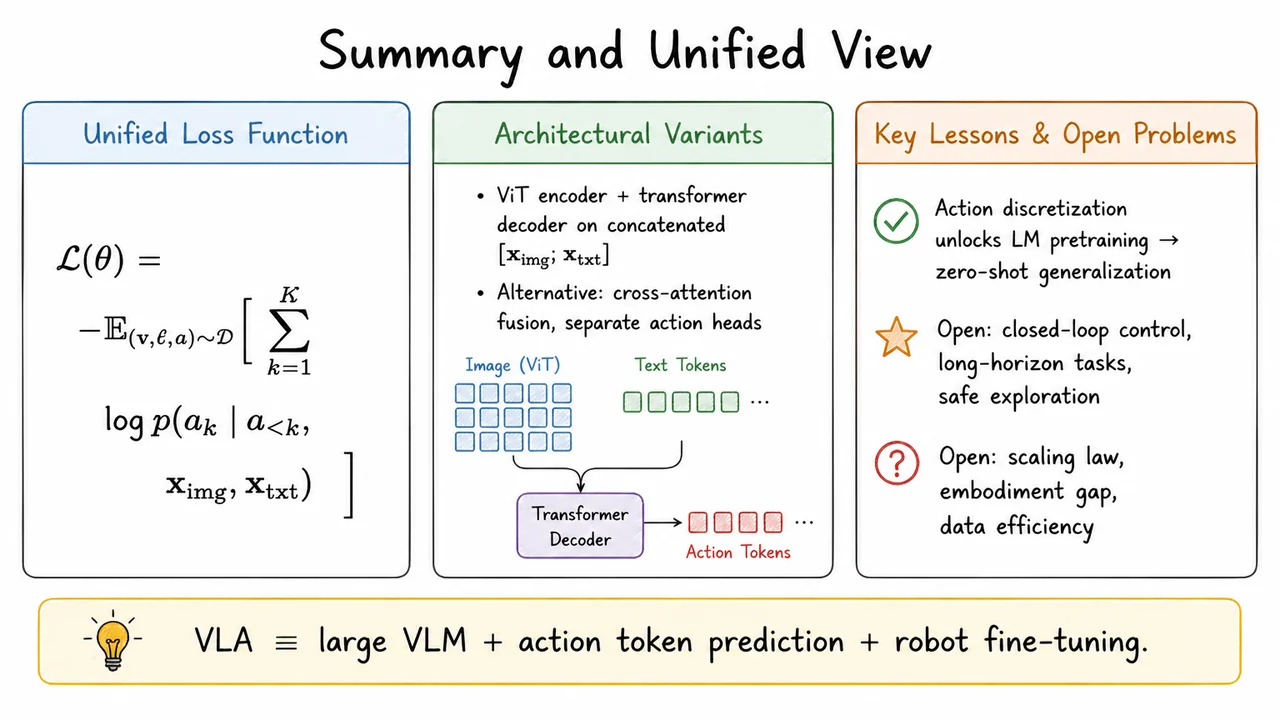
Having charted where Vision-Language-Action models sit among alternative robot learning paradigms, we can now step back and appreciate the conceptual and mathematical thread that ties the entire approach together. The core insight is deceptively simple: a robotic manipulation task can be cast as an autoregressive token-generation problem, where the model must predict a sequence of action tokens from an image and a natural language instruction. This framing not only inherits the rich representation learning of large vision-language models but also allows us to write down a single, unified loss function that drives all learning.
The foundation is the supervised imitation learning objective that maximizes the likelihood of observed expert actions. In a VLA model, the raw action signal—typically a continuous or high-dimensional control command—is first mapped to a discrete vocabulary through vector quantization or spatial binning. The model then receives an image context (processed by a vision encoder like ViT) and a text instruction ; these are transformed into a multimodal embedding. At each step , the model predicts the next action token conditioned on the visual, textual, and already-generated token history:
Here is a dataset of expert trajectories, each consisting of an observed image , instruction token (which becomes ), and a sequence of discretized action tokens . The expectation over the data distribution and the log-probability sum mirror the standard next-token prediction loss used to train large language models. The crucial difference is that the context tokens now include visual tokens—image patch embeddings—and the target tokens represent physical commands instead of words. This loss drives the model to internalize the complex mapping from pixels and instructions to grounded motor primitives.
Architectural variants emerge depending on how the visual and textual modalities are fused. The most straightforward design, and one that closely mirrors popular vision-language models like PaLI, concatenates the image patch embeddings with the text instruction tokens and feeds the whole sequence into a single transformer decoder. This early fusion lets cross-modal attention happen at every layer, allowing the model to learn fine-grained interactions between visual features and language. An alternative—sometimes used when compute budgets are tight or when the vision encoder must be kept frozen—uses a cross-attention module that attends to extracted image features from a fixed ViT, while a separate text encoder provides language context. Further design choices include whether the action head is the same autoregressive mechanism that also decodes language (a shared vocabulary) or a dedicated action decoder that translates a final hidden state into motor tokens, potentially with a separate action-specific embedding table. These trade-offs matter for training stability, inference latency, and how easily one can inject safety constraints at the output level.
The power of this unified formulation becomes clear when we examine the emergent capabilities of large-scale VLA models such as RT-2. Because the loss function and model backbone are almost identical to those of a vision-language pretrained model, the VLA inherits the generalization patterns of web-scale data. The discrete action vocabulary is the glue that makes this transfer possible: a token like “move arm left” in the instruction text and a symbolic action token “<act: delta_x=–5>” sit in the same representational space, and the model learns to align them. Consequently, the VLA can interpret novel task descriptions, apply logical chaining (“pick up the banana and then place it in the bowl”), and even combine multiple constraints from the instruction without having seen that specific combination during robot fine-tuning. This zero-shot generalization is a direct result of repurposing the semantic reasoning ability of the underlying VLM, a feat that would be difficult with modular pipelines where the vision-language module and the action policy share no common pretraining.
Yet the summary would be incomplete without acknowledging the open challenges that remain. VLA models are currently trained and evaluated primarily in open-loop, offline benchmarks: they predict actions that a human would have taken, but they do not observe the consequences of their own actions during training. This means the models can struggle in closed-loop execution, where small prediction errors compound and the robot must recover from unforeseen outcomes. Furthermore, long-horizon tasks that require sustained sequences of actions over many minutes and involve multiple sub‑goals push the limits of the autoregressive token generation, which can drift without explicit planning or memory. Safe exploration is another frontier—when deployed in uncertain environments, VLA systems must handle the inherent stochasticity of the model’s outputs and avoid unsafe commands, requiring additional runtime filters or confidence‑aware controllers. These are active research areas, and the unified VLA framework provides a clean platform on which to build solutions, be it through reinforcement fine‑tuning, hierarchical action representations, or explicit risk‑sensitive objectives.
The visual summary that follows distills these interconnected ideas into a single glance. It places the mathematical core—the negative log‑likelihood loss over discretized action tokens—in a prominent position, reminding us that everything in VLA training flows from this deceptively simple autoregressive objective. Next to it, the architectural variants sketch the space of design choices: early fusion of image and text tokens feeding a transformer decoder, contrasted with cross‑attention or separate action‑head alternatives. A third panel captures the key lessons (that action discretization unlocks LM pretraining and zero‑shot generalization) and the open problems (closed‑loop control, long horizons, safety). A horizontal banner below stitches these elements together with the elegant takeaway: VLA ≡ large VLM + action token prediction + robot fine‑tuning. The diagram is not a replacement for the detailed exposition but a conceptual map that lets the reader quickly recall how the mathematics, the engineering, and the frontier challenges are all facets of the same unifying vision.