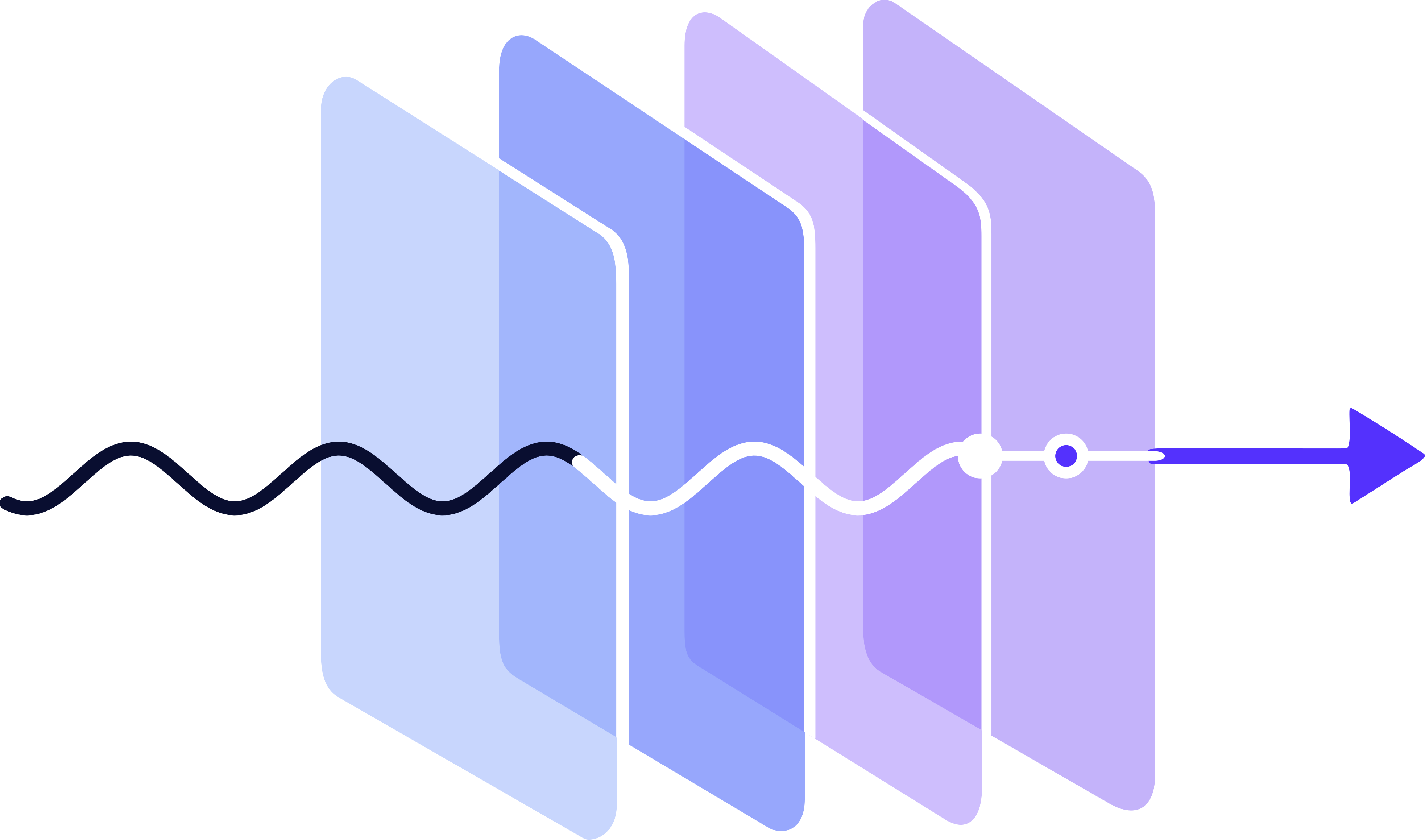
Imagine training a robot arm from a replay buffer that contains plenty of examples of ordinary motions—move left, move right, lower the gripper—but almost no examples of one unusual action near the edge of the actuator range. The actor proposes that unusual action anyway. The critic has to assign it a value, even though it has very little evidence for what will happen there.
That is the uncomfortable part of off-policy actor–critic learning. The actor is improved using a critic trained from previously collected transitions. Because the critic is a neural function approximator, it produces a value for every action the actor asks about, including actions that are poorly represented in replay. A prediction exists even when the evidence behind it is thin.
Suppose the critic happens to overestimate one such poorly covered action. The actor is explicitly trained to prefer actions with higher predicted value, so it moves probability toward that action. Now the next policy asks the critic about that region even more often. If the critic's optimistic error persists, the learner creates a feedback loop: weak coverage produces an unreliable value estimate, the unreliable estimate attracts the policy, and the policy amplifies the importance of the unreliable estimate.
This is the extrapolation problem that motivates much of the conservative machinery in SAC-style algorithms. In a narrow replay distribution, the learner has good evidence for only part of the state–action space. Outside that support, restricting the critic can be useful precisely because an unconstrained critic has freedom to invent large values where the data cannot correct it quickly.
Several familiar design choices make sense from this viewpoint. Entropy encourages the policy to gather broader experience rather than collapse too quickly. Norm control restricts how aggressively the actor and critic networks can bend their fitted functions. Clipped double-Q uses two value estimates and takes the smaller one in the Bellman target, deliberately sacrificing some optimism to reduce the chance that a single erroneous high estimate drives learning.
None of these mechanisms is free. Exploration can spend interactions on actions that are no longer useful. Function-class constraints can prevent the critic from fitting real structure. Taking the minimum of two critics introduces pessimistic bias and requires a second critic. Under scarce experience, those costs may be a good bargain because the alternative is unstable extrapolation.
The paper calls this operational setting data-limited (CPU-scale). That name should be read carefully. A CPU is not intrinsically what causes the problem. The relevant condition is relatively narrow replay coverage: experience arrives slowly enough, or from few enough parallel actors, that large regions remain weakly represented. CPU-scale environments are how the paper instantiates that regime experimentally.
So the classical recipe carries an implicit assumption: useful experience is scarce enough that protection from unsupported value estimates is worth paying for. WarpSAC begins by asking what happens when modern simulation removes that assumption.
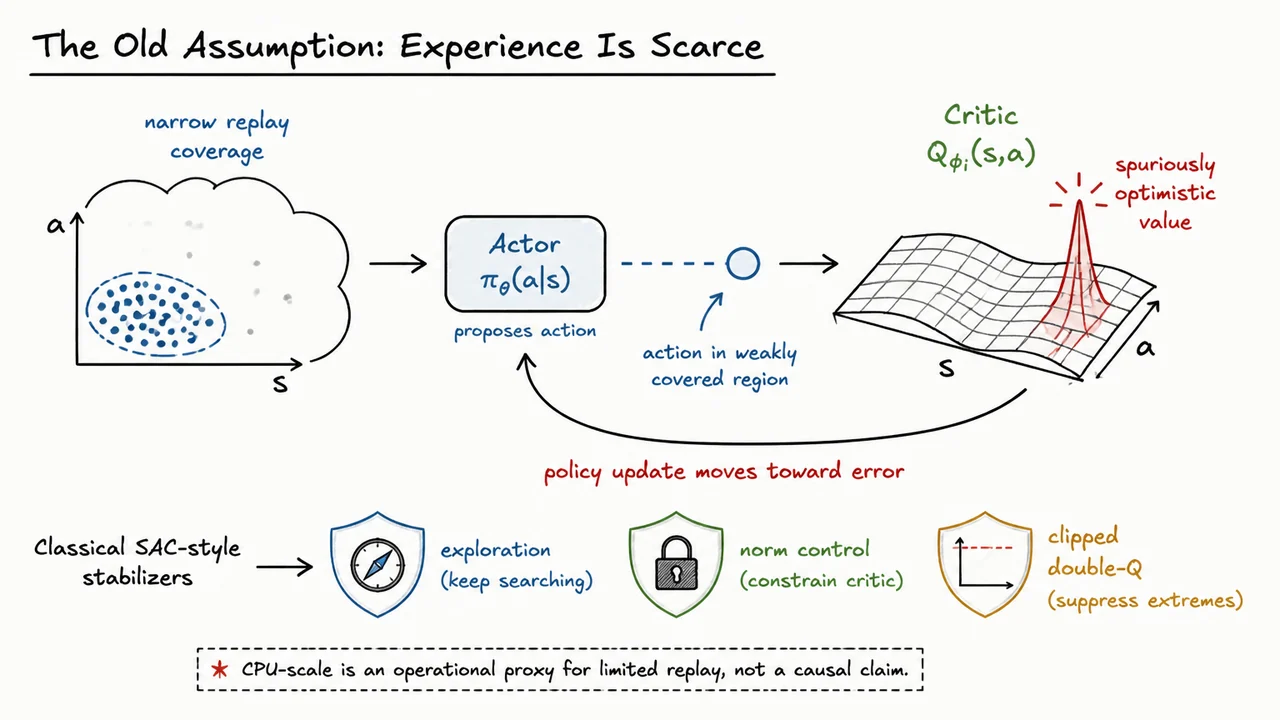
Massively parallel simulation changes the replay buffer before it changes the learning rule. Instead of one or a few environments contributing transitions sequentially, hundreds or thousands of environments can generate trajectories at the same time. The buffer is refreshed quickly and covers many more combinations of states and actions.
That alters what the critic is struggling with. In the narrow-data setting, the obvious danger is a prediction made far away from reliable evidence. With broad, rapidly refreshed replay, many of those regions are no longer poorly supported. The learner may already have abundant examples near the actions the current policy cares about.
Once coverage improves, the limiting factor can move elsewhere. The critic now has to fit a large and diverse stream of useful data quickly enough for the actor to exploit it. A constraint that was valuable because it prevented wild extrapolation can start to reduce fitting accuracy. If parameter normalization limits the critic's effective function class, the learner may be unable to represent sharp or complex value structure that is actually supported by data.
Clipped double-Q has a similar trade-off. Taking the smaller of two value estimates is a sensible defense when one critic might become spuriously optimistic in a weakly covered region. But when replay densely covers the relevant region, systematic pessimism can become unnecessary bias. The algorithm is then paying for protection against a failure mode that has become less dominant.
There is also a plain systems cost. Two critics require more computation than one. In scalable robotics, where the point of GPU-parallel simulation is to compress training wall time, an extra conservative component has to justify both its statistical effect and its runtime cost.
This does not imply that more data automatically makes every stabilizer harmful. Even a large replay buffer can contain hard tasks, distribution shifts, and regions where critic errors matter. The paper's claim is deliberately narrower: the relative value of a stabilizer can change with the data regime.
That leads to the question WarpSAC organizes the whole paper around: when replay coverage is narrow, which protections are worth keeping, and when replay coverage becomes broad, which of those same protections begin to hold learning back?
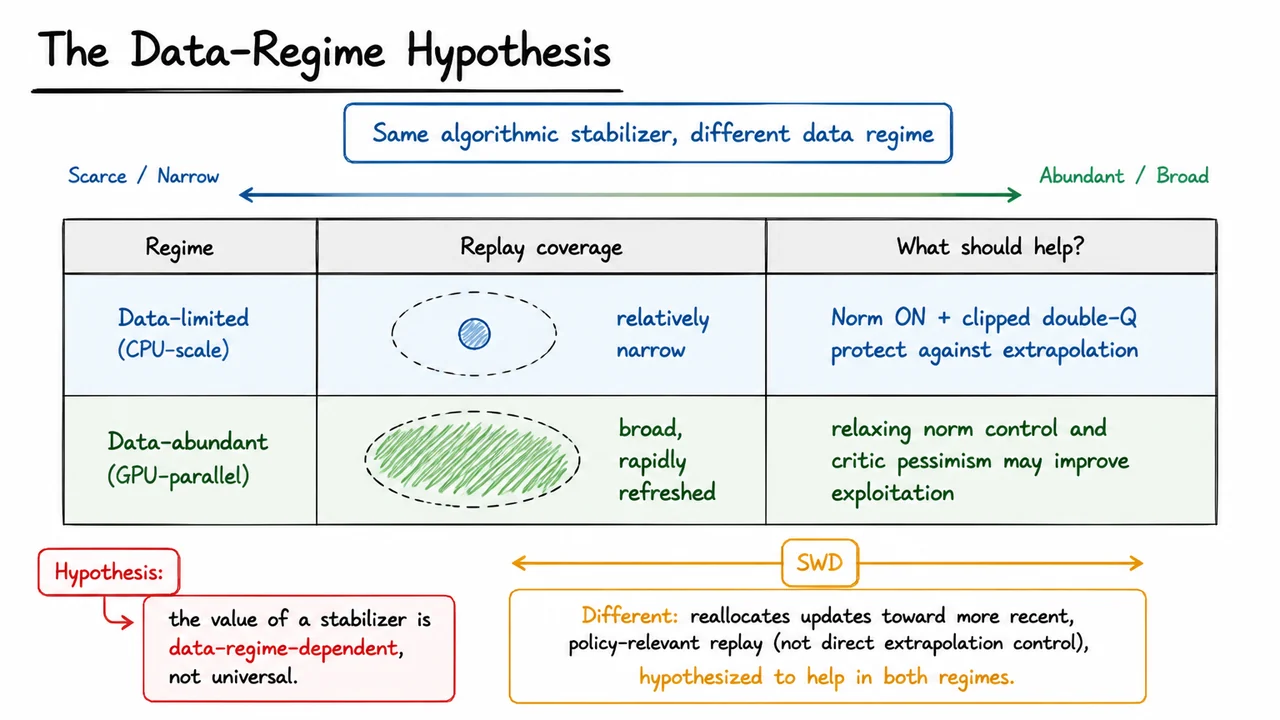
WarpSAC formalizes that question by separating two operational regimes. In the data-limited regime, replay coverage is relatively narrow. The paper associates this with its CPU-scale benchmarks. In the data-abundant regime, parallel simulation refreshes replay rapidly and supplies much broader state–action coverage; the paper associates this with its GPU-parallel benchmarks.
The hypothesis is deliberately about the data distribution seen by the learner. Under limited coverage, parameter projection normalization and clipped double-Q should still earn their cost: one restricts how freely the value function can extrapolate, and the other suppresses unusually high target values. Under abundant coverage, those same mechanisms can shift from protection to friction. The critic has more evidence, so expressive freedom and efficient fitting become more valuable.
This gives the paper a useful experimental prediction. If the hypothesis is correct, the best stabilizer configuration should change across regimes. A single fixed SAC recipe should be leaving performance on the table somewhere: either it is insufficiently conservative when data are scarce, or unnecessarily constrained when data are abundant.
Sample Weight Decay, or SWD, is treated differently. It does not directly make the critic more conservative. Instead, it changes how the replay buffer is used: newer, more policy-relevant transitions receive more sampling weight. The authors therefore expect its benefit to persist whether the buffer is narrow or broad. Even with enormous amounts of data, a fixed number of gradient updates can still be wasted on transitions produced by much older policies.
So the paper's working prescription is asymmetric. Normalization and critic conservatism are regime-dependent choices; replay recency weighting is intended to be regime-agnostic. The rest of the method is largely an exercise in isolating those claims carefully. To understand the ablations, we first need to see exactly where the conservative choices enter standard SAC.
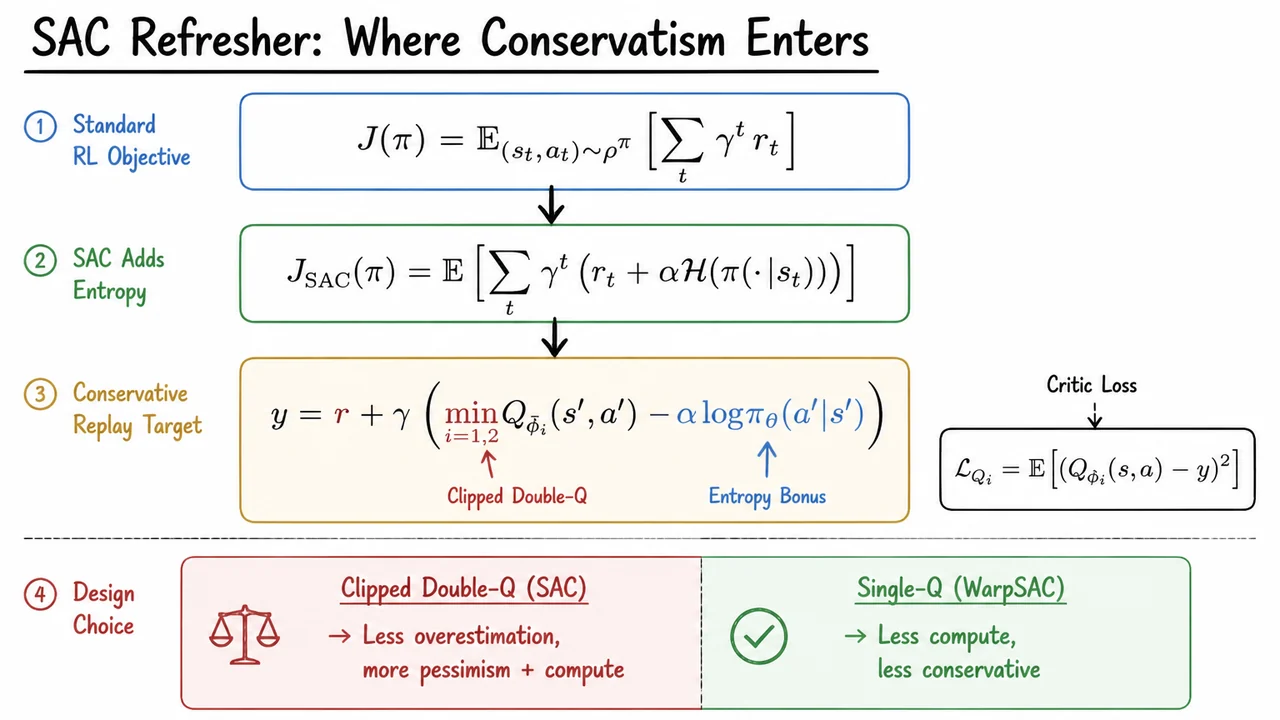
SAC starts with the usual reinforcement-learning objective: prefer policies that accumulate large discounted reward. Using for the state–action distribution induced by the policy,
Soft Actor-Critic adds a second preference: while collecting reward, keep the policy sufficiently stochastic. Its maximum-entropy objective is
The coefficient controls how much entropy matters relative to reward. The practical reason for this term is familiar: a stochastic policy continues to explore alternatives instead of committing immediately to whichever action currently looks best.
The critic is where WarpSAC's conservatism question becomes concrete. Given a replay transition , SAC samples a next action from the current actor and constructs a bootstrapped target. With clipped double-Q, that target is
Look closely at the minimum. SAC maintains two target critics, evaluates the same next action with both, and deliberately trusts the smaller prediction. If one critic has made a large optimistic error, the other critic can prevent that error from becoming the target used for bootstrapping.
Each critic then fits this target by minimizing its squared Bellman error,
This is a useful form of pessimism because bootstrapping can amplify value errors: today's target contains tomorrow's estimated value, so an overestimate can propagate backward through many states. Taking the smaller critic estimate makes that propagation less likely to be driven by a single positive error.
But the minimum is biased downward whenever the two critics disagree because of ordinary estimation noise. That is the price of clipped double-Q. It also means training and evaluating a second critic. A Single-Q variant removes the minimum and uses one critic instead, reducing both pessimistic bias and critic-side computation while giving up some protection from overestimation.
WarpSAC's question is therefore sharper than “does double-Q work?” It clearly has a reason to exist. The question is whether broad replay coverage makes its defensive bias less valuable than its statistical and computational cost.
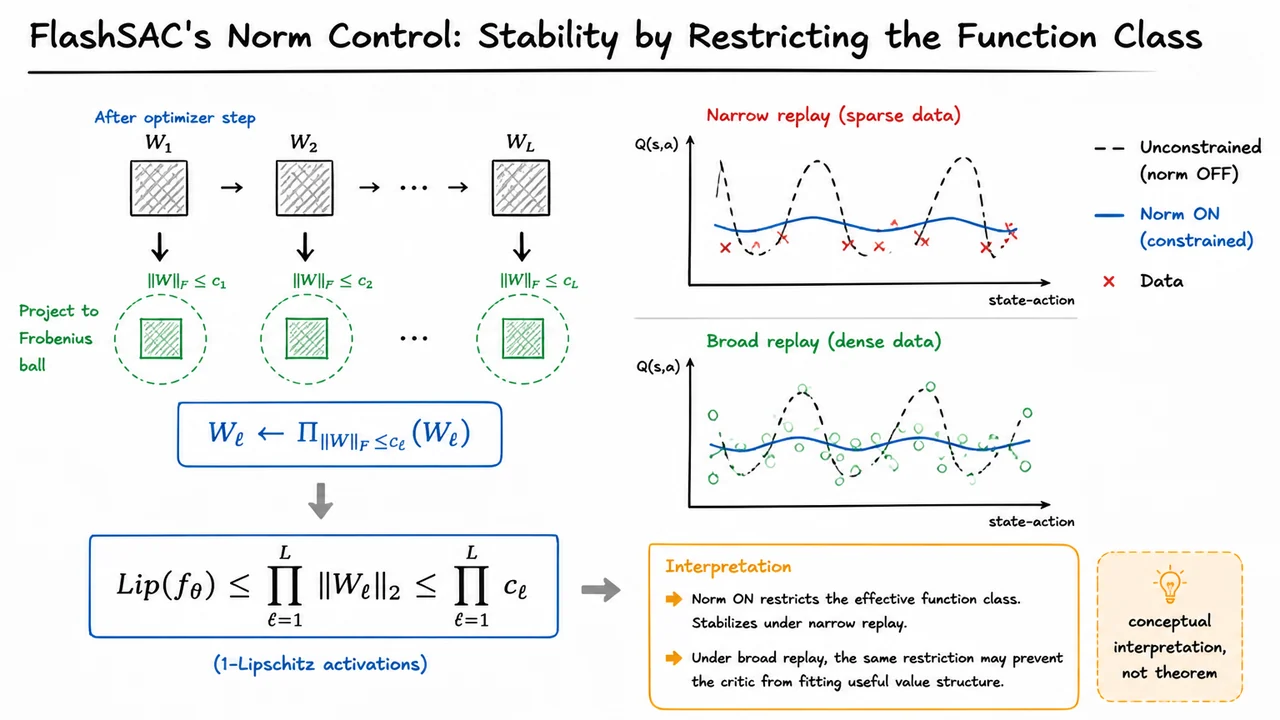
FlashSAC adds another kind of protection: after an optimizer step, it explicitly constrains the network parameters. The intuition is simple. If the critic's weights are allowed to grow and reshape the function arbitrarily, its predictions can change sharply in regions where replay gives little guidance. Restricting the weights limits that freedom.
The paper focuses on parameter projection normalization. For each network layer with weight matrix , the updated weights are projected back into a Frobenius-norm ball,
The constant is the allowed norm bound for that layer. If an optimizer step leaves inside the permitted region, nothing important changes. If it pushes the weights outside, projection pulls them back to the boundary.
Why connect this to extrapolation? The Frobenius norm upper-bounds the spectral norm,
For a network with 1-Lipschitz activations, multiplying the layerwise bounds gives the standard sensitivity bound
A smaller Lipschitz bound means the network cannot change its output arbitrarily fast as its input changes. In a replay buffer with gaps, that is an appealing property: nearby observed values place some restraint on what the critic can predict just outside the observed region.
There is an unavoidable trade-off. The same mechanism that prevents a wild unsupported spike also prevents some legitimate sharp structure. If replay has become broad enough to show that a particular state–action region truly contains a steep value change, the normalized critic still has to represent that structure inside the restricted function class. The constraint can then increase approximation error instead of reducing harmful extrapolation.
The paper uses the Lipschitz and function-class viewpoint to explain its empirical hypothesis. It does not prove a new sample-complexity theorem saying that a particular norm bound is optimal in one regime and harmful in another. The theoretical language is a conceptual lens for understanding the ablations.
We now have two distinct conservative mechanisms: clipped double-Q changes the target the critic is asked to fit, while parameter projection changes which critic functions are easy or even possible to fit. WarpSAC isolates these from a third choice—how replay samples are selected.
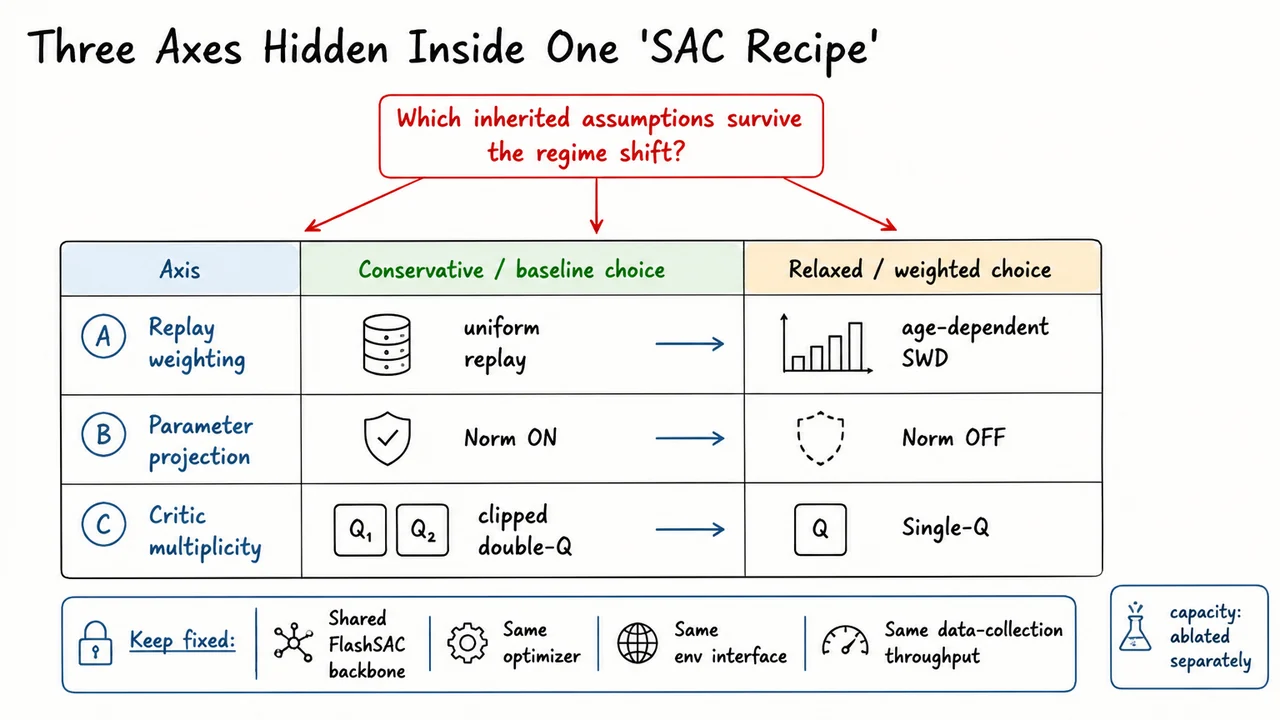
The cleanest way to read WarpSAC is as a component study. The authors keep the scalable FlashSAC training backbone and expose three choices that are usually bundled together inside a single recipe.
The first choice is replay weighting. Uniform replay treats every stored transition as equally likely to appear in a minibatch. WarpSAC's alternative is age-dependent Sample Weight Decay, which gives fresher transitions more weight.
The second choice is parameter projection normalization. With Norm ON, the FlashSAC projection constraint remains active after optimizer steps. With Norm OFF, that restriction is removed and the network has more freedom to fit the replay data.
The third choice is critic multiplicity. The conservative configuration uses clipped double-Q, meaning two critics contribute through their minimum. The relaxed configuration uses Single-Q and removes the second critic.
This decomposition matters because a raw comparison such as “WarpSAC beats FlashSAC” would tell us very little about why. If replay weighting, normalization, network size, optimizer settings, and data throughput all changed together, any explanation based on data regime would be hard to defend.
Instead, the main experiments hold the shared backbone, optimizer, environment interface, and data-collection throughput fixed while changing these three axes. Network capacity is handled in a separate ablation. That separation lets adjacent configurations answer narrower questions: does recency weighting help? Does turning normalization off help? Does removing the second critic help?
The resulting study is less about inventing a brand-new actor–critic objective than about auditing assumptions inherited from an older data regime. Each axis corresponds to a different question about what the learner needs: Which data should we reuse? How tightly should we constrain the value function? How pessimistic should the Bellman target be?
The first of those turns out to be the most portable across regimes, so we can examine it in detail before combining the three choices.
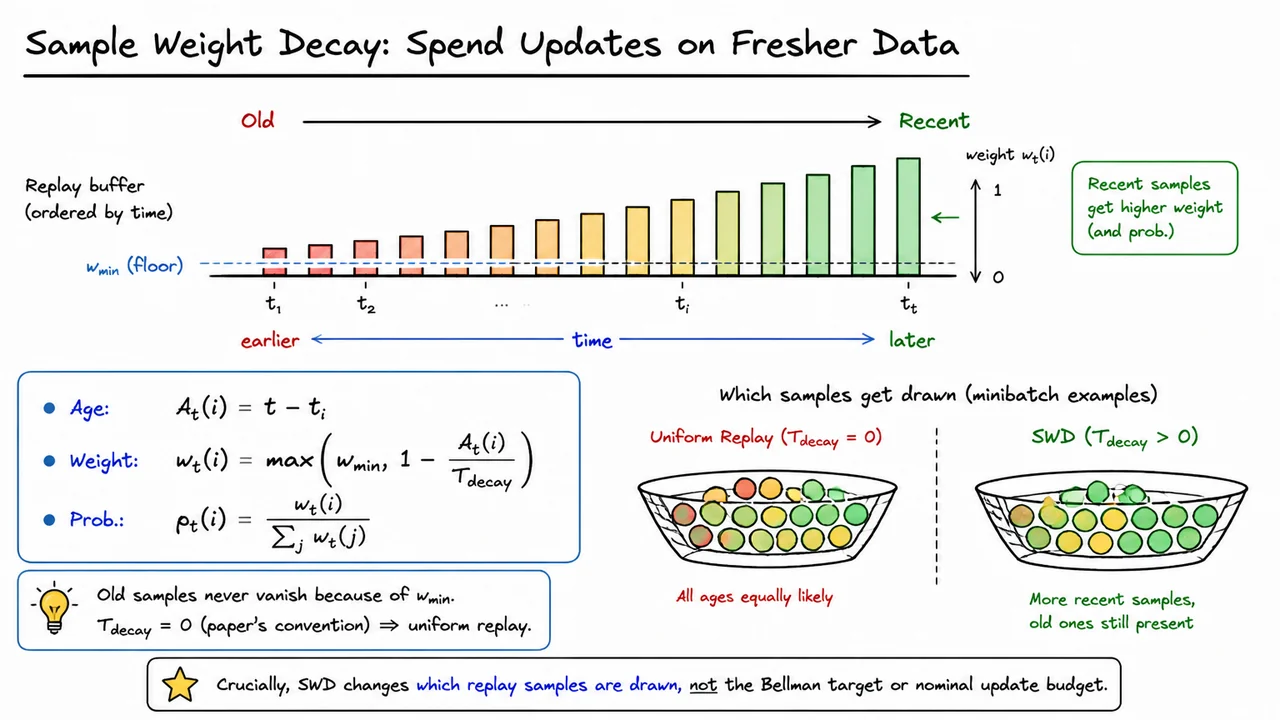
A replay buffer is useful because an off-policy learner can reuse experience many times. But “reuse everything uniformly” is itself a design choice. A transition produced by a policy from much earlier in training may be far less relevant to what the current actor is trying to do than a transition collected a few moments ago.
Let the replay buffer at training step be
where each transition is and was inserted at step . Its age is simply
Sample Weight Decay assigns larger sampling weight to younger transitions. The paper uses a linear decay with a floor:
The parameter controls how quickly a sample loses weight as it ages. The positive floor matters: an old transition becomes less likely to appear, but it is not erased from the learner's experience.
These unnormalized weights become sampling probabilities through
So SWD does not change what a transition means once it is sampled. The critic still uses the same Bellman loss, and the actor still follows the same SAC update. SWD only changes the distribution of minibatches presented to those updates.
Why should recency help? The replay buffer is generated by a sequence of changing policies. Early in training, the agent may spend most of its time falling over, missing an object, or visiting low-value regions. Later policies may behave very differently. Uniform replay continues spending equal sampling probability on those old behaviors even when the current policy's performance depends mainly on fitting value estimates around newer trajectories.
SWD redirects a fixed gradient budget toward data that is more closely aligned with the current policy. This is particularly useful when compute or network capacity limits how much of the buffer the learner can fit well at once. The floor preserves some historical coverage, so the mechanism is a bias toward recency rather than an aggressive deletion strategy.
The paper states that recovers its uniform-replay setting. More important than that convention is what SWD does not require: no auxiliary network, no new target, and no increase in the nominal update-to-data budget. It is a replay-side change.
That makes SWD conceptually different from Norm ON or clipped double-Q. Those mechanisms protect the learner by restricting value estimation. SWD tries to make the existing update budget more useful. The authors therefore retain it in both of WarpSAC's data regimes.
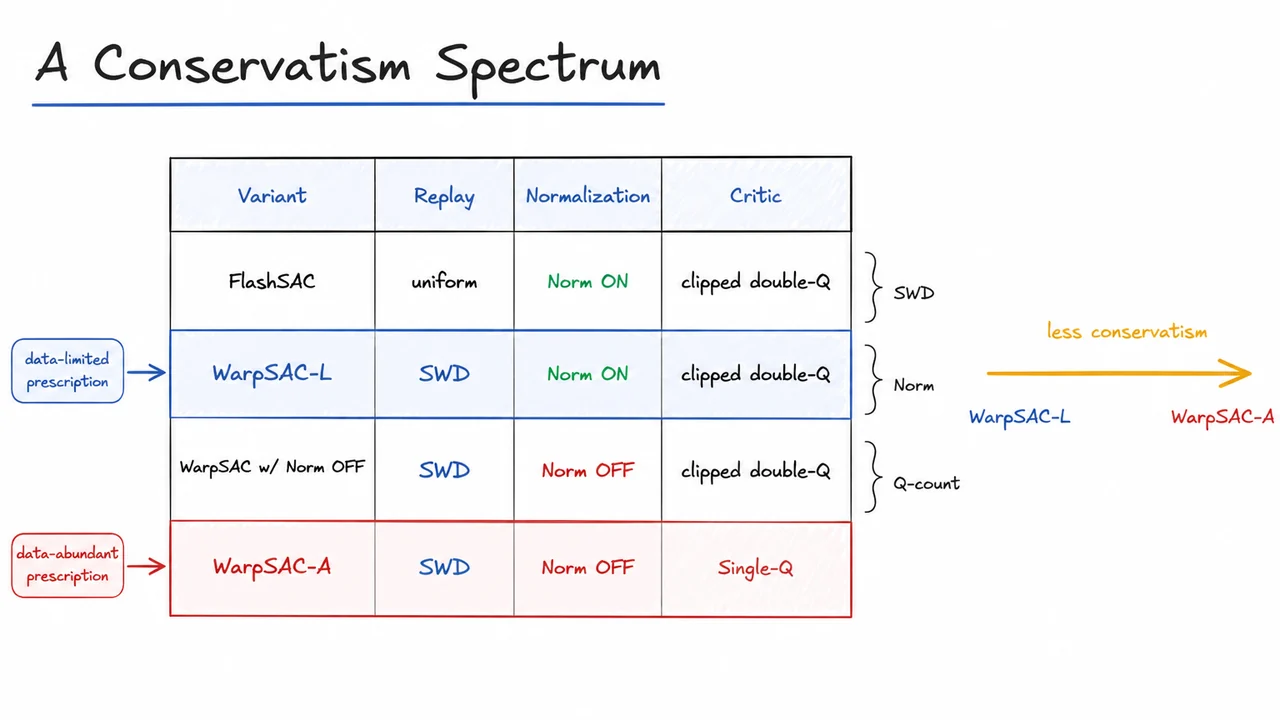
Putting the three axes together produces four useful checkpoints rather than one mysterious “WarpSAC” configuration.
FlashSAC is the reference point: uniform replay, Norm ON, and clipped double-Q. Moving from FlashSAC to WarpSAC-L changes only the replay rule—SWD is enabled while normalization and the two-critic target stay intact. That comparison tells us what age-aware replay contributes without changing the conservative machinery.
The next step, WarpSAC with Norm OFF, keeps SWD and clipped double-Q but removes parameter projection normalization. Comparing it directly with WarpSAC-L isolates the effect of function-class restriction.
Finally, WarpSAC-A keeps SWD and Norm OFF while replacing clipped double-Q with Single-Q. That last transition asks whether a second conservative critic is still necessary once replay coverage is broad and the value function is no longer norm-constrained.
The two named prescriptions sit at different points on this spectrum. WarpSAC-L is the data-limited recipe: SWD + Norm ON + clipped double-Q. It improves how the limited replay buffer is used while retaining the protections intended to control extrapolation. WarpSAC-A is the data-abundant recipe: SWD + Norm OFF + Single-Q. It keeps the replay-side efficiency gain while removing both forms of conservatism studied in the paper.
That makes one feature of the result easy to miss if we think of algorithm design as accumulating tricks. WarpSAC-A is simpler than the fully stabilized baseline. Its hypothesis is that once the data regime changes, additional machinery can become a liability rather than an insurance policy.
The experiments therefore have a very readable structure. If FlashSAC → WarpSAC-L helps in both regimes, SWD has broad value. If turning Norm OFF helps mainly in GPU-parallel training, normalization is regime-dependent. If Single-Q adds further gains on some high-throughput tasks, critic-side pessimism can also be relaxed—but that final claim must remain task-sensitive.
With those variants fixed, the practical algorithm is almost trivial: identify the intended data regime, choose the matching amount of conservatism, and use SWD in either case.
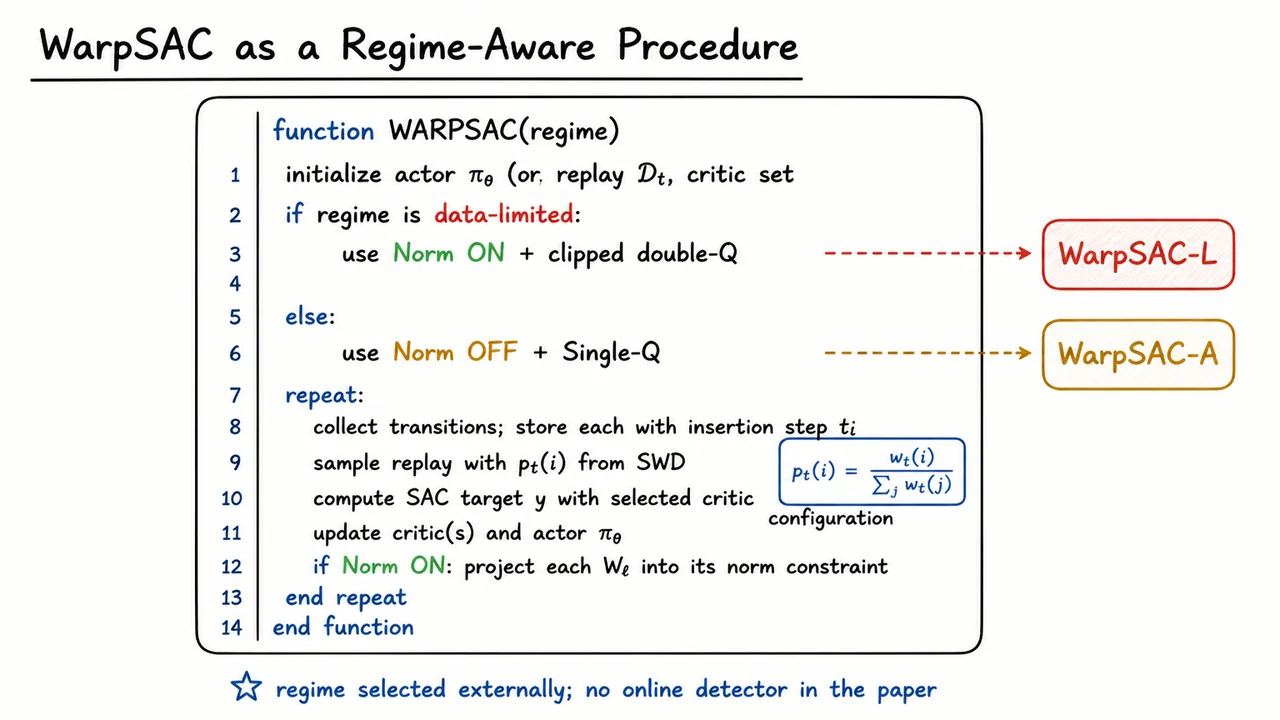
Operationally, very little changes in the outer training loop. The actor still collects transitions, the replay buffer still stores them, the critic still fits SAC targets, and the actor still improves against the critic. WarpSAC changes the configuration chosen around that loop.
At initialization, the intended data regime determines two switches. For a data-limited setting, use WarpSAC-L: keep Norm ON and clipped double-Q. For a data-abundant setting, use WarpSAC-A: turn normalization off and use Single-Q. SWD is enabled in either branch.
Each collected transition is stored together with its insertion time . When the learner needs a minibatch, it samples according to the SWD probabilities
The selected transitions then flow through the ordinary SAC machinery. Under WarpSAC-L, the Bellman target uses the minimum of two target critics, both critics are trained, and the parameter projection step is applied after optimization. Under WarpSAC-A, one critic supplies the target and the projection step is skipped.
This simplicity is intentional. The paper does not introduce an auxiliary model that estimates coverage, a controller that continuously tunes conservatism, or a learned gate between the two variants. The regime is chosen offline from the training setup.
That limitation is worth keeping explicit because the names “L” and “A” can make the method sound more adaptive than it currently is. WarpSAC is regime-aware in the sense that its recipe is selected to match an anticipated data regime. It is not yet regime-adaptive in the sense of detecting a changing regime during a run.
For a practitioner, the immediate prescription is therefore straightforward: if data collection resembles the paper's relatively narrow CPU-scale setting, start with WarpSAC-L; if massively parallel simulation produces broad, rapidly refreshed replay, WarpSAC-A is the intended choice. The experiments will tell us how well that rule survives contact with actual tasks.
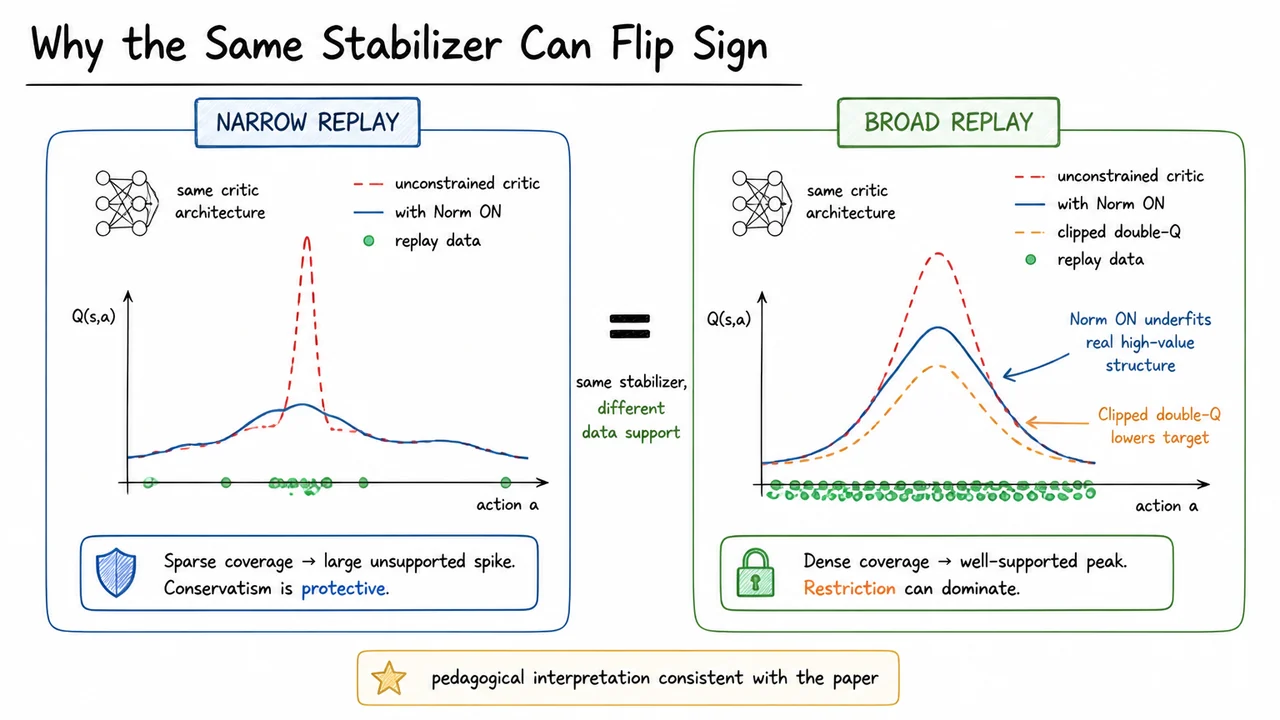
A small thought experiment makes the regime hypothesis easier to test mentally. This is pedagogical interpretation, not an additional experiment reported in the paper.
Take the same critic and imagine training it under two different replay distributions. In the first case, replay contains dense evidence around a small set of ordinary actions and almost nothing elsewhere. The actor proposes an action just outside that dense region. An unconstrained critic can assign a large value there because few samples push back against the mistake.
In that setting, Norm ON has an obvious use: it limits how sharply the fitted value function can depart from nearby observations. Clipped double-Q adds another guardrail by requiring an optimistic estimate to survive disagreement between two critics before it strongly influences the target. The learner may underfit some structure, but preventing an unsupported value spike can be more important.
Now keep the architecture and objective conceptually the same, but replace the replay distribution with one produced by many parallel actors. The action region that used to be sparse is now densely sampled. Suppose the data genuinely reveal a narrow high-value structure there. The critic no longer needs to guess whether that structure exists; replay contains direct evidence for it.
A strong norm constraint can now smooth away part of the very structure the learner is trying to fit. Likewise, if two noisy critics both approximate a well-supported high value, taking their minimum systematically chooses the lower estimate. The mechanisms have not changed, but the error they prevent has become less important while their bias remains.
This is the sense in which a stabilizer can “flip sign.” The claim is about its net effect. Under scarce coverage, the reduction in extrapolation error can outweigh lost expressivity and pessimism. Under abundant coverage, better fitting can matter more than those protections.
Real tasks are messier than this toy picture. Broad replay does not guarantee perfect coverage, and a GPU-parallel task can still benefit from two critics. The paper's own results contain such exceptions. The thought experiment only tells us what pattern to look for: as coverage increases, normalization should become easier to remove, and Single-Q should become viable on at least some high-throughput tasks.
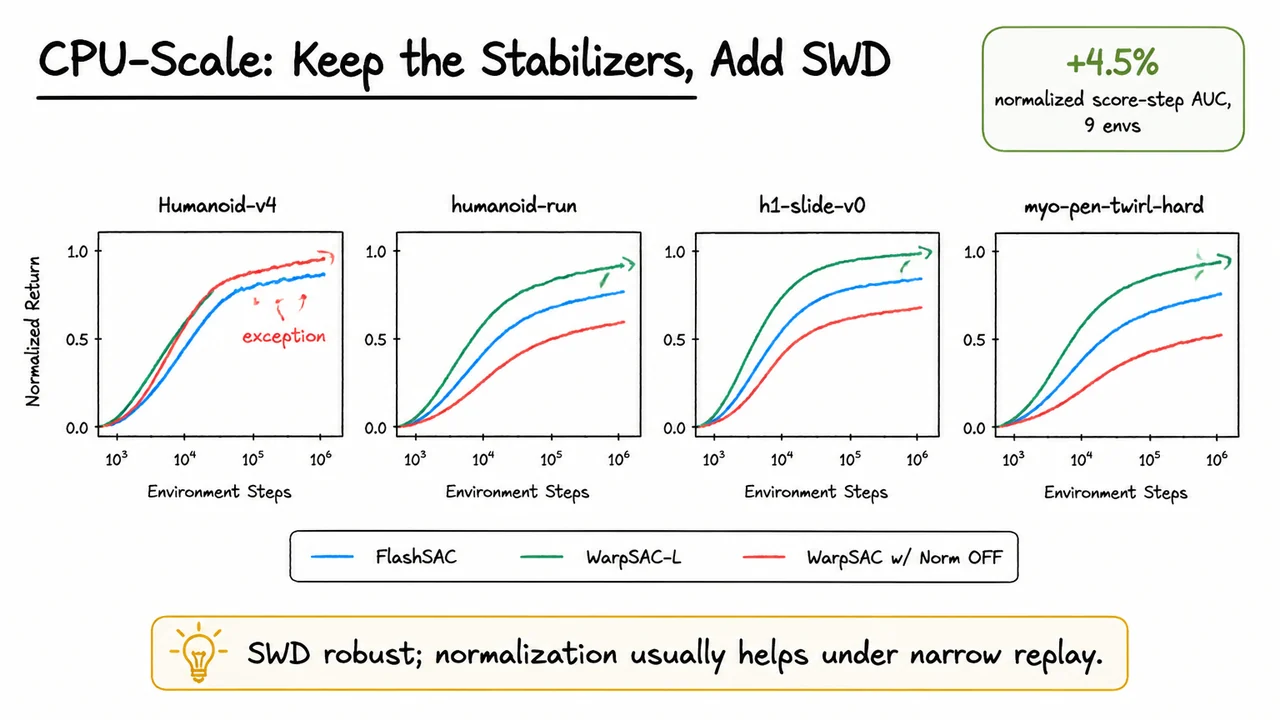
The CPU-scale experiments test the conservative side of the prescription across MuJoCo, DeepMind Control Suite hard tasks, HumanoidBench, and MyoSuite. These are the settings the paper treats as relatively data-limited, so the prediction is that SWD should help while normalization should usually remain useful.
That is broadly what the representative learning curves show. Both WarpSAC variants improve over the uniform-replay FlashSAC baseline on the highlighted tasks, which is the first piece of evidence that SWD is doing useful work independently of the normalization choice.
The prescribed WarpSAC-L configuration—SWD with Norm ON and clipped double-Q—reaches the strongest final performance on humanoid-run, h1-slide-v0, and myo-pen-twirl-hard. This is consistent with the paper's interpretation that constraining the value function remains helpful when replay coverage is narrower and extrapolation error is harder to correct from data alone.
There is also an important exception. On Humanoid-v4, the SWD variant with Norm OFF reaches a slightly higher final return. That matters because it prevents a simplistic conclusion such as “CPU-scale means normalization is always better.” The paper's claim is statistical and regime-level: normalization is generally the better prescription in this data-limited group, while individual tasks can prefer a different point on the spectrum.
Across nine CPU-scale environments, the paper reports that WarpSAC improves mean normalized score–step AUC over FlashSAC by 4.5%. AUC here rewards learning speed throughout training, rather than looking only at the final checkpoint, so the number captures sample efficiency as well as endpoint performance.
Taken together, these experiments support two parts of the hypothesis. First, age-aware replay weighting provides a fairly robust improvement over uniform replay. Second, removing normalization is not systematically advantageous when replay is limited. The conservative function-class constraint still appears to earn its cost often enough that WarpSAC-L is the recommended variant for this regime.
The stronger test is what happens when the buffer is flooded with parallel experience. If the data-regime story is correct, the preferred normalization setting should shift—and on some tasks the second critic should become dispensable as well.
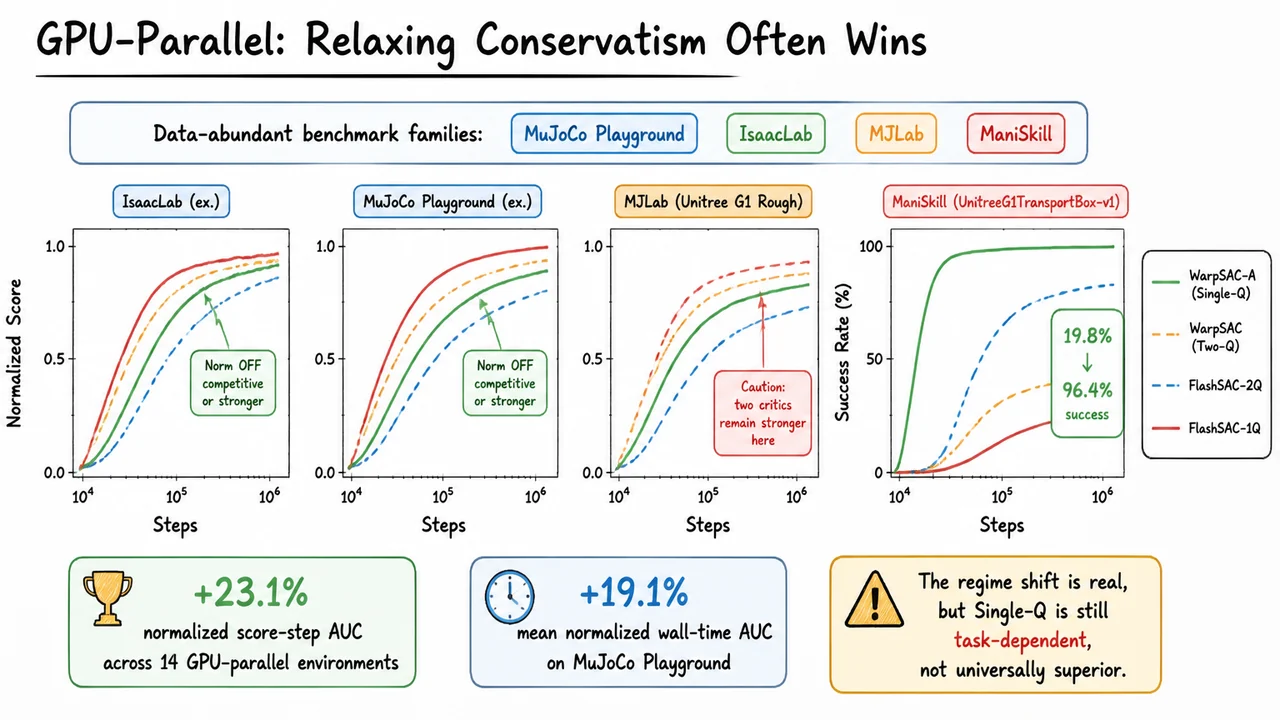
The GPU-parallel experiments cover MuJoCo Playground, IsaacLab, MJLab, and ManiSkill. Here the replay buffer is populated at high throughput by many simultaneous environments, so this is the paper's data-abundant regime.
The normalization pattern changes first. On representative IsaacLab, MuJoCo Playground, and MJLab tasks, the SWD variant with Norm OFF is competitive with or stronger than WarpSAC-L. That is the sign the hypothesis predicted: when replay already provides broad coverage, restricting the critic's function class can cost more than the stability it provides.
ManiSkill gives the most dramatic result for the fully relaxed prescription. On UnitreeG1TransportBox-v1, the paper reports a FlashSAC success rate of 19.8% and a WarpSAC-A success rate of 96.4%. WarpSAC-A combines SWD, Norm OFF, and Single-Q, so this task shows that both conservative mechanisms can be relaxed successfully in at least one demanding high-throughput manipulation setting.
The aggregate results point in the same direction. Across fourteen GPU-parallel environments, WarpSAC improves normalized score–step AUC over FlashSAC by 23.1%. On MuJoCo Playground, the paper reports a 19.1% gain in mean normalized wall-time AUC, directly reflecting the practical goal of learning more quickly in elapsed training time.
The Single-Q story needs more care than the normalization story. On the MJLab rough-terrain Unitree G1 task, the two-critic WarpSAC variants outperform FlashSAC, while WarpSAC-A is less consistent. Broad replay therefore does not make clipped double-Q obsolete everywhere. Some tasks still benefit from critic-side conservatism even inside the GPU-parallel regime.
That nuance improves the main result rather than weakening it. The paper is not arguing for a universal rule that “more data means one critic.” Its stronger evidence is that the fully conservative FlashSAC recipe is no longer uniformly appropriate at scale. Normalization often becomes restrictive; Single-Q can be highly effective in some high-throughput settings; SWD continues to help across the comparison.
The next question is why the gains are especially large in some settings. Network capacity provides a useful clue, because a constraint on the function class matters most when the network already has little spare capacity.
The capacity ablation separates two ideas that can otherwise look similar: having too little useful data and having too little model capacity to use the data well.
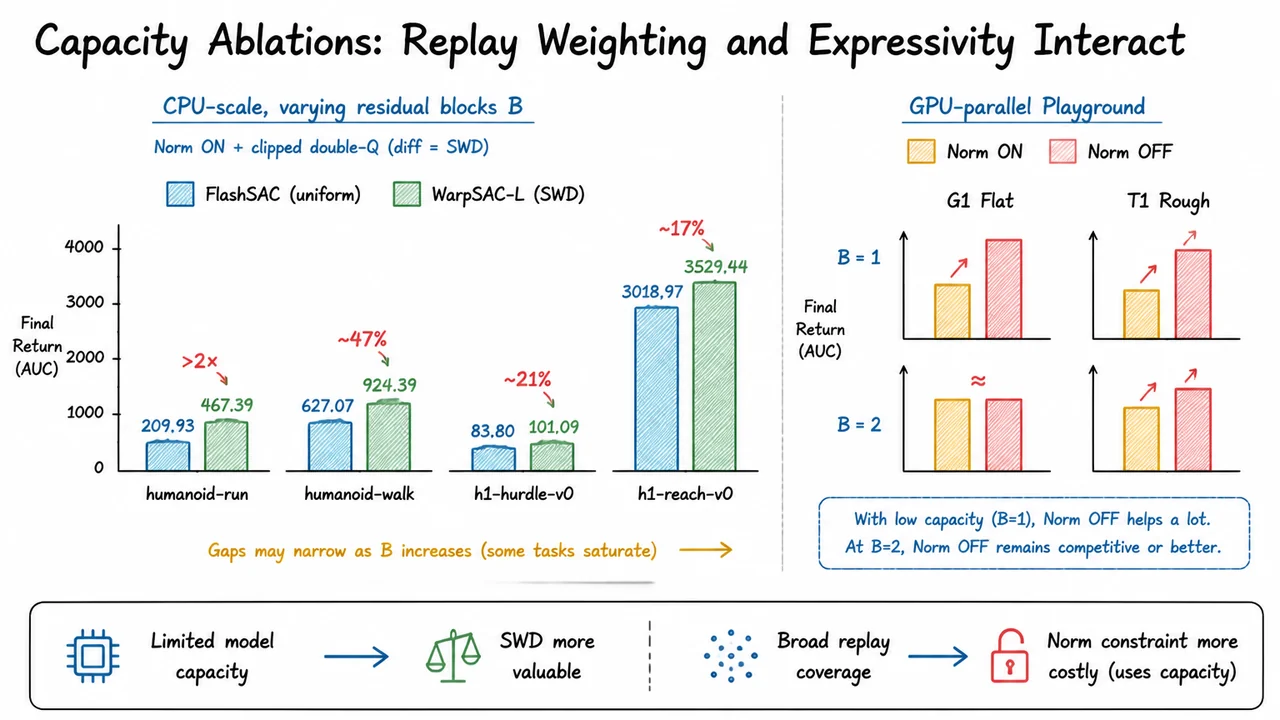
On the CPU-scale tasks, WarpSAC-L and FlashSAC both keep Norm ON and clipped double-Q. The controlled difference is replay weighting. The authors vary the number of residual blocks and ask whether SWD matters more when the network is small.
With a single block, the gains are substantial. On humanoid-run, final return increases from 209.93 to 467.39, more than doubling. On humanoid-walk, it rises from 627.07 to 924.39, roughly a 47% gain. The reported gains are about 21% on h1-hurdle-v0, from 83.80 to 101.09, and about 17% on h1-reach-v0, from 3018.97 to 3529.44.
This is consistent with a simple resource-allocation interpretation of SWD. A small network cannot fit every part of a broad historical replay distribution equally well. Giving more update probability to recent, policy-relevant data helps concentrate the limited function capacity where it currently matters. As the number of blocks increases, the gap narrows on some saturated tasks, although SWD remains competitive or better across the tested capacities.
The GPU-parallel capacity ablation exposes the other side of the trade-off. In MuJoCo Playground, turning normalization off produces a large improvement on G1 Flat and T1 Rough when the network has only one block. With two blocks the difference becomes smaller, but Norm OFF remains competitive or better across the tested Playground tasks.
That pattern is exactly what we would expect if normalization is consuming useful expressivity. When the network is already small and replay coverage is broad, constraining the weights leaves even less capacity for fitting the value structure supported by the data. Adding more blocks gives the constrained model room to compensate, so the penalty can shrink.
The two ablations therefore complement each other. SWD helps decide where limited learning capacity should be spent. Norm OFF decides how much representational capacity the learner is allowed to use. In the data-abundant regime, good replay utilization and sufficient critic expressivity have to work together.
The paper then takes the comparison outside simulator-only benchmark scores. Its sim-to-real case study trains a Unitree G1 humanoid on Unitree-G1-Flat, a 29-degree-of-freedom locomotion task.
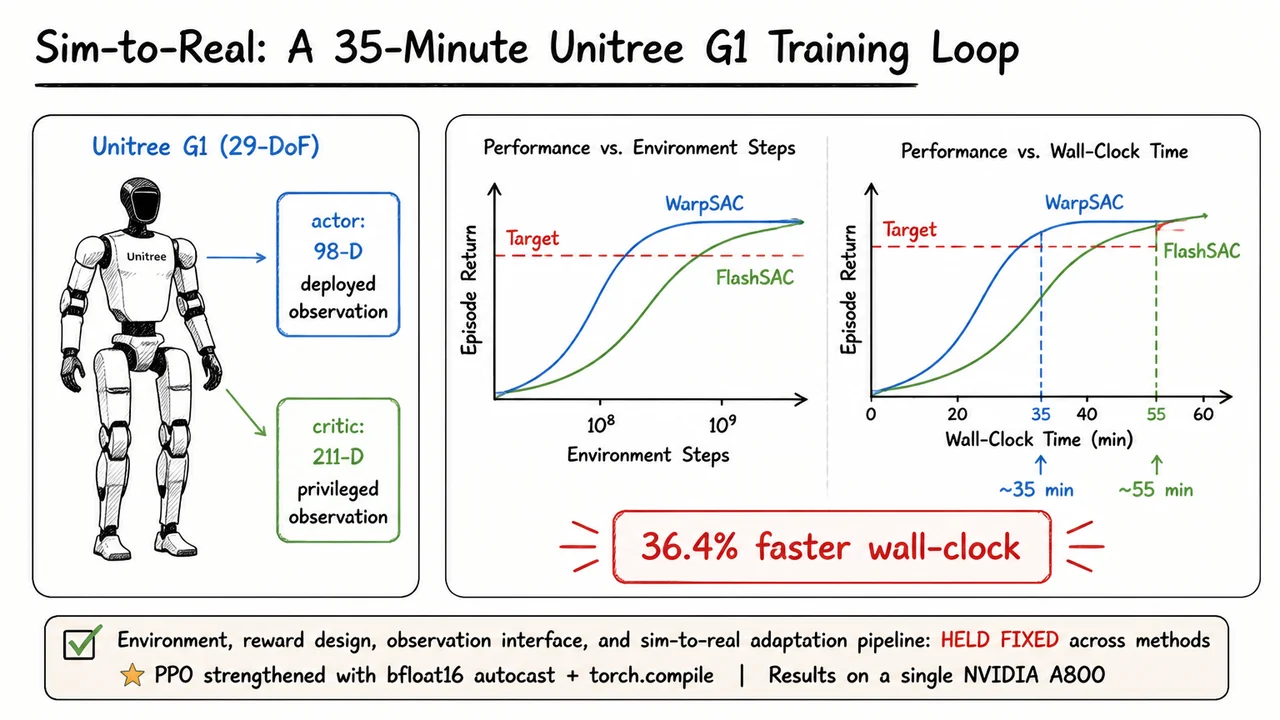
The setup uses an asymmetric actor–critic. The policy that will actually run on the robot receives a 98-dimensional observation, while the critic is allowed a richer 211-dimensional privileged observation during training. That is a common sim-to-real pattern: give the training-time critic extra state information without making the deployed policy depend on signals unavailable on the real robot.
For the comparison, the environment, reward design, observation interface, and sim-to-real adaptation pipeline are held fixed. This matters because otherwise a faster real-world result could come from easier rewards or a different deployment stack rather than from the learning algorithm.
The PPO baseline also deserves context. The authors do not compare against an avoidably slow vanilla rsl_rl path. They add bfloat16 autocasting and torch.compile, making PPO a stronger wall-clock baseline under the same general training profile.
On a single NVIDIA A800, WarpSAC reaches the target performance in roughly 35 minutes. FlashSAC requires about 55 minutes in the same end-to-end setup. The paper reports this as a 36.4% reduction in wall-clock time.
The result is practically meaningful because the timing includes the training loop rather than an isolated kernel benchmark: simulation, replay, learner updates, logging, and evaluation all contribute to elapsed time. It shows that the replay-side exploitation improvements can matter in the complete path to a deployable locomotion policy.
The appropriate conclusion is still scoped. This is one humanoid task, one adaptation pipeline, and one hardware setup. It does not establish that WarpSAC will always transfer better than FlashSAC or PPO on every robot. What it does establish in the paper's experiment is more concrete: under a controlled Unitree G1 pipeline, the regime-aware off-policy recipe reaches the target substantially faster.
That brings the evidence back to the design principle. The most interesting outcome is not simply that one named algorithm wins; it is that different data regimes reward different amounts of stabilization, while one replay-side change remains useful across them.
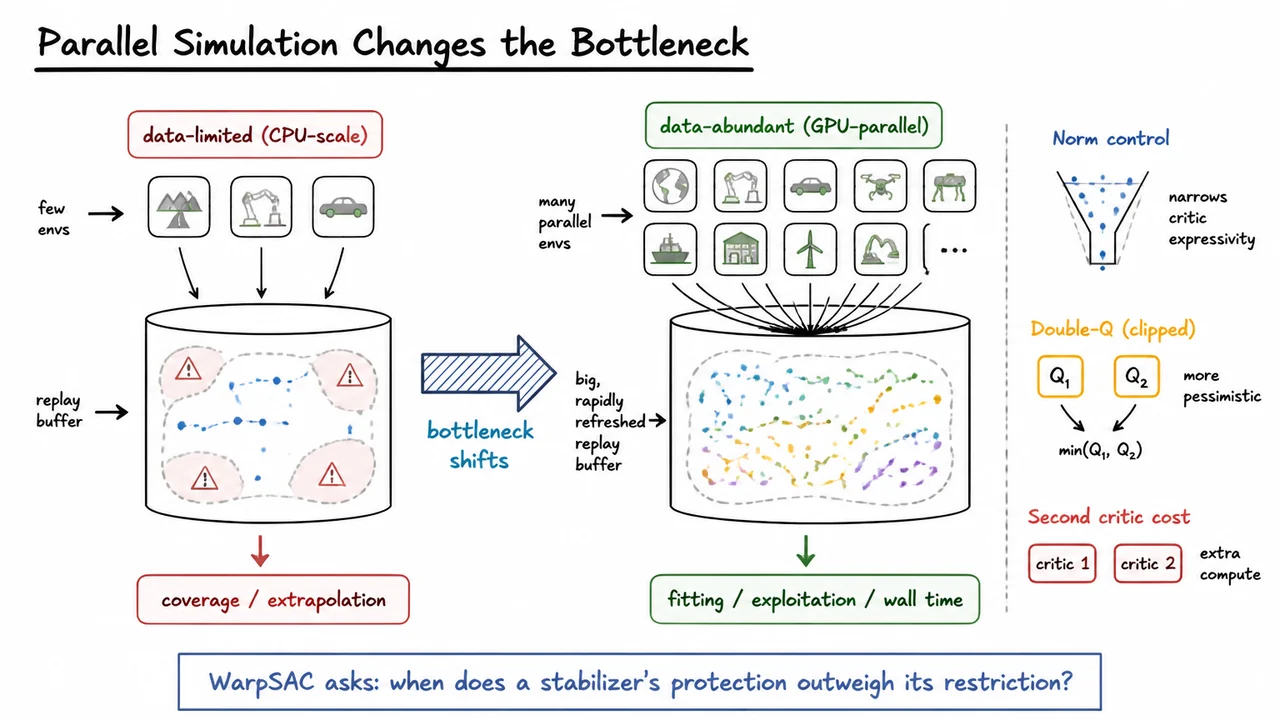
The practical rule is compact. For relatively narrow, data-limited replay, use WarpSAC-L: SWD + Norm ON + clipped double-Q. For broad, rapidly refreshed GPU-parallel replay, use WarpSAC-A: SWD + Norm OFF + Single-Q. In both cases, keep SWD.
Among the three axes studied, SWD has the strongest cross-regime evidence in this paper. The authors report it as consistently beneficial across all eight benchmark families and across the tested network capacities. That does not mean age-based replay is guaranteed to improve every possible RL problem; it means it is the one component whose benefit survives the paper's deliberately broad set of regime changes.
Normalization deserves a more conditional conclusion. It is useful when replay coverage is narrow enough that controlling extrapolation matters, but it can restrict value fitting once parallel simulation supplies abundant evidence. The capacity ablations reinforce this interpretation: the restriction is especially costly when the network itself has little spare expressivity.
Critic multiplicity is even more task-dependent. WarpSAC-A shows that Single-Q can be both viable and dramatically better in some high-throughput manipulation settings, while the MJLab rough-terrain result shows that two critics can still help within the same broad GPU-parallel category. So “data-abundant” is a prescription-level guide, not a proof that pessimism is always unnecessary.
The largest limitation follows directly from the method's simplicity: the regime choice is made before training. A system that begins with narrow coverage and later becomes data-rich has no mechanism in the current WarpSAC prescription for gradually relaxing its constraints. The paper identifies online regime adaptation as a natural next step—monitor replay coverage or value-extrapolation signals, then adjust normalization strength or critic multiplicity as the learner's data situation changes.
There is also a wider research question hiding behind the three chosen axes. SAC-style pipelines inherit many other stabilizers and schedules: entropy weighting, target-network delays, gradient clipping, replay-ratio choices, and more. WarpSAC's results suggest that these mechanisms should also be audited against the data regime instead of assumed to be universally beneficial.
That is the broader lesson of the paper. Scaling simulation changes more than how quickly we collect samples. It changes which algorithmic compromises are sensible. When experience is scarce, conservative constraints can protect the learner from what it does not know. When experience becomes abundant, the same constraints can prevent the learner from using what it already knows.
For scalable off-policy RL, the useful design question is therefore: what failure mode does each stabilizer protect against, and does the current replay distribution still make that failure mode dominant? WarpSAC's answer is that matching stabilizers to coverage can be more effective than simply stacking more of them.